U.S. and Moroccan soldiers tested unmanned ground vehicles (UGVs) equipped with counter-drone systems alongside more than 10 U.S. companies during the Army’s NANO ACE event in Tan-Tan, Morocco, from October 3 to 14, 2026. NANO ACE, short for Needs-Driven Acquisition for Near-Term Operations Accelerated Capability, ran at the Moroccan Multidomain Training Area (MDTA) and evaluated semi-autonomous capability sets meant to extend counter-unmanned aircraft system (C-UAS) coverage. According to the Army, the effort answers an emergent joint force requirement to field integrated autonomous sensing and effector capabilities on an accelerated acquisition timeline.
NANO ACE builds on Operation Jailbreak, the Army’s first Right to Integrate sprint, which brought roughly 600 participants from more than 50 companies to Fort Carson, Colorado, in May 2026. Led jointly by the Army’s chief technology officer and the Pathway for Innovation and Technology director, under the executive direction of the Army Acquisition Executive, the series aims to break down barriers between military systems and speed integrated capabilities to units. The Morocco phase followed preliminary assessments at Yuma, Arizona, that concluded in September, and took place on the site of the future Africa Multidomain Training and Experimentation Center (AMTEC).
How NANO ACE Tested Autonomous Counter-UAS Ground Vehicles
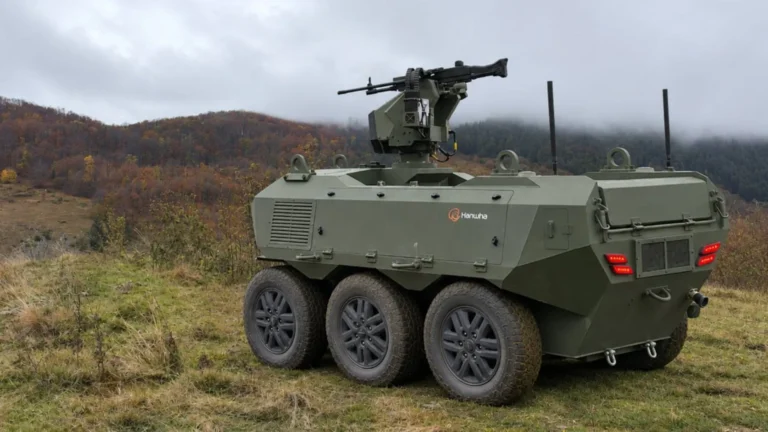
The prototypes combined autonomous ground platforms with interchangeable payloads, mission management software and resilient communications. Developers were graded against two core operational criteria: the ability to operate independently on unimproved terrain, and the ability to survive a contested electronic warfare (EW) environment. Imagery released by the Army, whose captions designate the event NANO ACE II, shows UGVs with drone-sensing capability, soldiers mounting a machine gun on a UGV, a soldier flying a Group 1 unmanned aircraft during counter-drone testing, and an autonomous C-UAS system defeating a drone.
The Army has not identified the participating vendors or the specific systems evaluated in Tan-Tan. One industry team has publicly tied its work to the NANO ACE effort: Invariant Corporation and Hyperion Technology Group integrated their FireFLY passive acoustic sensor onto the FireAnt small UGV built by Swarmbotics, feeding detection and tracking data into the Integrated Battle Command System-Maneuver (IBCS-M). The announcement came on October 13, during the Tan-Tan campaign, but did not specify whether the demonstration took place in Morocco or during the Yuma phase. FireFLY detects drones by sound without transmitting radar or radio-frequency energy, which matters for the EW survivability criterion: a passive sensor does not reveal its position in the electromagnetic spectrum.
The evaluation brought together nine organizations, including the Global Tactical Edge Acquisition Directorate (G-TEAD), an unnamed tactical Army division, the Army Test and Evaluation Command (ATEC), U.S. Army Central, U.S. Africa Command (AFRICOM) and U.S. Army Southern European Task Force, Africa (SETAF-AF). “In one place we are able to test, evaluate, validate and procure,” said Lt. Col. Corbett Baxter, SETAF-AF deputy director of AMTEC. Maj. Kyle Rau, a C-UAS evaluator with ATEC, said the capability set could save soldiers “effort, time and cognitive load” and keep them out of the kill zone.
AMTEC Turns Tan-Tan Into an Open-Spectrum Test Range
The Royal Moroccan Armed Forces and AFRICOM signed the AMTEC memorandum of understanding in Stuttgart on July 13, 2026. The document provides for three components: the multidomain training area, a drone academy and an innovation and experimentation center, with the full center planned for Tan-Tan by 2030. The drone academy is intended to train operators, planners and instructors from Morocco and other African partner nations for counterterrorism missions against threats in West Africa.
The Army says AMTEC is designed to exploit the region’s open electromagnetic spectrum, uncongested airspace and contested terrain. Those conditions matter for C-UAS testing: as an Army first lieutenant who helped evaluate the technology put it, if a system cannot handle this terrain or this spectrum, soldiers need to know before it reaches a forward position. NANO ACE therefore served a second purpose: assessing the range itself. The Army acknowledges the MDTA is still maturing. “NANO ACE gives our tactical formations and private industry a series of events to stress test their systems, operate in a degraded and contested area,” said Col. Woodrow D. Miner, SETAF-AF director of AMTEC.
Analysis: The significance of NANO ACE lies in the acquisition model more than in any single platform. G-TEAD relies on soldier-led evaluations rather than the Army’s traditional acquisition process, and companies that succeed in its Accelerated Capability Events can earn an Other Transaction Agreement (OTA) award. Running test, evaluation and procurement in one location compresses that loop further, in line with the Army’s stated goal of cutting integration time from months to days. For Morocco, hosting U.S. experimentation on a Moroccan-owned range gives its soldiers hands-on exposure to autonomous C-UAS concepts alongside U.S. forces. For the Army, Tan-Tan offers a range where systems can be stressed in the degraded and contested conditions Miner described.
ATEC’s findings are meant to give senior leaders a basis for deciding how and when to deploy the capability set, along with recommendations for future iterations. Key unknowns remain: which systems advanced, whether G-TEAD will issue production orders, and how quickly the MDTA, drone academy and innovation center will be built out ahead of the 2030 target. AFRICOM has said African Lion 2027 will serve as a proof of concept for AMTEC; that exercise and further NANO ACE iterations will show whether Tan-Tan becomes a standing node in the Army’s rapid acquisition network.