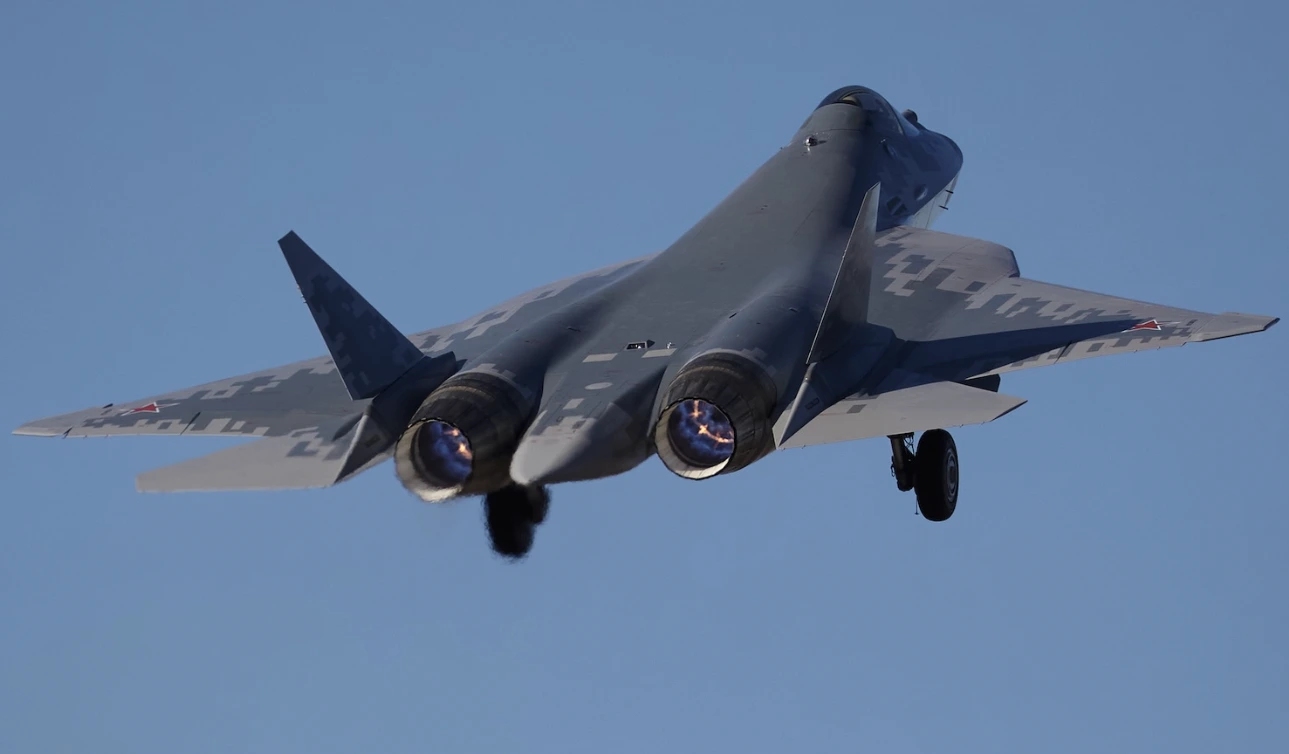
Russia’s United Aircraft Corporation (UAC), part of state conglomerate Rostec, has delivered a new batch of Su-57 multirole fighters to the Russian Aerospace Forces (VKS), Rostec announced on November 19, 2026. The aircraft carry modernized onboard systems and an upgraded weapons complex, according to the company, which again declined to say how many jets were handed over. The fighters completed a full cycle of factory testing, were flown in various operating modes by Ministry of Defense pilots, and then ferried to their home airbase.
The handover is the third publicly announced Su-57 delivery of 2026, following batches reported on February 9 and September 24, and follows 2025, a year in which no Su-57 deliveries were publicly announced at all. The VKS is working through a 2019 contract for 76 serial aircraft due by 2028, but UAC has not published delivery quantities since late 2022, leaving fleet estimates to tail-number tracking and analyst counts that diverge widely. Combat use over Ukraine and an export campaign for the Su-57E variant now both draw on the same production base at the Komsomolsk-on-Amur Aviation Plant.
Upgraded Su-57 Fighters: What Rostec Disclosed and Withheld
A VKS Su-57 pilot quoted in the announcement described the aircraft as a new technical configuration, language Rostec also used for the February and September deliveries. The pilot said the aircraft had already “performed well” in what Moscow calls its special military operation, and that the new configuration would broaden the range of missions assigned to the type. The pilot added that capabilities built into the aviation weapons complex allow the use of new types of air-launched munitions.
Rostec went further, describing the Su-57 as the most combat-tested fifth-generation fighter in real operations and stating that the jet can employ the latest munitions, “including low-observable cruise missiles.” That claim is contestable: Israeli F-35I aircraft have flown combat missions since 2018. The company published no modification list, no radar or software designations, and no weapon names.
Open-source reporting points to the likely contents. The low-observable cruise missile reference is widely associated with the Kh-69, a faceted, stealth-shaped missile sized for the Su-57’s tandem main internal bays, which Ukrainian officials have reported encountering in strikes. Publicly available specifications indicate the Su-57 sensor suite centers on the N036 Byelka X-band active electronically scanned array (AESA) radar, supplemented by side-looking arrays, L-band arrays in the wing leading edges, and the 101KS electro-optical system. Internal carriage of standoff weapons is the operationally relevant point: it lets the aircraft launch from Russian-controlled airspace without degrading its radar signature, the employment pattern observed over Ukraine since 2022.
Engines, Production Pace, and the Su-57E Export Push
The engine question remains open. The Moscow-based Centre for Analysis of Strategies and Technologies (CAST) assessed that the September batch retained the AL-41F1, or izdeliye 117, first-stage engine, which publicly available specifications rate at roughly 142 kN of afterburning thrust. The second-stage izdeliye 177 flew for the first time on a Su-57 testbed on December 22, 2025, paired with one legacy engine. UAC Director General Vadim Badekha said in June 2026 that the new engine would fit without airframe modification and that serial deliveries are expected in the coming years. Rostec did not say whether the November aircraft differ in propulsion, and there is no indication they do.
On production, Rostec said the Su-57 remains in demand, that its plants are not slowing output, and that new batches are already in production. Badekha called the Su-57 the best aircraft in its class and said timely fulfilment of the state defense order is UAC’s key task. Ukrainian outlet Militarnyi reported an April 11, 2026 fire at a composite-parts workshop at the Komsomolsk-on-Amur plant and linked it to the seven-month gap between the first two 2026 deliveries; Russia has issued no official statement on the fire or any damage. Militarnyi also put the September batch at two aircraft.
Export demand adds pressure on the same line. Algeria began operating the Su-57E after receiving its first aircraft in late 2025, and Rosoboronexport said around the DSA-2026 exhibition in Kuala Lumpur in April that several partners had already contracted for the Su-57E, and its chief executive Alexander Mikheyev said in September that deliveries to new foreign customers would begin in 2026.
Analysis: The November handover confirms a pattern rather than an acceleration. Russia is treating the Su-57 as an evolving standoff strike and sensor platform, feeding combat lessons into incremental avionics, software, and weapons integration instead of waiting for a definitive block standard. That approach suits a low-rate program, but small, unquantified batches leave the serial fleet, estimated at anywhere from about 20 to 49 aircraft depending on the count, short of the 76-aircraft order, while export commitments now compete for the same airframes. For NATO planners, the more consequential variable is the munitions: an internally carried low-observable cruise missile on a stealthy launch platform compresses warning time for air and missile defenses regardless of how many Su-57s are flying.
The next indicators are a possible year-end delivery (UAC announced its final Su-57 handovers of the year in late December in both 2023 and 2024), any disclosure of batch size or modification content, the start of izdeliye 177 serial deliveries, and confirmation of Su-57E shipments to a second export customer. Until UAC publishes numbers, the pace of the program can only be inferred from tail numbers and imagery.