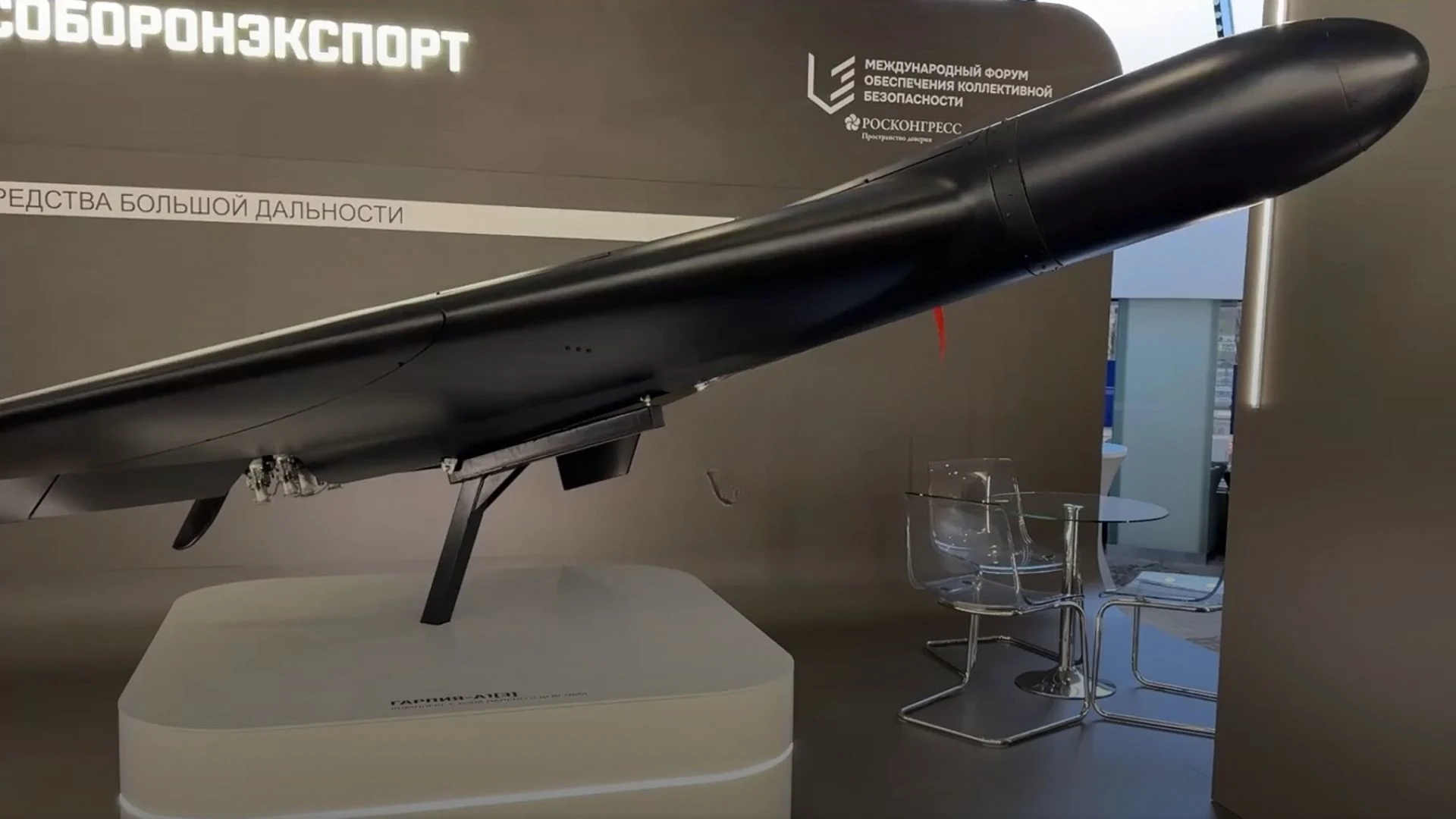
Russia’s state arms exporter Rosoboronexport displayed the export version of the Garpiya-A1 long-range loitering munition, designated Garpiya-A1 (E), at the International Collective Security Forum in Moscow on November 10, 2026. The system, manufactured by the Almaz-Antey Group, is marketed as a one-way attack drone able to strike fixed targets up to 1,000 km away with a warhead weighing more than 50 kg.
The Moscow display extends a marketing campaign launched in August 2026, when Rosoboronexport chief executive Alexander Mikheyev announced that Almaz-Antey had begun serial production of the export variant at a rate sufficient to meet foreign contracts without affecting Russian requirements. The forum, held November 10 to 11 under Russia’s 2026 chairmanship of the Collective Security Treaty Organization (CSTO), ran alongside the CSTO leaders’ summit in Moscow, giving the system direct exposure to delegations from Russia’s closest military partners. Rosoboronexport has also said it is open to localizing production in countries it considers friendly to Moscow.
Inside the Garpiya Loitering Munition: BLA-D Airframe and Performance
The Garpiya-A1 (E) system is built around the BLA-D long-range unmanned aerial vehicle, a flying-wing design with a propeller driven by a gasoline engine. Manufacturer data gives a fuselage length of 3.4 m, a wingspan of 3 m and a takeoff mass of 250 kg. The munition operates at altitudes between 50 and 2,500 m, reaches a maximum speed of at least 170 km/h, and offers a range of about 1,000 km with endurance of at least six hours.
Rosoboronexport states the munition flies automatically to fixed targets at preset coordinates and claims a circular error probable (CEP) of no more than 4 m. That accuracy figure has not been independently verified. Mikheyev has described the Garpiya-A1 (E) as the only loitering munition on the export market with a range of up to 1,000 km. The company has not disclosed the warhead type, engine designation, launcher configuration or unit price.
The figures place the system in the same class as the Iranian Shahed-136. Publicly available specifications indicate the Shahed-136 measures about 3.5 m long with a 2.5 m wingspan and a mass of roughly 200 kg, making the Russian design slightly wider and heavier. Ukrainian military intelligence credits the domestic Garpiya-A1 with a takeoff weight of up to 300 kg, a speed of 185 km/h and a range of up to 1,500 km, which suggests the export model is offered with reduced or more conservatively stated performance. Imagery of the export variant shows a four-element navigation antenna consistent with the jam-resistant Kometa-M4 satellite navigation module, a detail drawn from Ukrainian imagery analysis rather than manufacturer disclosure.
Shahed Lineage and Kupol’s Sanctioned Production Base
The domestic Garpiya-A1 is produced by the Izhevsk Electromechanical Plant (IEMZ) Kupol, an Almaz-Antey subsidiary, and Russian forces use it to strike military and civilian targets deep inside Ukraine. European security officials have described it as a Shahed-derived design adapted to Chinese components, including L550E piston engines made by Xiamen Limbach Aviation Engine Co. The United States and the European Union sanctioned Xiamen Limbach in October 2024, and Kupol itself is under US and EU sanctions.
Internal Kupol documents reported in 2025 showed a Russian Ministry of Defense contract for more than 6,000 Garpiya drones that year, up from 2,000 in 2024. Ukrainian military intelligence estimated in mid-2025 that Russia was launching around 500 Garpiya drones per month. Production figures for 2026 have not been published.
That industrial base is now being pointed toward export. Almaz-Antey has said it will present the Garpiya-A1 (E) at the Vietnam International Defence Expo, scheduled for December 2026 in Hanoi, and at Airshow China in Zhuhai. Rosoboronexport has not named a customer or confirmed a signed contract. It has also not said whether the export variant uses the same imported engines and navigation components as the domestic model, a point that bears directly on secondary sanctions exposure for any buyer.
Analysis: The Garpiya-A1 (E) gives mid-tier militaries access to 1,000 km precision strike, produced at scale under combat conditions, without the cost and complexity of a cruise missile program. Rosoboronexport’s claim of exclusivity is contestable: publicly available specifications for Israel Aerospace Industries’ Harop cite a range of up to 1,000 km, although with a warhead of roughly 23 kg. The more consequential element is the localization offer. Licensed production in partner states would spread a combat-proven long-range one-way attack capability beyond direct Russian control and create new supply chains that Western sanctions regimes would have to track.
The next markers are the system’s appearances in Hanoi and Zhuhai, where buyer interest will become clearer. Key unknowns remain unit price, warhead options, the export bill of materials, and whether any CSTO member acquires the system under Moscow’s proposed program to equip the bloc’s Collective Forces with Russian weapons.