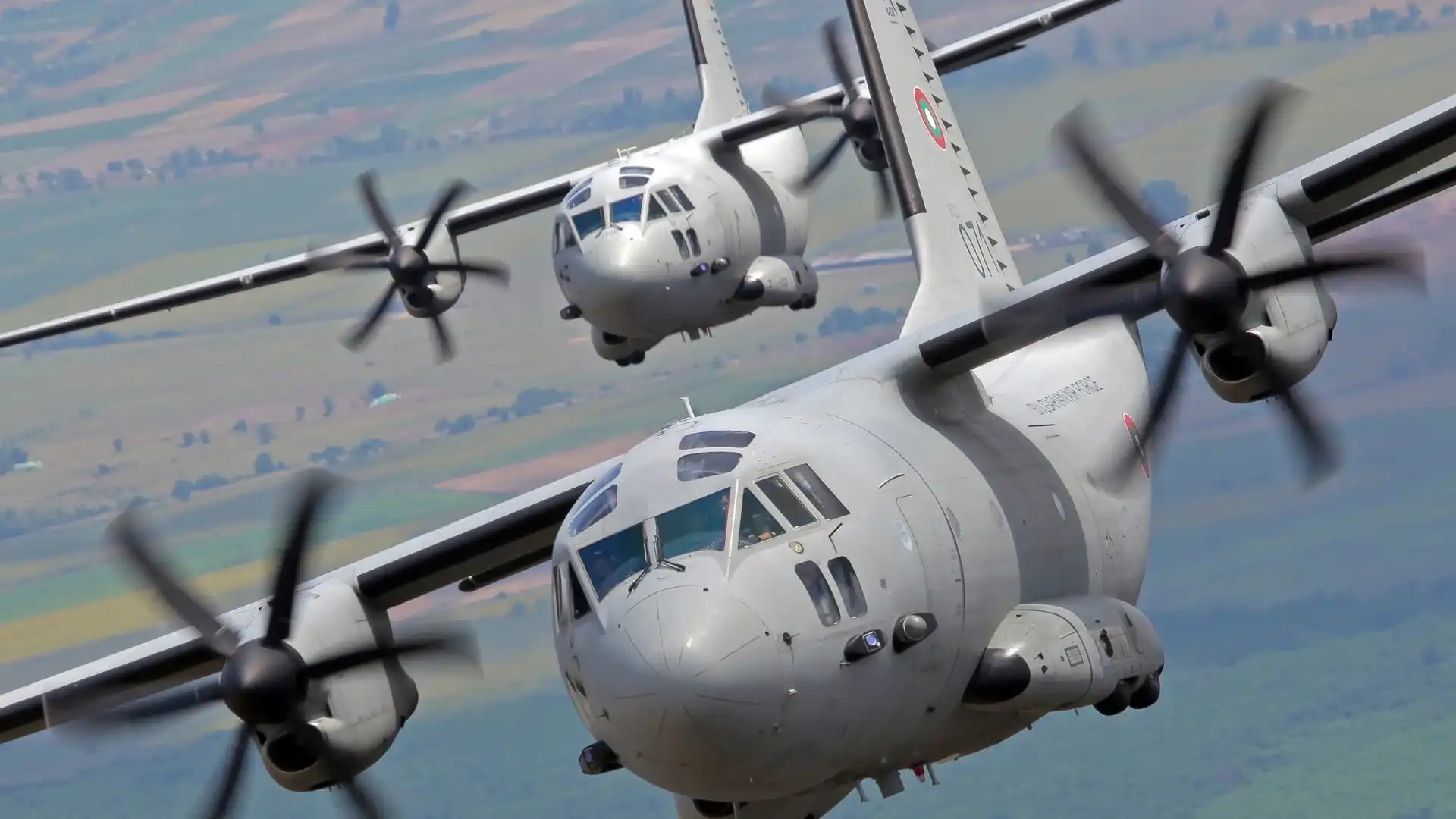
Leonardo has been awarded a contract to deliver a major avionics upgrade for the Bulgarian Air Force’s fleet of three C-27J Spartan tactical transport aircraft, the Italian company announced in Sofia on November 23, 2026. The modernization covers a redesigned cockpit human-machine interface, new navigation and surveillance equipment, and an upgraded communications system, intended to keep Bulgaria’s only medium tactical airlift fleet aligned with evolving military and civil aviation standards.
The three aircraft are operated from the 16th Transport Air Base at Sofia-Vrazhdebna and entered service from 2007. Bulgaria signed for five C-27Js in February 2006 in a deal valued at €91.8 million, later reduced to three airframes, with the final aircraft delivered in March 2011. With the oldest airframe approaching two decades of service and its mid-2000s avionics facing obsolescence, Sofia joins a growing list of Spartan operators choosing to refresh rather than replace. Leonardo did not disclose the contract value, the induction schedule, or where the modification work will take place.
Inside the C-27J Spartan Upgrade: Cockpit, Navigation and Communications
Leonardo has described the package only in functional terms: a redesigned human interface to increase situational awareness, advanced navigation and surveillance technology, and an upgraded communications system. The company has not named specific equipment or suppliers, nor confirmed whether Bulgaria is adopting the full C-27J Next Generation avionics configuration now offered on new-build aircraft.
Comparable contracts give a sense of scope. Italy’s March 2023 agreement with Armaereo, the Italian Air Force armament and airworthiness directorate, covers a new mission computer, flight management system, head-up and head-down displays, radio and satellite communications, and a new self-protection suite. In February 2023, US Special Operations Command awarded Leonardo a $91.9 million contract for the 1.2+ avionics update package, aimed at replacing components more than 15 years old and maximizing commonality across the fleet. Australia signed an A$70 million radio upgrade in October 2022. Leonardo has not said whether Bulgaria’s package also covers the self-protection system, as Italy’s does.
The emphasis on navigation and surveillance, combined with Leonardo’s reference to civil aviation standards, points to compliance with European airspace requirements for performance-based navigation and transponder-based surveillance, although the specific mandates targeted have not been confirmed. The C-27J’s original fully digital MIL-STD-1553 avionics architecture should simplify integration.
The airframe itself is unchanged. Publicly available specifications indicate two Rolls-Royce AE 2100-D2A turboprops rated at 4,637 shp (3,458 kW) each, driving Dowty R391 six-blade propellers, the same powertrain as the C-130J Super Hercules. Leonardo lists a maximum payload of 11,300 kg, capacity for 46 troops (60 in high-density configuration) or 36 stretchers with six medical attendants, a maximum cruise speed of 325 knots true airspeed, and a maximum range of 5,852 km.
Bulgaria’s Three-Aircraft Fleet and Its Role in NATO Airlift
Bulgaria selected the C-27J over the EADS CASA C-295 to replace Antonov An-26s that needed three technical stops to reach Iraq, where Bulgarian troops were then deployed. The Spartans have since supported national contingents abroad, medical evacuation and humanitarian tasks, and allied logistics. In July 2024, a Bulgarian C-27J carried official US cargo and personnel for the first time, flying out of Aviano Air Base, Italy. Vrazhdebna also hosted the 2017 edition of the Balkan Spartan multinational exercise, which brought European C-27J operators together for joint training, maintenance exchanges and cargo reconfiguration drills.
That regional community matters for a small fleet. Romania, Greece, Slovakia and Lithuania also fly the C-27J, and Romania is among the operators already upgrading its avionics. A common avionics baseline across neighboring NATO fleets eases shared training, spares pooling and mutual support during deployments. Leonardo says the C-27J now has 22 operators worldwide, more than 100 aircraft ordered and almost 300,000 accumulated flight hours. On the same day, the company also announced a long-term logistics support agreement with the Peruvian Air Force, a sign of the growing weight of in-service support in the program.
Analysis: With only three aircraft, each Spartan represents a third of Bulgaria’s tactical airlift, so availability counts for more than headline capability. An avionics refresh is a low-cost way to keep the fleet certified, interoperable and usable in both military and civil airspace while the defense budget remains dominated by the F-16 Block 70 program and air defense priorities. The upgrade also brings Bulgaria into line with Italy, Romania and US operators, gradually converging NATO’s Spartan fleets on a shared configuration that simplifies sustainment on the Black Sea flank.
The main unknowns are cost, timeline and fleet availability during modification. Taking one of three aircraft out of service for an extended period will temporarily reduce Bulgaria’s airlift capacity by a third, making the induction sequence a key decision. Further details are expected from the Bulgarian Ministry of Defense, along with confirmation of whether the work will be performed in Italy or in Bulgaria.