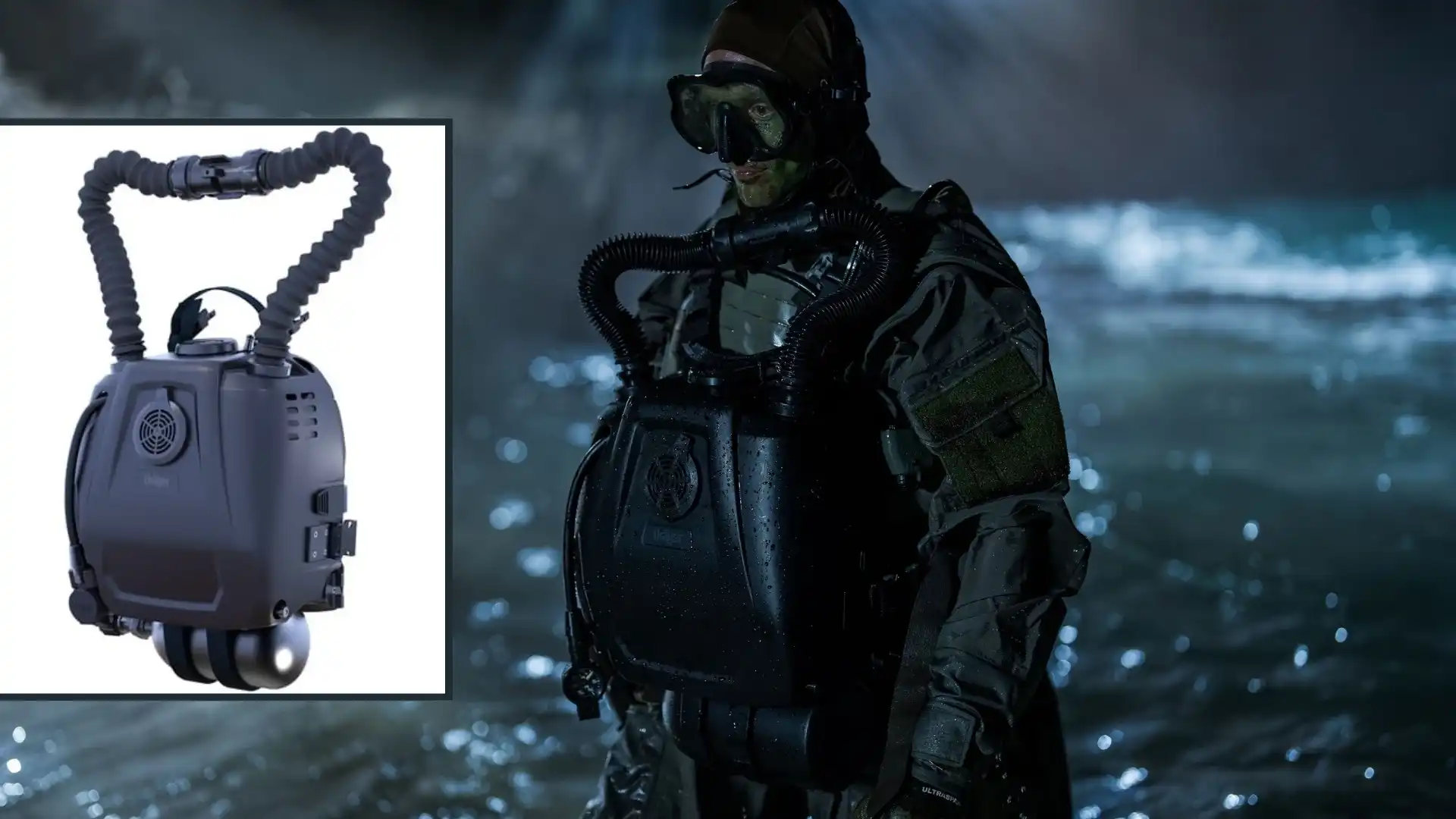
The U.S. Navy has placed the oxygen variant of Dräger’s LAR 8000 combat diving rebreather on its Authorized for Navy Use (ANU) list, the German safety technology group announced from Houston on November 23, 2026. ANU status follows a design safety review, testing, and evaluation, and gives program leaders and dive teams a recognized Navy pathway to evaluate the closed-circuit oxygen rebreather for operational use.
The listing is not a procurement award, and Dräger has disclosed no contract, quantity, or adopting unit. It nonetheless arrives as U.S. special operations divers look beyond legacy equipment. Dräger’s U.S. military diving footprint dates to the early 1980s, when its LAR V, designated MK 25 by the Navy, became the standard closed-circuit oxygen rebreather for U.S. Special Operations Command (SOCOM). On May 29, 2026, SOCOM issued Commercial Solutions Opening Call CSO003 seeking white papers on next-generation special operations combat diving technologies.
LAR 8000 Rebreather Specifications: Oxygen and Nitrox Envelopes
The LAR 8000 is a low-profile, dual-mode rebreather. In closed-circuit (CCR) configuration, the diver breathes 100 percent oxygen (NATO A gas) while the system scrubs exhaled carbon dioxide rather than venting it, producing no bubble trail. For deeper profiles, the unit switches to semi-closed-circuit (SCR) operation on NATO B nitrox, a mix of 60 percent oxygen and 40 percent nitrogen. The Navy listing covers the O₂ variant only.
Publicly available manufacturer specifications indicate dive durations of up to 240 minutes on oxygen at depths to 10 meters of seawater (33 feet), and approximately 105 minutes on nitrox at depths to 24 meters (79 feet). The rig weighs 14 kg (31 pounds) in air, measures 45.5 by 34 by 19 cm, and is neutrally buoyant in water. It holds 2.5 kg of soda lime and accepts either prepacked DiveSorb Go 8000 cartridges or loose DiveSorb Pro CO₂ absorbent.
Dräger highlights an adjustable lung demand valve to tune breathing resistance, tool-free assembly through its P Con quick connector when visibility, time, or working space is limited, and a hard housing protecting the breathing bag, absorbent canister, and pneumatics. A non-magnetic configuration conforming to NATO STANAG 2897 Class A is offered for specialized mission requirements. The company has not specified whether the ANU-listed build is the magnetic or non-magnetic version.
Navy ANU Listing Opens Evaluation Path Across Diving Missions
Dräger positions the O₂ variant for swimmer delivery vehicle operations, open-water missions, and submarine lockout, in which divers exit a submerged boat through a flooded chamber. Each profile constrains equipment differently: depth, visibility, space inside a delivery vehicle or lockout trunk, diver loadout, and signature management all shape what a team can carry.
“The LAR 8000 was developed and tested for how it is carried and prepared, how it performs underwater, and how easy it is to maintain,” said Chief Navy Diver Christopher Shawn Young, USN Ret., product manager for Dräger’s Military Diving Solutions. Rear Adm. George W. Ballance, USN Ret., vice president of sales for emergency and rescue services at Dräger, Inc., presented the system as a continuation of the MK 25 lineage.
Analysis: The ANU listing removes a certification barrier rather than creating demand. Its value lies in timing. SOCOM’s CSO003 call and a February 2026 Navy explosive ordnance disposal market survey for a next-generation underwater breathing apparatus show that the U.S. combat diving community is actively reassessing its breathing equipment. Should Dräger compete, the original MK 25 supplier would do so with a Navy-cleared design and fewer certification hurdles than new entrants, although the nitrox SCR mode that gives the LAR 8000 its depth margin remains outside the listing.
Key unknowns remain: which commands will evaluate the LAR 8000, whether Dräger will submit the SCR nitrox configuration for ANU review, and whether evaluation leads to a program of record. Dräger has published no timeline for any of these decisions.