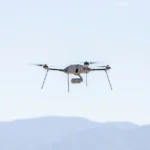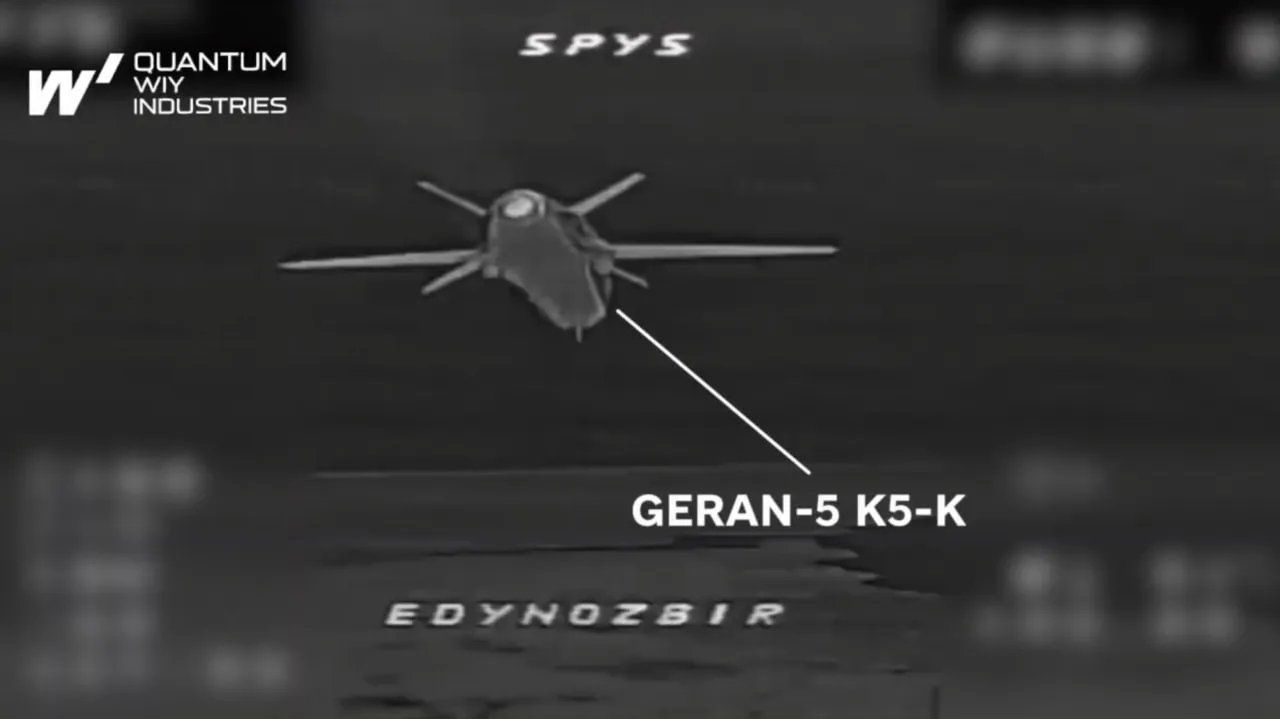
A SPYS interceptor drone built by German-Ukrainian joint venture Quantum WIY Industries (QWI) destroyed a Russian Geran-5 K5-K jet-powered strike weapon over Ukraine, the company told Militarnyi on November 23, 2026. QWI said the SPYS achieved the kill alone, with no other air defense asset involved, during combat testing. Ukrainian intelligence assesses that the K5-K cruises above 450 km/h and can reach 1,000 km/h in certain maneuvers, while the upgraded SPYS tops out at 500 km/h. QWI did not disclose the date, location, or target speed at interception.
The claim matters because the K5-K sits at the fast end of Russia’s long-range strike family. Ukraine’s Defense Intelligence Directorate (HUR) classifies it as a compact cruise missile rather than a drone, citing its aerodynamic design and performance, and says Russian forces began using it against Ukrainian cities in early fall 2026. Jet-powered variants fly far faster than propeller-driven Geran-2 drones, shrinking the reaction time available to interceptor crews.
SPYS Interceptor Drone Upgraded for High-Speed Jet Targets
Quantum Systems and Ukrainian manufacturer WIY Drones formed QWI in April 2026, during German-Ukrainian government consultations, to develop and scale interceptor drones. It followed a Ukrainian order for Quantum Systems to deliver 15,000 WIY-built STRILA interceptors.
The SPYS is designed to counter attack and reconnaissance drones over military positions, mobile units, and critical infrastructure. According to the company, the updated production version draws on combat experience against jet targets: top speed rises to 500 km/h, range to 45 km, and standard warhead mass to 500 grams. WIY’s published figures still list a speed of around 450 km/h and a 4 km ceiling, which likely describe an earlier configuration.
The airframe has also been adapted for launch from carrier drones. QWI says air launch saves battery charge otherwise spent climbing, preserving energy for the attack run. The company is working on container launch and has tested a rocket booster to cut the time needed to reach altitude and speed. “Russia keeps adapting its attack systems, so we work closely with Ukrainian brigades to adjust our systems accordingly,” said Sven Kruck, co-CEO of Quantum Systems.
Geran-5 K5-K: Compact Cruise Missile Profile and Guidance
Based on HUR’s examination of a nearly intact example, the K5-K is 4 m long with a 3 m wingspan, against 6.5 m and 3.2 m for the baseline Geran-5. Power comes from a TRD-200 turbojet assembled with Chinese-made components at Russia’s Alabuga plant, the main Geran production site.
HUR assesses cruise speed at above 450 km/h, with peaks of up to 1,000 km/h during certain maneuvers, a ceiling of about 6 km, and a claimed range of 1,000 km. The warhead weighs 90 kg; the examined prototype carried a TBBCh-90 thermobaric charge. Navigation combines satellite-aided inertial guidance, a controlled reception pattern antenna (CRPA) for jamming resistance, and the Susanin optical module with a dual-band camera. Its estimates are still moving: alongside the K5-K analysis, it lowered the original Geran-5’s cruise speed from 450 to 600 km/h to 400 to 450 km/h.
Analysis: The published numbers leave the SPYS a thin margin. A 500 km/h interceptor facing a target that cruises above 450 km/h and can sprint toward 1,000 km/h cannot rely on a tail chase. It needs early cueing, a position ahead of the predicted track, and a head-on or crossing geometry. That explains QWI’s push toward carrier-drone launch and rocket boost, both of which bank altitude and energy before the engagement. The gap between the K5-K’s 6 km ceiling and the 4 km figure WIY lists for SPYS points to the same constraint. One claimed kill validates the concept but says nothing yet about probability of kill at scale.
Next indicators include confirmation from Ukrainian air defense units, disclosure of SPYS production volumes, and fielding of the container-launched and boosted variants. In October, Ukrainian military officials told Militarnyi that Russia’s design changes to the K5-K are primarily meant to raise its speed to about 900 km/h, adding that no measured data were yet available. On October 22, presidential defense technology adviser Serhii Beskrestnov also published a photo of what Militarnyi assesses as a second, unidentified small cruise missile, with a box-shaped fuselage, a diamond-shaped wing, and a V-tail. If Russia reaches the 900 km/h goal, interceptor speed margins will narrow further.