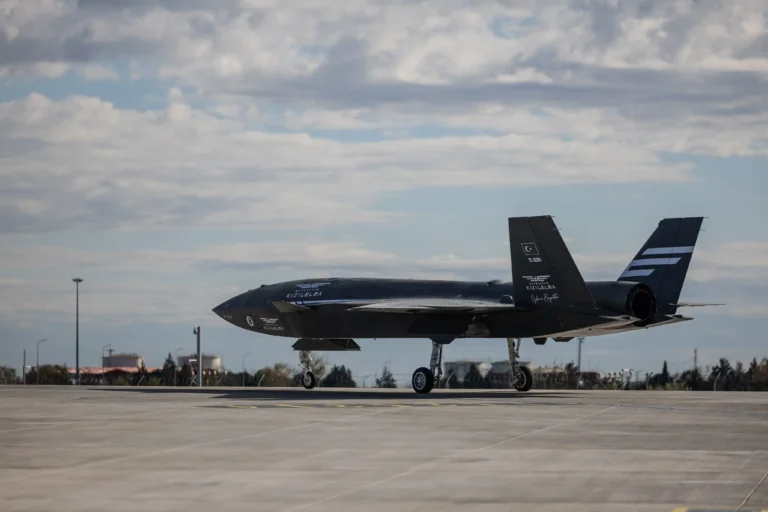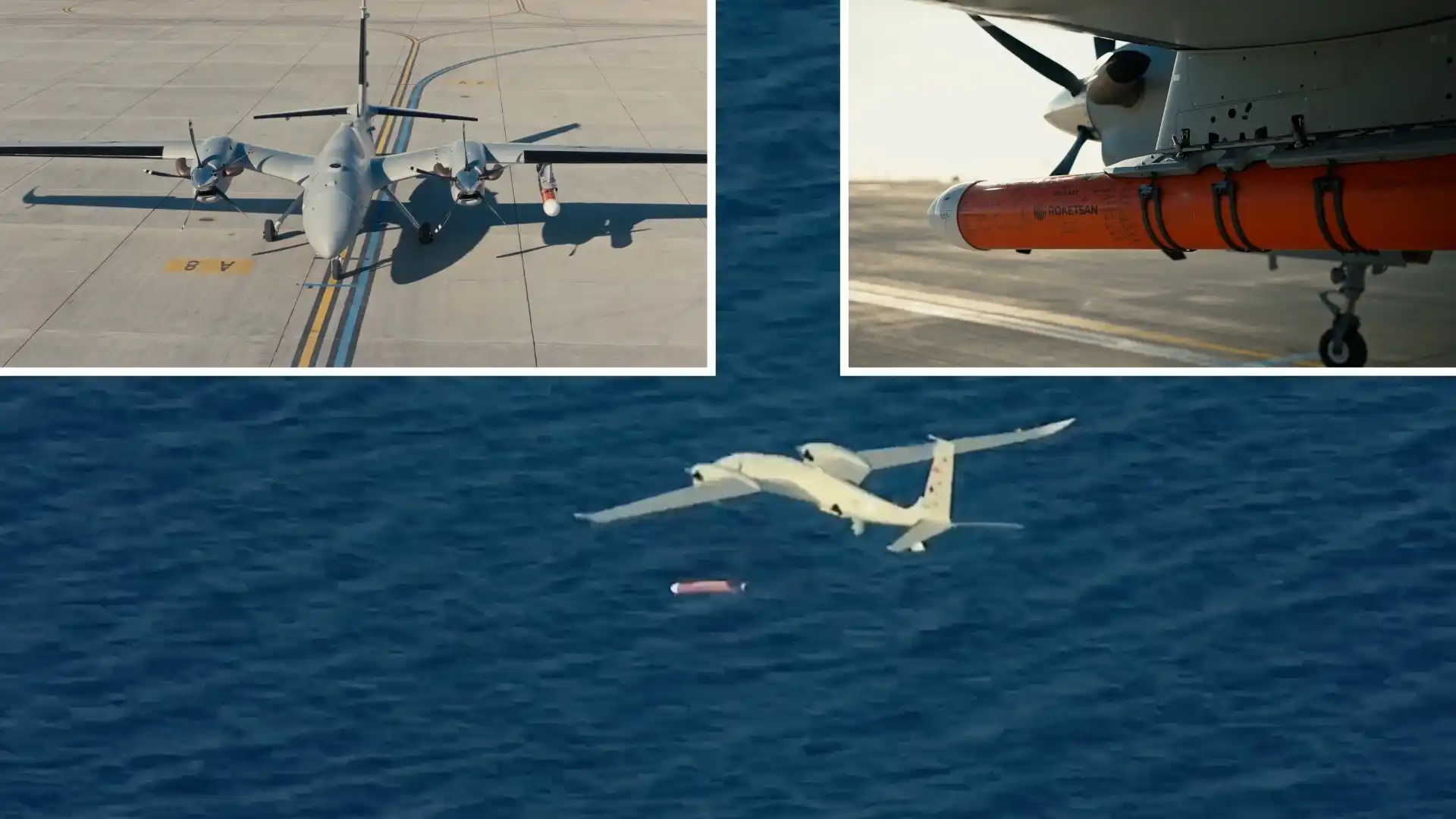
Türkiye’s Bayraktar AKINCI unmanned combat aerial vehicle (UCAV) has released Roketsan’s ORKA next-generation lightweight torpedo in flight, Baykar and Roketsan announced on November 22, 2026, adding an anti-submarine weapon to the drone’s munitions portfolio. Flying from Baykar’s AKINCI Flight Training and Test Center at Çorlu, in Tekirdağ province, the aircraft dropped the torpedo from an underwing station over the Gulf of Saros in the northern Aegean. The weapon separated cleanly and entered the water at the designated point before the drone returned to base. Türkiye’s state news agency described it as ORKA’s first drop from an unmanned aircraft.
The trial is Baykar’s latest anti-submarine warfare (ASW) milestone in two months. On September 22, 2026, a Bayraktar TB3 operating from the amphibious assault ship TCG Anadolu released two sonobuoys from Baykar’s SAS POD dispenser during the Seawolf-I/2026 exercise, and released four more during the Blue Whale-2026 exercise this month. Ankara now has an unmanned sensor demonstration and an unmanned weapon demonstration, built around a torpedo meant to replace the US-made Mk 46 in Turkish service.
ORKA Torpedo Design, Guidance, and What the Saros Test Showed
Roketsan describes ORKA as a fully autonomous, high-speed lightweight torpedo built to engage submarines of various types. Its homing head combines active and passive sonar with acoustic counter-countermeasure capability, backed by internal guidance once the weapon is in the water. A brushless DC electric motor drives a pump-jet propulsor, powered by a high-energy lithium battery. The warhead is a shaped-charge insensitive munition with an impact fuze, and Roketsan specifies a push-out launch.
The company lists a range of 15 km and a speed above 45 knots. Its 2024 product sheet gives a length of 2.85 m, a mass of 220 kg and a diameter of 275 mm, although the program was launched as a 324 mm development, the NATO lightweight torpedo standard. Earlier program data cited a 25 km range before Roketsan revised the figure in 2021. Approved launch platforms include surface ships, helicopters, maritime patrol aircraft and armed unmanned aerial vehicles.
The results disclosed so far are limited. The official accounts describe separation and water entry only. Turkish defense outlet SSBülten reports that after entry the sonar head processed target data, tracked a submarine target and conducted an engagement using internal guidance, while Turkish outlet Envanter Medya reports that the released clip shows the torpedo striking its target. Baykar titled its footage an “ORKA Next-Gen Lightweight Torpedo Firing Test.” Neither company has disclosed the target type, run distance, depth or whether a live warhead was fitted.
ORKA was launched in December 2020, with Roketsan as prime contractor and Aselsan as partner. It draws on the 533 mm AKYA heavyweight torpedo, which entered mass production under a January 18, 2024 contract after more than 70 test firings since 2013, and sank decommissioned surface targets in December 2023 and June 2026.
AKINCI Payload Capacity and Türkiye’s Unmanned ASW Kill Chain
Baykar lists the AKINCI at a maximum takeoff weight of 6,000 kg with a 1,500 kg payload, a 20 m wingspan and a 12.2 m length. The aircraft operates at 30,000 ft with a 40,000 ft service ceiling, uses line-of-sight and satellite datalinks, and flies in three variants: AKINCI-A with two 450 hp turboprops, AKINCI-B with two 750 hp engines and AKINCI-C with two 850 hp engines. At 220 kg per round, the payload budget could in theory accommodate several torpedoes, but Baykar has not disclosed an operational carriage configuration.
The drone already has a maritime strike record. It hit a sea target with a Teber-82 guidance kit in April 2022 and struck moving and fixed naval targets with MAM-T munitions from 30,000 ft in May 2024. ORKA moves it from surface attack into the subsurface fight, a role normally assigned to maritime patrol aircraft and ASW helicopters.
Baykar and Roketsan frame the TB3 and AKINCI as complementary: the TB3 detects, using onboard processing that handled acoustic data from its own buoys and from a crewed patrol aircraft during Seawolf-I, while the AKINCI engages. That chain has not yet been demonstrated end to end. No cueing of an AKINCI torpedo drop by drone-laid sonobuoys has been announced.
Analysis: Releasing a torpedo from a UCAV is an integration step; holding submarines at risk is a sensing problem. The value of an ORKA-armed AKINCI lies in cost and persistence: a long-endurance drone can stay on station over the Aegean, the Eastern Mediterranean or the Black Sea and deliver a weapon on cue without committing a crewed patrol aircraft or a frigate’s helicopter. That only works if detection and localization data reach the drone fast enough for a 15 km torpedo to acquire its target. For NATO, a domestic weapon on an exported airframe also opens an ASW strike option to navies that lack maritime patrol fleets, outside the US export control regime that governs the Mk 54.
Neither company has given a date for ORKA qualification, a production contract or entry into the Turkish Naval Forces inventory. The next markers are a confirmed live-warhead shot against a submerged target, a sonobuoy-cued engagement combining the TB3 and AKINCI, and ORKA integration on helicopters, frigates and the MIR unmanned surface vessel, which already fires NATO-standard lightweight torpedoes.