The Swiss F-35A program remains on schedule, with the first eight jets due for delivery in the United States in the second half of 2027, the Swiss Armed Forces said on November 24, 2026. The first Swiss aircraft are already in production, the first jets are expected in Switzerland in mid-2028, and full operational readiness is planned for the end of 2032. Fliegerstaffel 1 (Fighter Squadron 1) will be reactivated at Payerne Air Base from 2029 as the service’s first F-35A squadron.
The progress report follows a turbulent year for the program. Switzerland signed for 36 F-35As in September 2022 through the US Foreign Military Sales (FMS) system, backed by a commitment credit of 6.035 billion Swiss francs (CHF). After Washington refused to honor the fixed price Bern believed it had secured, the Federal Council decided on December 12, 2025, to buy the maximum number of aircraft possible within the CHF 6 billion ceiling approved by voters in September 2020. Parliament completed approval of a CHF 394 million supplementary credit on September 15, 2026, which the Federal Department of Defence, Civil Protection and Sport (DDPS) expects to fund 30 aircraft. Keeping all 36 would have required roughly CHF 1.1 billion more. The final number is not yet confirmed.
Swiss F-35A Delivery Timeline From Fort Worth to Payerne
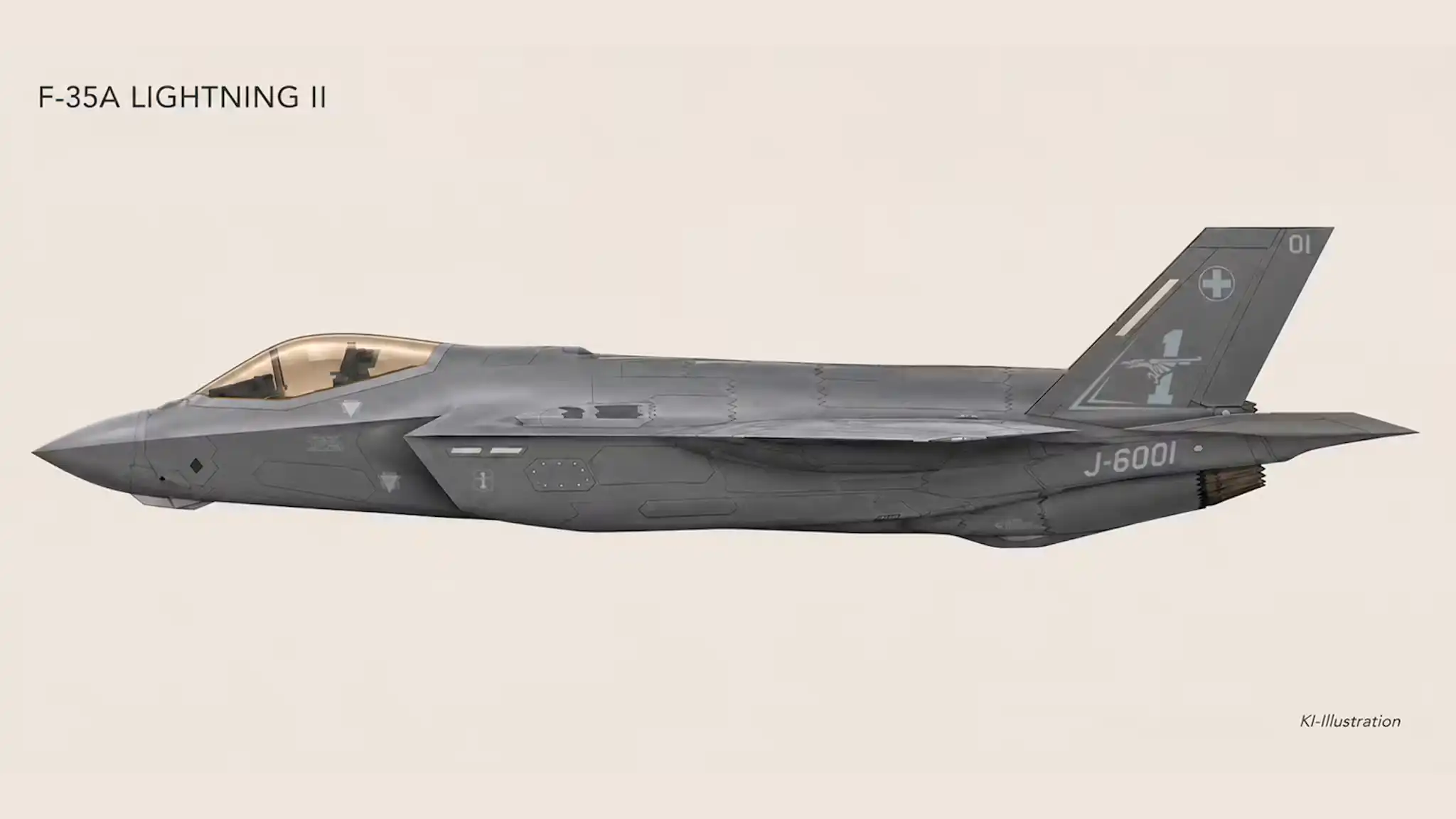
A symbolic milestone came on September 21, 2026, at Lockheed Martin’s Fort Worth, Texas, plant. Chief of the Armed Forces Lieutenant General Benedikt Roos, Air Force Commander Major General Christian Oppliger, Air Force Brigade 31 commander Brigadier General Werner Tarnutzer and National Armaments Director Urs Loher signed the forward fuselage bulkhead of the first Swiss jet, which will carry the military registration J-6001. The ceremony is symbolic and has no technical function. Main assembly of the first Swiss aircraft had begun in May 2026 on Lockheed Martin’s center wing assembly line in Marietta, Georgia.
The DDPS timeline:
- Mid-2027: a first contingent of Swiss ground crew begins training in the United States.
- Second half of 2027: the first eight F-35As are delivered in the US and used to train the first Swiss pilots, at Ebbing Air National Guard Base in Fort Smith, Arkansas, according to earlier government statements.
- Mid-2028: the first aircraft arrive in Switzerland.
- End of 2029: first operational services.
- 2030: closure of the New Fighter Aircraft (NKF) project once all aircraft and support systems are delivered.
- End of 2032: full operational readiness.
Production is spread across the F-35 industrial network. The eight training jets come from Fort Worth, while the remaining Swiss aircraft will be delivered from Leonardo’s final assembly and checkout (FACO) facility in Cameri, Italy, the only F-35 final assembly line in Europe. In August 2026, Cameri mated fuselage section MJ-4 with its wing; the assembly will become J-6004 after integration in Fort Worth. Under the RIGI offset project, RUAG agreed with Lockheed Martin in October 2026 to carry out final assembly and testing of three F-35As at Emmen, down from the four originally planned, with production due to start in autumn 2027.
Integrated Air Defense Role and the Return of Fliegerstaffel 1
Swiss officials frame the F-35A as more than a replacement for the F/A-18C/D Hornet fleet. Its sensors and networking are meant to give it a central role in integrated air defense, working with ground-based air defense systems, radars and command structures to detect threats earlier and respond effectively. According to US Air Force data, its single Pratt & Whitney F135-PW-100 engine produces 43,000 lb of thrust, while Lockheed Martin figures give a combat radius on internal fuel of more than 590 nautical miles and a 25 mm GAU-22/A cannon among its weapons. For a country whose airspace a fighter can cross in minutes, the ability to build and share an air picture well beyond the border is the operational payoff.
The transition demands new training and operating procedures, supported by modern simulators, international cooperation and in-house expertise. Fliegerstaffel 1 provides the institutional anchor: its roots reach back to the beginnings of Swiss military aviation, and its traditional emblem, the mythological bird Rokh, will return in adapted form.
Analysis: The November update is less about new information than about restoring confidence in a program damaged by the fixed-price dispute and the likely cut from 36 to 30 aircraft. By holding to milestones set before the cost row, the DDPS signals that the reduction hit fleet size, not schedule. The price is depth. With the first eight airframes committed to pilot training in the US, a fleet of roughly 30 jets leaves a thin margin to sustain round-the-clock air policing while generating conversion sorties through 2032. That makes networking with ground-based air defense a necessity: with fewer jets than planned, each F-35A must add value across the whole system.
The next milestones are the delivery of J-6001 and the start of Swiss pilot training in Arkansas in the second half of 2027. The definitive fleet size depends on the US government concluding contracts for the next production lots and engines, with confirmation expected in 2027. The first jets should reach Payerne in mid-2028, followed by the reactivation of Fliegerstaffel 1 in 2029. The final unit price remains unknown.