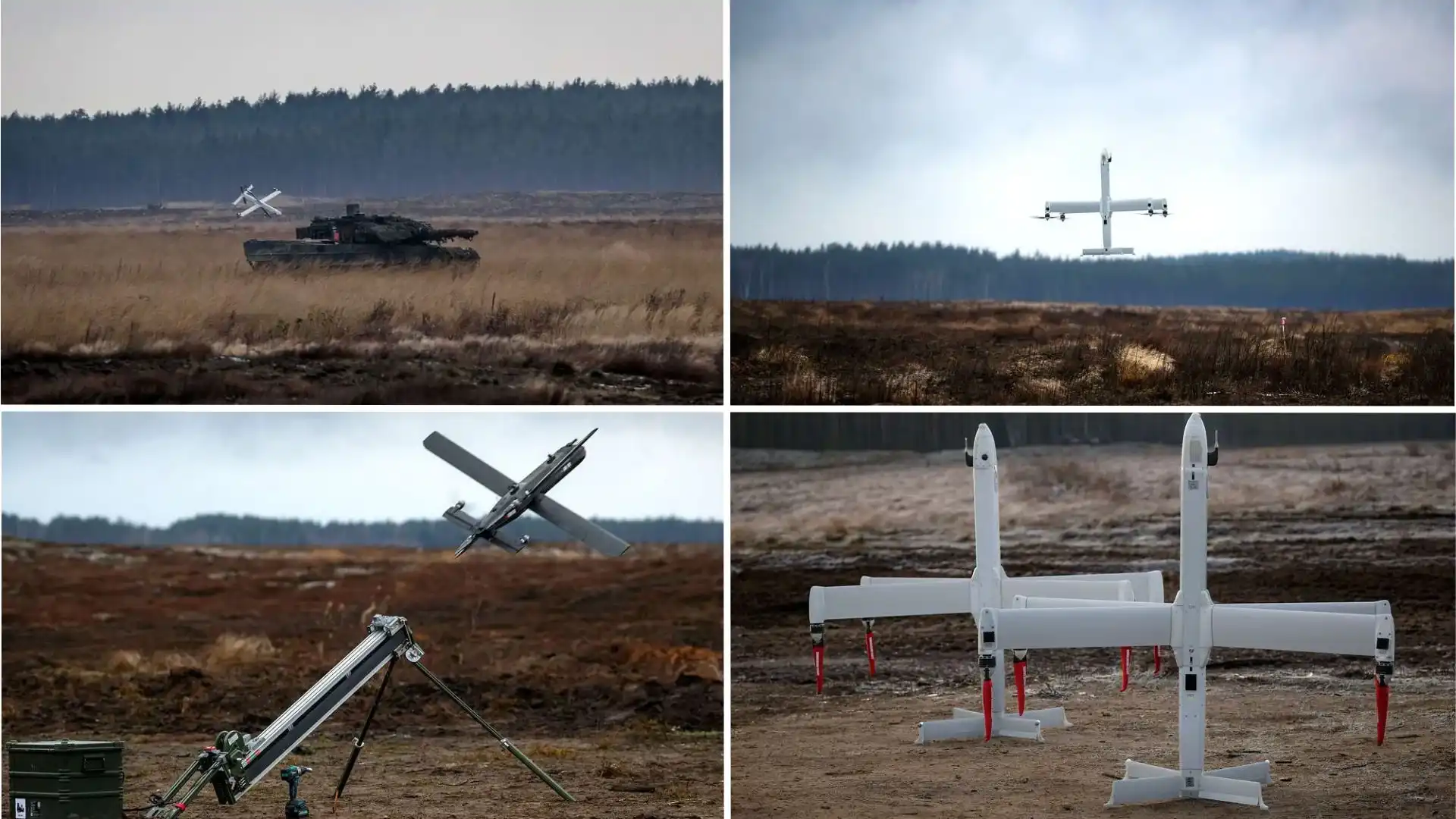
Germany’s Panzerbrigade 45 “Litauen” flew loitering munitions in a force-on-force exercise for the first time on November 22, 2026, at the Rūdninkai training area in Lithuania. The brigade employed two different systems against armored targets roughly 12 kilometers from the Belarusian border. The German Army (Heer) confirmed the trial on November 24, with Inspector of the Army Lieutenant General Christian Freuding observing the launches during Exercise Freedom Shield 26-2.
The trial comes nine months after Berlin opened its loitering munition procurement. The Bundestag budget committee released the first funds on February 25, 2026, and the Federal Office of Bundeswehr Equipment, Information Technology and In-Service Support (BAAINBw) signed framework contracts the next day. Panzerbrigade 45 is slated to become the first major Heer formation to field the weapons, from 2027. Freedom Shield 26-2, which began on November 17 with about 3,800 troops from eight NATO nations, is the largest Bundeswehr field exercise yet held in Lithuania.
Two Loitering Munitions Flown at Rūdninkai Training Area
The Heer did not name the systems in its account, but its description matches the two types under contract. One is a white airframe that lifts off vertically from the ground: the Virtus, built by Berlin-based Stark Defence. The other is a dark airframe with X-shaped wings that soldiers launch from a catapult rail: the HX-2, built by Munich-based Helsing. Both use electric propulsion.
Publicly available specifications indicate the Virtus has a takeoff weight of about 30 kilograms, a top speed near 250 kilometers per hour, and a range of 100 to 130 kilometers depending on the source. The HX-2 is lighter at 12 kilograms, reaches up to 220 kilometers per hour, and is credited with a range of up to 100 kilometers. Both figures exceed the reach of tube artillery, which is the point: the brigade can strike armor and command posts without closing to direct-fire distance.
According to the Heer, each munition flies under its own power into the target area and loiters while onboard sensors and software detect targets such as a main battle tank or a command post and present them to the operator. The engagement decision stays with the soldier at the screen, not with the weapon. The senior noncommissioned officer who leads the brigade’s Loitering Munition Systems (LMS) section described his task as operating the munition and engaging enemy armor in the terrain.
German defense reporting from the exercise indicates that roughly 100 munitions were available, flown by trained soldiers instead of manufacturer personnel, generally with inert warheads, and cued by reconnaissance drones. The Bundeswehr has not released sortie counts or hit rates.
Bridging the Indirect Fire Gap Before 2027 Fielding
The brigade is rehearsing tactics with the weapons before they formally enter service. The Heer says the aim is to train operators and adapt combat procedures to the expected battlefield, drawing on lessons from the war in Ukraine. It also describes the munitions as a stopgap until new long-range artillery systems arrive.
Freuding framed the trial in those terms. “I am convinced that this will bring us quickly to closing the gap, to the interim solution, in the area of indirect effects,” he said, in remarks translated from German. He added that loitering munition systems had been employed successfully in a force-on-force exercise for the first time, and under very difficult weather conditions.
The contract structure supports rapid scaling. Under the first call-offs, Stark is to deliver 2,200 Virtus munitions for about 270 million euros and Helsing 4,300 HX-2 munitions for a comparable sum. The two seven-year framework agreements were approved with a combined volume of about 4.3 billion euros, but the budget committee capped each contract at 1 billion euros, and call-offs beyond that require new parliamentary approval. A third type, Rheinmetall’s FV-014, came under a framework contract on April 22, 2026, with an initial order of about 300 million euros. On November 19, BAAINBw reported that Virtus and HX-2 had passed live-fire tests, most of them at the WTD 91 test center in Meppen, as part of an ongoing qualification campaign.
Analysis: The sequencing is the notable element. Germany moved from budget approval to soldier-operated employment in a brigade-level exercise in nine months, and did so ahead of formal fielding. Running two competing designs inside the same formation gives the Heer comparative data on launch footprint, weather tolerance, and operator workload that range trials cannot supply. For NATO, the result will be a forward-stationed heavy brigade with an organic 100-kilometer-class precision strike option, on terrain where Belarusian territory sits well inside that envelope. The open variables are performance under electronic attack and the short-range air defense needed to protect launch teams, neither of which the Bundeswehr has addressed publicly for this trial.
Freedom Shield 26-2 runs through November 27. According to Germany’s delegation to NATO, the experience gained in Lithuania will feed into equipping further land force units. Deliveries to Panzerbrigade 45 are due from 2027, the year the brigade is scheduled to reach full strength. Still undisclosed are the delivery schedule by type, the size and structure of the LMS units, and the date the FV-014 joins the brigade’s trials.