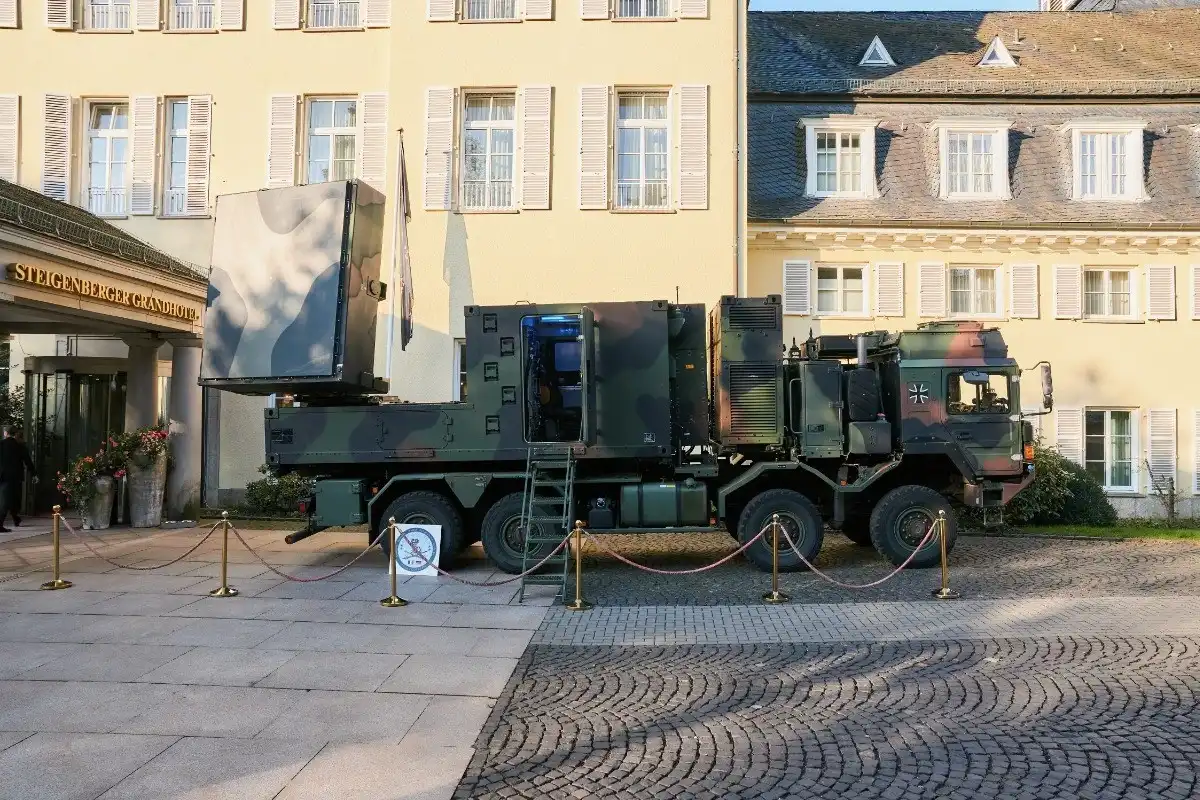
HENSOLDT has presented the first fully upgraded German COBRA counter-battery radar produced under the system’s Mid-Life Update (MLU) program, unveiling it publicly on October 20, 2026, at the 25th anniversary celebrations of the Organisation Conjointe de Coopération en Matière d’Armement (OCCAR) on the Petersberg near Bonn. The radar was shown installed on Germany’s new carrier vehicle. In its announcement on November 16, 2026, the company said the milestone marks the transition from development and qualification activities to fleet-wide deployment.
COBRA, short for Counter Battery Radar, is one of the oldest cooperative programs managed by the Bonn-based agency. The trilateral procurement was integrated into OCCAR in 2001, and the Euro-ART consortium delivered 29 production systems from 2004: 10 to France, 12 to Germany and 7 to the United Kingdom. Germany and France remain the participating nations in the current modernization. The program has also gained operational weight since Germany transferred one COBRA to Ukraine in September 2022 as part of its military aid.
Inside the COBRA Mid-Life Update: DGS3, NINU, NPPU and NSP
The MLU program was launched and contractually agreed in 2019 with ESG Elektroniksystem- und Logistik-GmbH, HENSOLDT and Lockheed Martin Corporation. HENSOLDT completed its acquisition of ESG on April 2, 2024. The aim is to improve system performance and resolve the obsolescence of components that have been in service for two decades.
Four core upgrades define the standard. The Data System Group 3rd Generation (DGS3) replaces the radar’s data handling architecture. A new inertial navigation unit (NINU) renews the positioning function that drives the accuracy of every weapon location; installation kits for the positioning device were procured through the NATO Support and Procurement Agency (NSPA). A New Prime Power Unit (NPPU) and a new signal processor (NSP) complete the package.
The program also renewed the test environment. A new Radar Target Generator (RTG) simulates target trajectories, and a new environmental simulator (RES II) replaces the COBRA Radar Environment Simulator (CRES), which had been in service since the 1990s and had become obsolete and unreliable.
The underlying sensor remains unchanged in concept. COBRA uses a fully active phased array antenna built from several thousand transmit/receive modules. According to OCCAR, the system detects targets out to 100 km and can locate and classify up to 40 batteries within two minutes; the French Army cites a location range of up to 40 km, while the 100 km figure reflects the system’s enhancement package. The Bundeswehr lists a crew of four for its COBRA systems. Beyond locating hostile artillery, mortars and rocket launchers, COBRA can predict impact points and perform friendly fire registration by tracking outgoing rounds and generating correction data.
New Carrier Vehicles and the Franco-German Fleet Timeline
In parallel with the radar upgrade, Germany and France are introducing modified carrier vehicles (MCVs) under separate national initiatives so that the modernized sensors can be operated from current platforms. German COBRA systems originally entered service on an 8×8 MAN truck chassis. The German vehicle shown at Bonn is an unprotected transport vehicle (Ungeschütztes Transportfahrzeug, UTF), according to OCCAR, which did not name its manufacturer; the French platform has not been officially identified.
All MLU modernization work across the fleets of both participating nations is scheduled for completion in 2027. That date reflects a slip against earlier planning: in 2022, OCCAR expected the main MLU measures to be implemented in fielded systems by 2025, and an initial campaign aimed to retrofit 20 French and German systems by the end of that year. France received its first five systems fitted with new positioning units at the 1st Artillery Regiment in Belfort. The German fleet also shrank when Berlin sent one radar to Kyiv, which had requested 40; press reports have estimated the unit cost at around €50 million, which makes replacement a budget decision rather than a routine buy.
HENSOLDT acts as System Design Authority. In November 2025, OCCAR signed a three-year in-service support contract with the company on behalf of France and Germany, covering 2026 through 2028, with a focus on configuration management, technical support, IT security and obsolescence remediation. HENSOLDT said operational readiness was maintained throughout the modernization process. No contract values for the MLU or the carrier vehicle initiatives have been disclosed.
Analysis: The COBRA MLU preserves capability rather than expanding it. Germany and France operate a small fleet of roughly 20 systems, and the upgrade adds no radars to that inventory. The war in Ukraine has shown that weapon-locating radars are priority targets for loitering munitions and long-range fires, and fielding the upgraded sensor on an unprotected truck places the burden of survivability on rapid emplacement and displacement. The program’s main achievement is industrial: with ESG absorbed, HENSOLDT now holds design authority, upgrade and sustainment responsibility, which simplifies obsolescence management through the mid-2030s.
The next milestones are the completion of fleet retrofits in 2027 and the in-service support horizon at the end of 2028. Open questions include the number of German and French carrier vehicles to be procured, the identity of the French platform, and whether Germany will replace the system it transferred to Ukraine.