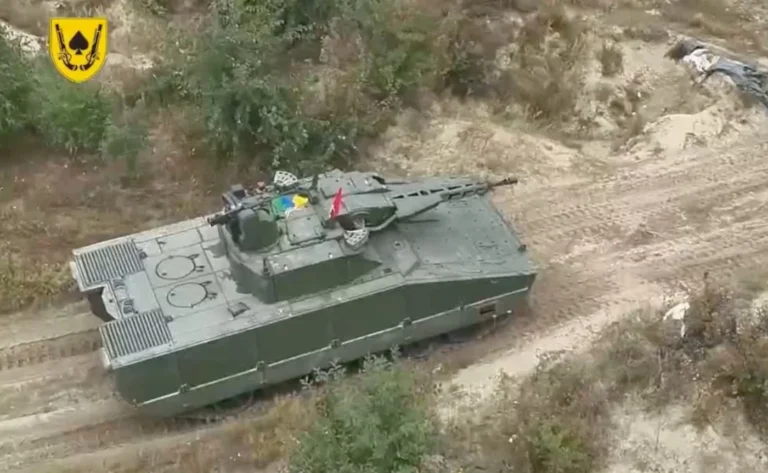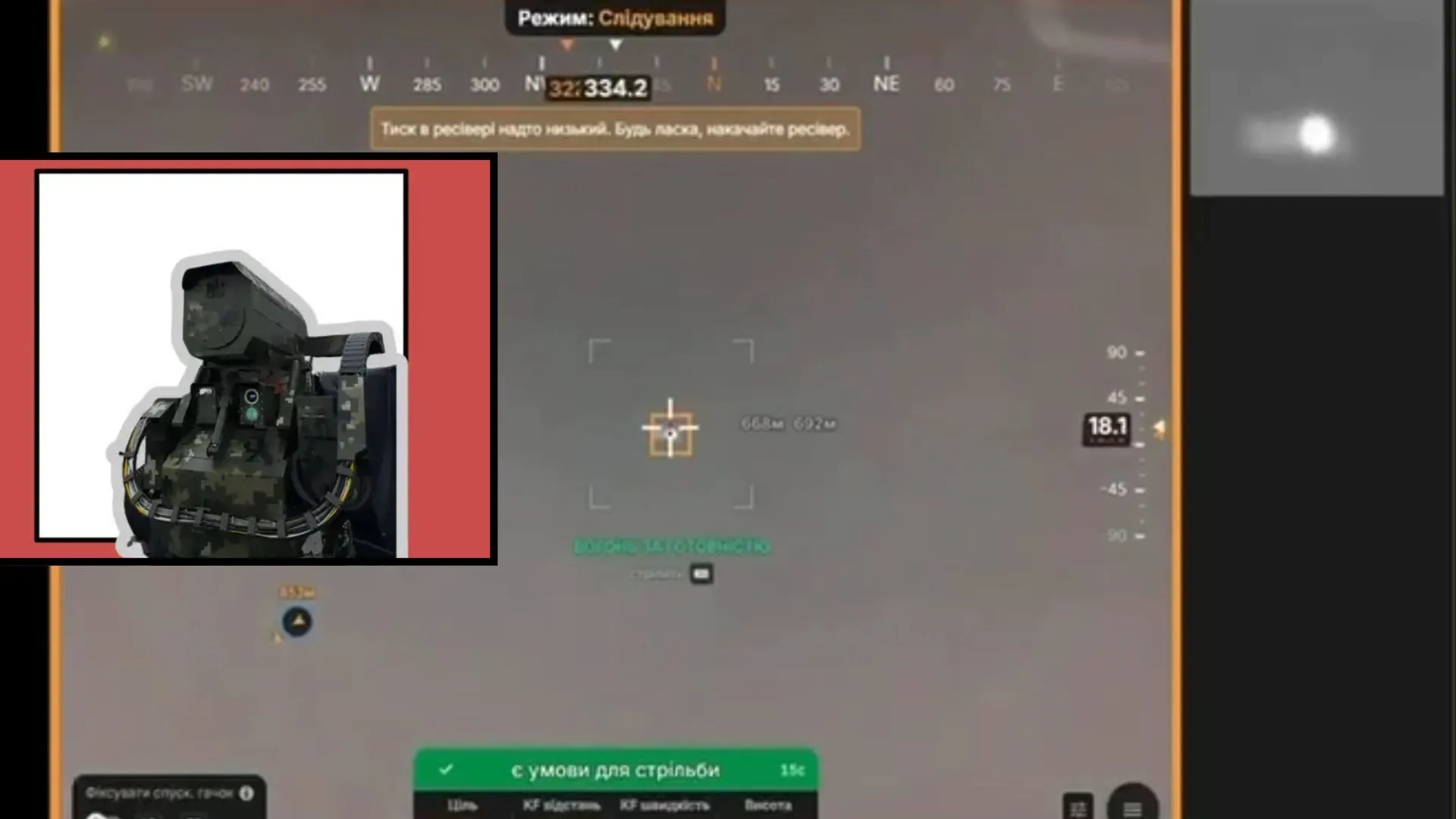
A Ukrainian Blysk laser air defense system has shot down a jet-powered Russian Geran attack drone while protecting a critical infrastructure facility, according to Serhii “Flash” Beskrestnov, adviser to Ukraine’s president on defense technology. Beskrestnov disclosed the engagement on November 25, 2026, on his Telegram channel alongside a 21-second video, describing it as the first time in the world that a combat laser had destroyed a jet-powered Geran. The date and location of the intercept were not disclosed, and the claim has not been independently verified.
The announcement comes as jet-powered Shahed derivatives have become the hardest target set in Russia’s long-range strike campaign. Russian forces launched more than 3,000 jet-powered drones at Ukraine in September 2026, up from roughly 350 in June, according to Ukraine’s Air Force, which reported intercepting only about 60% of them, compared with 90% to 95% of slower propeller-driven models. Kyiv has answered with high-speed interceptor drones, privately operated air defense crews, and now directed energy.
Blysk Laser Specifications: 4 kW Beam and One-Kilometer Reach
Blysk is developed and operated by Carmine Sky, a Ukrainian private air defense operator, under the state Private Air Defense program with support from Brave1, the government’s defense technology cluster. The company placed the system on combat duty in Kyiv in early November 2026, according to company representatives speaking to BBC News Ukrainian in a report published on November 19.
Company representatives describe a 4 kW beam with an effective range of up to approximately one kilometer, capable of burning through the airframe of Shahed and Geran-type drones. Required dwell time varies sharply by target: a small first-person-view (FPV) drone can be disabled in a fraction of a second, while a Shahed must stay in the beam for several seconds, which the company attributes to the multilayer construction of their airframes. During its first days on duty, Blysk recorded no kills, with cloud cover and fog over the Kyiv region degrading beam effectiveness.
Carmine Sky has not disclosed the beam wavelength, tracking and cueing sensors, mounting configuration, power supply, or cost per engagement. The company states that Blysk is unrelated to Tryzub, the laser weapon developed by Celebra Tech, which entered final testing in May 2026 with a claimed engagement range of 5 kilometers. At 4 kW, Blysk sits at the low end of the directed-energy spectrum: publicly available specifications rate Israel’s Iron Beam at about 100 kW with a range of up to 10 kilometers.
Why Jet-Powered Geran Drones Strain Ukraine’s Layered Air Defense
Beskrestnov did not specify which jet-powered variant was destroyed. Russia now fields the Geran-3, Geran-4, and Geran-5. The Geran-3, derived from Iran’s Shahed-238, uses a compact turbojet that Ukraine’s Defense Intelligence (HUR) credits with speeds of 550 to 600 km/h, more than double the roughly 250 km/h of the propeller-driven Geran-2. Publicly available estimates put its payload at 50 to 90 kilograms. HUR said in August 2026 that Russia had halted Geran-3 production to concentrate on the Geran-4 and Geran-5, the latter credited by HUR with speeds of up to 600 km/h.
That speed compresses engagement windows for mobile fire groups armed with heavy machine guns and for interceptor drones that must match the target in pursuit. The Private Air Defense program, established by the Cabinet of Ministers in November 2025, was designed to thicken this terminal layer. By mid-October 2026, nearly 100 companies had joined, according to the Ministry of Defense, which reported on November 16 that private crews using interceptor drones and automated machine-gun turrets had destroyed nearly 90 aerial targets since they began operating in spring 2026. These groups operate under the coordination of Ukrainian Air Force commands rather than independently.
Carmine Sky says lasers are cheaper to operate and pose less danger to surrounding facilities than conventional air defense systems, and that it is developing a full line of laser installations.
Analysis: Simple arithmetic defines Blysk’s operational niche. At 600 km/h, a jet-powered Geran covers one kilometer in about six seconds. A dwell requirement of several seconds at maximum range leaves Blysk roughly one engagement opportunity per target, and only under favorable geometry: a drone diving toward the defended site presents a low angular rate that lets the beam hold a single aim point, while a crossing target does not. This makes Blysk a terminal point-defense layer for individual facilities, not an area defense system. Its value lies in adding a last layer with no interceptor magazine to exhaust against leakers that survive guns and drones. Its vulnerability to cloud and fog, however, means it cannot serve as a primary layer through a Ukrainian winter.
Beskrestnov cautioned that it is too early to discuss serial production, and testing continues while the lasers defend critical infrastructure. Key unknowns remain: the Geran variant engaged, whether the result is repeatable, the cost per engagement, and system availability in poor weather. The next indicators will be whether the Ministry of Defense formally integrates lasers into the Private Air Defense framework, whether Carmine Sky fields higher-power variants, and whether Blysk records further confirmed kills during the winter strike season.