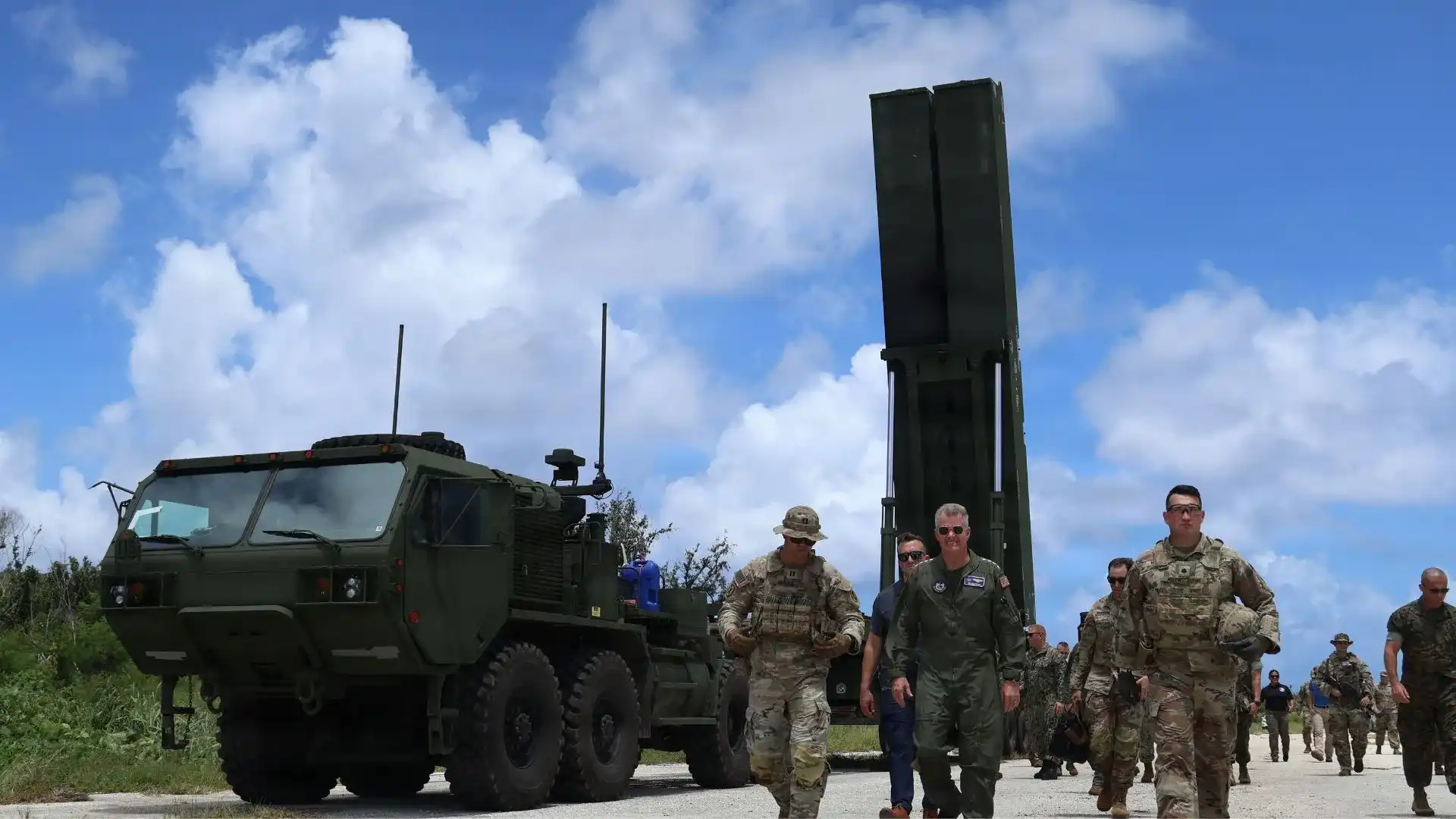
The U.S. Army has fully fielded its first Dark Eagle hypersonic battery, formally the Long-Range Hypersonic Weapon (LRHW), Lt. Gen. Frank Lozano told Breaking Defense in a November 19, 2026, interview. “It is fully fielded. It is ready to go,” said Lozano, the service’s Portfolio Acquisition Executive (PAE) for Fires, describing the battery as a globally deployable and employable warfighting capability. Its four launchers carry eight missiles able to strike targets up to 1,725 miles (2,775 km) away. He declined to say when or where the battery reached that status.
The declaration closes a fielding effort that ran about three years behind schedule. The Army originally planned to field the first battery in 2023, but testing setbacks, including a mechanical problem with the launcher, forced a delay. A revised September 2025 target was also missed, and as recently as October 2026 the program office told Bloomberg training, sustainment and readiness work remained before it could declare the system fully fielded. Asked whether that statement was inaccurate, Lozano said he did not “want to go so far as to say that.” He noted that some ground support equipment arrived as early as 2021, complicating any single milestone date.
Dark Eagle Hypersonic Battery Architecture and Strike Envelope
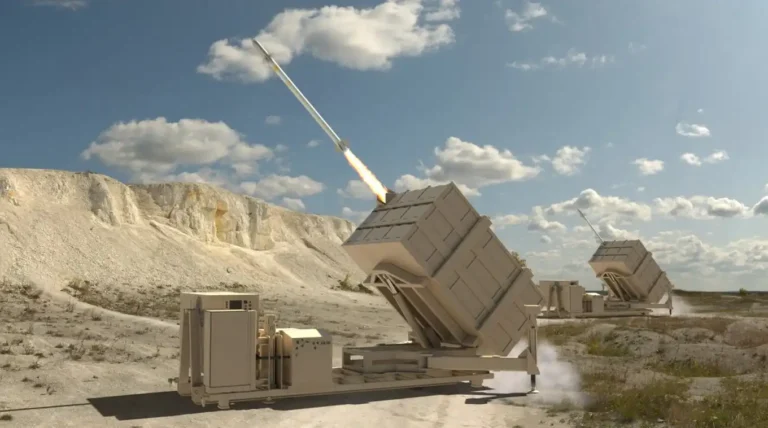
Each battery comprises four trailer-mounted transporter erector launchers (TELs), each carrying two All-Up Rounds plus Canister (AUR+C), for eight ready missiles. A Battery Operations Center (BOC) and a support vehicle complete the unit. The round pairs a two-stage solid rocket booster, developed by Lockheed Martin and Northrop Grumman, with the Common Hypersonic Glide Body (C-HGB), produced by Dynetics and derived from the Alternate Re-Entry System. After burnout, the glide body separates and maneuvers inside the atmosphere at speeds the Army puts above 3,800 mph, roughly 6,100 km/h, toward targets up to 1,725 miles (2,775 km) away.
A boost-glide trajectory stays lower than a ballistic arc and can change course in flight, compressing warning time and complicating intercepts; the Army intends it for high-payoff, time-sensitive targets. According to the Congressional Research Service, U.S. Strategic Command (USSTRATCOM) holds employment authority for LRHW missions under direction from the National Command Authority, a sign that the Pentagon treats the weapon as a strategic conventional asset rather than a theater artillery round.
Soldiers of the 7th Infantry Division (Multi-Domain Command, Pacific) trained with the system on Guam during exercise Valiant Shield 2026, held from June 22 to July 1, the first time Dark Eagle deployed to the island. From Guam, the system’s published range reaches into China’s coastal provinces. The same AUR+C is shared with the Navy’s Conventional Prompt Strike (CPS) program, destined for Zumwalt-class destroyers and later Virginia-class submarines. The two services last flew the common missile from Cape Canaveral Space Force Station, Florida, on March 26, 2026.
Production Bottlenecks Shape the Second and Third Batteries
Industrial capacity is now the program’s pacing constraint. The July 2026 Government Accountability Office (GAO) annual weapon systems assessment found that the Army and Navy paused production to address problems identified in testing, and that prime contractor Lockheed Martin continued to experience issues at its facility, including missing, inconsistent and unclear work standards for missile production. A separate GAO review published July 17, 2026, assessed Lockheed’s line at six to seven rounds per year against a target of 12, with that output shared between the Army and Navy. The annual assessment also found the second LRHW battery’s delivery slipping at least six months beyond plan.
Lozano declined to detail the manufacturing problems but called for tougher component qualification testing of solid rocket motors, integrated guidance sections, inertial navigation units, and seekers and seeker components. Citing operational security, he gave no dates for the next two batteries but said the Army is “already over halfway through production” of the third and expects both to reach full capability faster than the first. In its fiscal 2025 annual report, the Pentagon’s test office said the Army intends to field the two additional batteries by the fourth quarter of fiscal 2028.
Lozano also signaled a possible shift in the program’s industrial model. He said he would like to have two or three vendors in production against a single requirement, so the Army can shift purchases if one supplier hits quality problems. A separate scaled hypersonics effort aims to fill the gap between Dark Eagle and cheaper, shorter-range systems such as Castelion’s Blackbeard; no vendors or figures have been disclosed.
Analysis: The Army now has the first U.S. ground-based hypersonic strike capability in service, but eight missiles do not constitute a deterrent force. With joint Army-Navy production running at roughly half the required rate, magazine depth rather than technology defines how much weight Dark Eagle carries in Indo-Pacific planning. With no disclosed fielding date, the milestone is also partly definitional, and the Pentagon’s test office said in March 2026 that data were still insufficient to assess operational effectiveness, suitability and survivability. Lozano’s multi-vendor push amounts to an admission that single-source dependence on Lockheed Martin is the program’s main structural risk.
The next indicators are delivery dates for the second and third batteries, the pace at which Lockheed’s line approaches 12 rounds per year, and any formal solicitation opening LRHW production to additional suppliers. Operational test results under the Master Test Strategy approved in October 2025 will determine whether Dark Eagle matures from a single fielded battery into a sustained long-range fires capability.