The U.S. Navy’s Gray Flag 2026 large-force test event wrapped up on September 25, 2026, at Naval Base Ventura County Point Mugu, California, after participating aircraft flew more than 750 sorties aimed at exposing integration failures before fleet aviators encounter them on deployment. The Navy describes this year’s iteration as the largest in the event’s history.
The sortie count tops the roughly 600 flown at Gray Flag 2024 and the more than 500 flown in 2025. The two-week 2026 event drew more than 3,000 participants from more than 150 organizations, and aircrews logged more than 2,000 flight hours against hundreds of multi-domain test objectives for the fleet and joint force. The growth tracks a problem no single platform program can solve alone: whether aircraft, weapons, communication systems and networks from different services and allies can pass data under realistic conditions.
How Gray Flag 2026 Tested Joint and Allied Data Exchange
Naval Test Wing Pacific and Air Test and Evaluation Squadron (VX) 9 hosted the event and led test execution alongside the Naval Air Warfare Center Weapons Division (NAWCWD), which manages the Gray Flag program and operates the 36,000-square-mile instrumented Point Mugu Sea Range. NAWCWD commander Rear Adm. Keith Hash said the range, combined with neighboring ranges, allows new systems to be tested the way the joint force will employ them, so problems are found and fixed at Point Mugu rather than in the fleet.
Royal Australian Air Force (RAAF), Royal Canadian Air Force and Royal Air Force personnel joined U.S. Navy and U.S. Air Force test teams, supported by surface and subsurface participants. On a single day, 78 aircraft launched for one test event, a Gray Flag record, and Point Mugu pumped more than 1.3 million gallons of jet fuel over the two weeks.
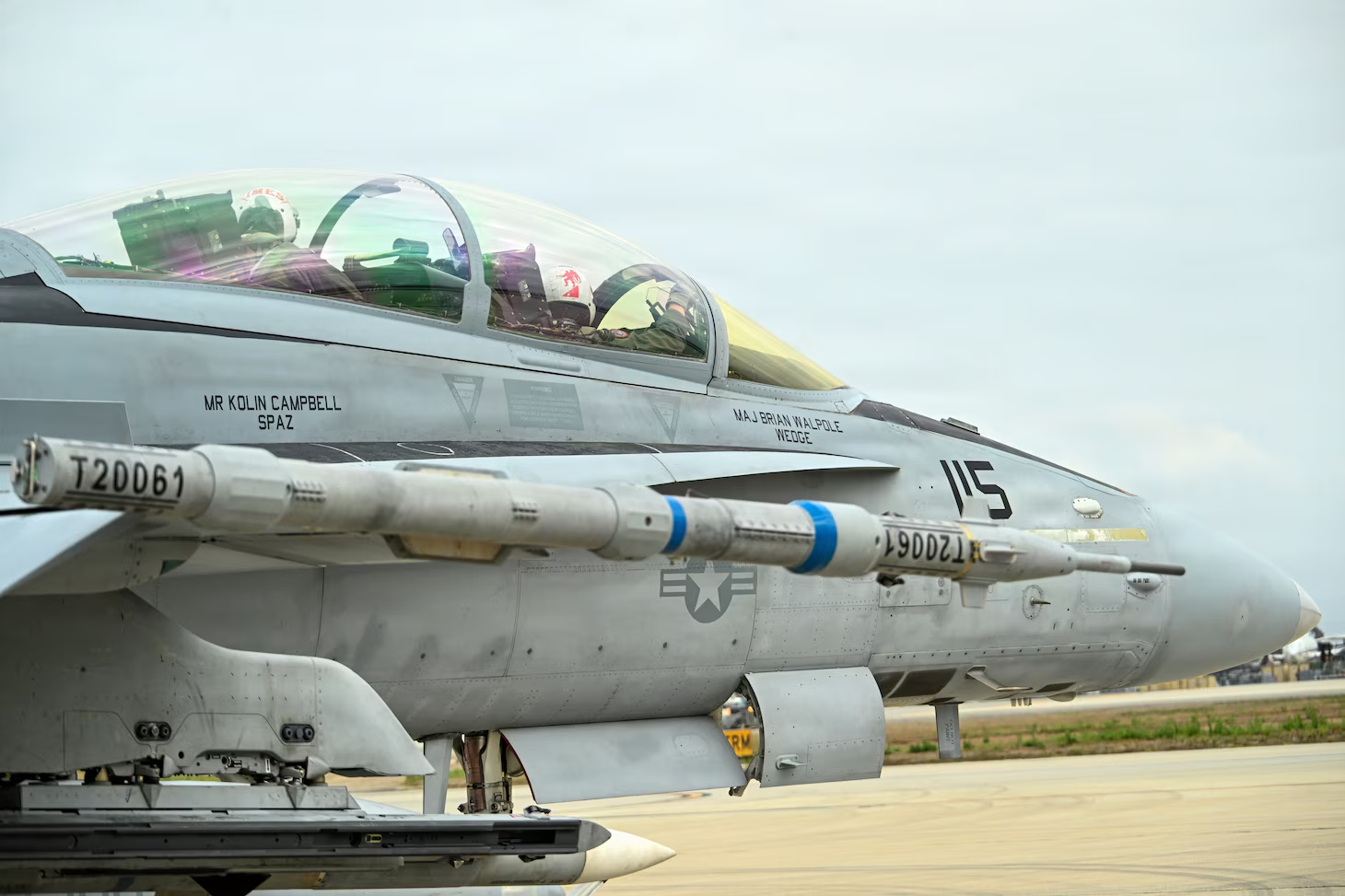
Official imagery released by NAWCWD shows F-35 Lightning II fighters operating near Point Mugu, an F/A-18F Super Hornet assigned to Air Test and Evaluation Squadron (VX) 31, and E-2D Advanced Hawkeyes detached from Air Test and Evaluation Squadron (VX) 1 to support the event. The E-2D carries particular weight in an interoperability test: publicly available specifications indicate the aircraft pairs the AN/APY-9 UHF-band radar with the Cooperative Engagement Capability, making it the central airborne node of the Navy’s Naval Integrated Fire Control-Counter Air architecture.
The Navy did not disclose which specific systems, software builds, datalinks or weapons were under test, and it has not released results from individual test objectives.
Closing Joint Interoperability Gaps Before Systems Reach the Fleet
Capt. Christopher Putre, commodore of Naval Test Wing Pacific, said simulations model the links between platforms as working as designed, which means they can miss failures that only appear when data must cross between aircraft in flight. Until those links are exercised in live scenarios, he said, the force cannot know they will hold in a joint fight.
Marine Lt. Col. Timothy Burchett, commanding officer of VX-31, said those links are hardest to maintain when crews arrive somewhere new, especially on deployment. His China Lake-based squadron is one of Gray Flag’s founding units. Testing alongside partner nations lets teams correct problems or develop workarounds so fleet aviators are, in his words, “lethal from day one.” The goal, Burchett said, is solid joint interoperability on the first attempt.
Adam Madson, Gray Flag program manager at NAWCWD, faced that problem as an EA-18G Growler pilot at Clark Air Base in the Philippines, where he had to work out how to network with U.S. Air Force units and communicate with a ship. Madson said a flaw discovered after delivery forces new training and aircrew workarounds. He described Gray Flag as the last point where testers can still change a system before it reaches the fleet.
For allied participants, the value sits further upstream. Wing Commander Trent Baldry, commanding officer of the RAAF’s No. 1 Squadron, which operates the F/A-18F Super Hornet from RAAF Base Amberley, Queensland, according to publicly available information, said Gray Flag gives Australia interoperability insight it could not generate alone. He added that the event informs Australian requirements for future projects and platform upgrades.
Analysis: Gray Flag’s expansion reflects a shift in where naval aviation risk now sits. Each platform, from the F-35 to the E-2D, runs its own established test program; the failure points increasingly lie in the seams between them, across service networks and allied systems procured on separate timelines. Madson’s Clark Air Base example is instructive: dispersed operations in the Western Pacific will put Navy, Air Force and allied assets on unfamiliar networks at short notice, the exact condition Burchett identified as most demanding. Baldry’s comment also indicates the event now functions as a requirements tool for partners, not only a verification venue for U.S. programs. That pushes interoperability earlier in the acquisition cycle, where corrections cost less than fleet-level workarounds and retraining.
Analysts will now work through the event’s petabytes of test data, which Madson said will inform the tactics aviators fly and the specifications engineers test against. Putre noted that a test falling short still counts as a success if the team knows why and can point engineers to the fix. The Navy has not said which programs will receive changes from this year’s findings, or on what timeline. Gray Flag runs annually at Point Mugu, and the 2027 iteration will show whether this year’s growth in sorties and participation holds.