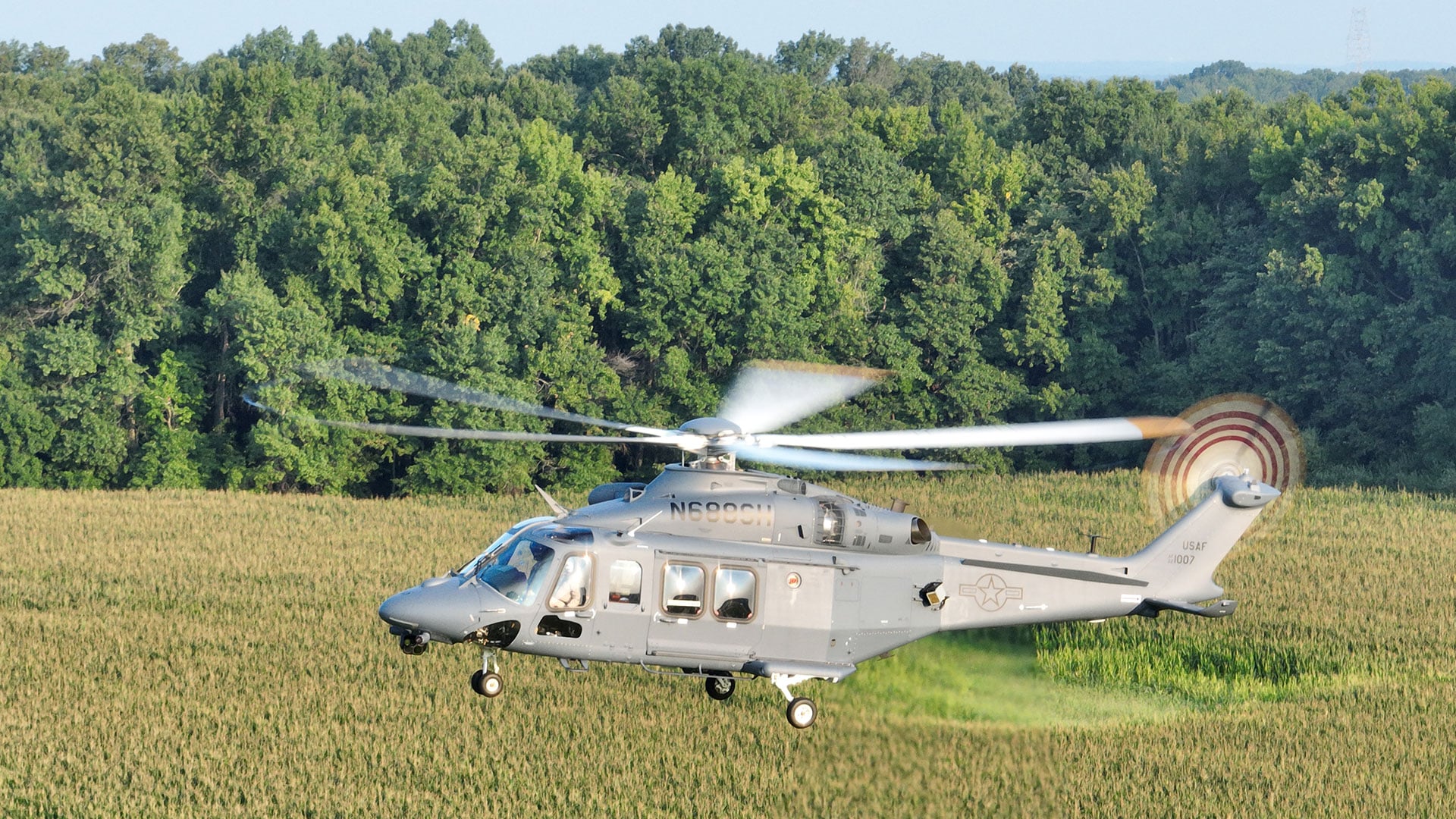
The U.S. Air Force has ordered four more MH-139A Grey Wolf helicopters from Boeing in the program’s first full-rate production (FRP) award, the company announced on September 29, 2026. The contract, awarded September 25 and valued at roughly $85 million including sustainment work, according to Boeing, raises the number of aircraft under contract to 42. Boeing has delivered 27 helicopters to date, including 20 low-rate initial production (LRIP) airframes, and expects to deliver the new lot in 2028 or 2029.
The order follows two milestones cleared earlier in 2026. The first was the FRP decision, which slipped from a September 2025 target. The second was Initial Operational Capability (IOC), which Air Force Global Strike Command (AFGSC) declared effective August 10. The Grey Wolf replaces the UH-1N Huey, which has flown the intercontinental ballistic missile (ICBM) security mission for more than five decades. The Air Force selected the Boeing and Leonardo team on September 24, 2018, under a contract with a $2.4 billion ceiling for up to 84 aircraft. Certification problems delayed the program, and the FY2025 budget dropped the VIP transport role and cut the buy from 80 to 42 helicopters. The resulting unit cost growth triggered a Nunn-McCurdy breach. A later Pentagon review restored 14 aircraft, setting the program of record at 56 in the FY2026 budget request.
Grey Wolf Helicopter Performance, Survivability and Mission Systems
The MH-139A is a militarized derivative of the Leonardo AW139, a dual-piloted, twin-engine medium utility helicopter. Leonardo builds the airframe at its Northeast Philadelphia facility. Boeing, as prime contractor, procures and integrates the military mission equipment and supports the fleet after delivery. Power comes from two Pratt & Whitney Canada PT6C-67C turboshafts under Full Authority Digital Engine Control (FADEC).
The Air Force’s key performance parameters required a 135-knot cruise speed, at least three hours of endurance and a minimum unrefueled range of 225 nautical miles. A current Air Force base fact sheet lists a maximum cruise speed of 146 knots, a maximum speed of 167 knots and a range of 410 nautical miles. AFGSC states the Grey Wolf is nearly 50 percent faster than the UH-1N and carries twice as many troops. Earlier service publications cited a cabin 30 percent larger than the Huey’s.
For survivability, the engines sit in turbine burst containment boxes and use directed exhaust to reduce the infrared signature. The aircraft carries chaff and flare dispensers, a missile warning system, ballistic protection for the cockpit and cabin, and crashworthy, self-sealing fuel tanks. AFGSC aircraft can be armed with cabin-mounted 7.62 mm M240 machine guns. The open-architecture glass cockpit integrates weather radar, enhanced ground proximity warning and military UHF and satellite communications.
The speed and range figures translate into response time across the 20th Air Force’s missile complex, which spans roughly 33,600 square miles of dispersed launch facilities. Developmental testing flagged several problems: crosswind and low-visibility limitations, debris ingestion in hover and mission equipment deficiencies. Open-source program assessments still point to fixes for the intercom and machine-gun mounts.
MH-139A Fielding Plans From Malmstrom to the Sentinel Transition
The path to IOC ran through the 582nd Helicopter Group. The 550th Helicopter Squadron flew the first Initial Operational Test and Evaluation (IOT&E) sortie in January 2025, and IOT&E concluded in June 2025. The Grey Wolf flew its first operational Minuteman III convoy security mission in January 2026. Malmstrom Air Force Base, Montana, was the first operational location. Minot Air Force Base, North Dakota, receives aircraft from the third production lot, and F.E. Warren Air Force Base, Wyoming, completes the three missile wings. The Air Force Reserve’s 908th Flying Training Wing at Maxwell Air Force Base, Alabama, hosts the formal training unit.
Funding now sets the pace. The Air Force requested $253 million in FY2027 for four airframes. A draft of the FY2027 National Defense Authorization Act would add $128 million and four more aircraft, for $380 million covering eight. Kathleen Jolivette, vice president and general manager of Vertical Lift Programs at Boeing Defense, Space & Security, said the FRP milestone “validates key readiness levels for Grey Wolf and supports the service’s fielding plans to secure vital national assets across the country’s strategic missile fields.”
AFGSC also ties the helicopter to the LGM-35A Sentinel program. As Sentinel facilities come online and Minuteman III sites are phased out, the command says the Grey Wolf’s speed, range and modern command and control systems will be crucial to maintaining continuous security coverage.
Analysis: The first FRP lot validates the design, not the production rate. Four-aircraft lots keep unit costs elevated, the same dynamic that pushed the program into a Nunn-McCurdy breach after the 2024 cut. With 42 helicopters on contract against a 56-aircraft objective, the remaining 14 depend on FY2027 and later appropriations. That gap carries operational weight. The Huey cannot leave the missile fields until all three wings and the training pipeline are fully equipped. The security burden also grows rather than shrinks while Sentinel construction overlaps with Minuteman III operations, a transition expected to run well into the 2030s.
Boeing expects to deliver the FRP lot in 2028 or 2029. The Air Force has not published a date for Full Operational Capability or for the UH-1N’s final retirement from the missile fields. The next decision point is final FY2027 authorization and appropriations. Whether Congress funds four or eight aircraft will determine how quickly the remaining helicopters in the program of record reach contract.