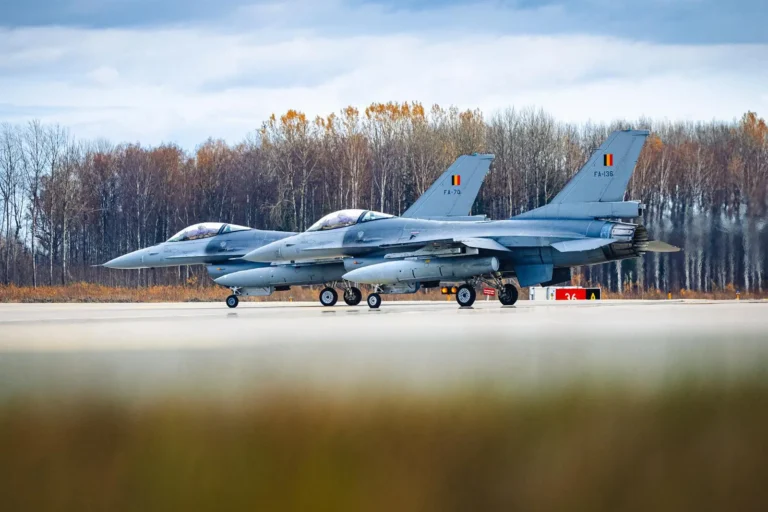
The U.S. Air Force has awarded Northrop Grumman Systems Corp. a $79,608,480 contract modification for Active Electronically Scanned Array (AESA) radars for its F-16 fleet, pushing the cumulative face value of the underlying contract past $2 billion. Announced by the Department of War on November 13, 2026, modification P00191 to contract FA8615-17-C-6047 raises the total to $2,061,087,012 from $1,981,478,532. Work will be performed in Linthicum Heights, Maryland, and is expected to be completed by December 31, 2027. The Air Force Life Cycle Management Center (AFLCMC) at Wright-Patterson Air Force Base, Ohio, is the contracting activity.
The radar is the AN/APG-83 Scalable Agile Beam Radar (SABR), the core sensor in the Air Force plan to keep its F-16 Fighting Falcon fleet combat-relevant into the 2040s. The contract began in May 2017 as a $243.9 million urgent buy of 72 radars for Air National Guard F-16s, driven by a U.S. Northern Command (NORTHCOM) Joint Emergent Operational Need for fighters able to track small radar cross-section threats such as cruise missiles in the homeland defense mission. Nine years later, it carries more than eight times that value.
How the $79.6 Million F-16 AESA Radar Award Is Funded
The full $79.6 million is obligated at award, drawn from five appropriations spanning three fiscal years. Procurement accounts make up $65,392,680, or roughly 82 percent of the action: $35,937,544 in fiscal 2026 funds, $19,688,883 in fiscal 2027 funds and $9,766,253 in fiscal 2025 funds. The remaining $14,215,800 is research, development, test and evaluation (RDT&E) money, split between $11,372,640 in fiscal 2026 and $2,843,160 in fiscal 2027.
The procurement-heavy mix points to hardware, but the announcement does not state how many radars the modification buys. The RDT&E total of $14,215,800 also matches the full value of two earlier modifications to the same contract, P00144 in March 2025 and P00178 in June 2026, although both of those mixed procurement and RDT&E funds. The Air Force has not publicly detailed what the RDT&E line funds.
In December 2019, the Air Force added about $1 billion for up to 372 radars, with work then expected to run to May 2027. The vehicle stood at $1.51 billion by April 2023, $1.68 billion in March 2025 and $1.84 billion in June 2026, meaning more than $200 million has been added in roughly five months. The contract is also not radar-only. In April 2026, AFLCMC used it for a $30,617,137 modification (P00172) to Northrop Grumman’s Rolling Meadows, Illinois, operation to complete the Spiral 1 development phase of radio frequency compatibility work for the F-16 Integrated Viper Electronic Warfare Suite (IVEWS). Two more IVEWS modifications followed on the same contract in September 2026: $87,417,804 (P00188) for low-rate initial production and $36,987,335 (P00187) for the Big Iron software effort. Together, those two September awards total $124.4 million, more than half of the growth since June. The $2 billion total therefore includes significant electronic warfare development and production work beyond radar procurement.
APG-83 SABR Architecture and the Shift From APG-68
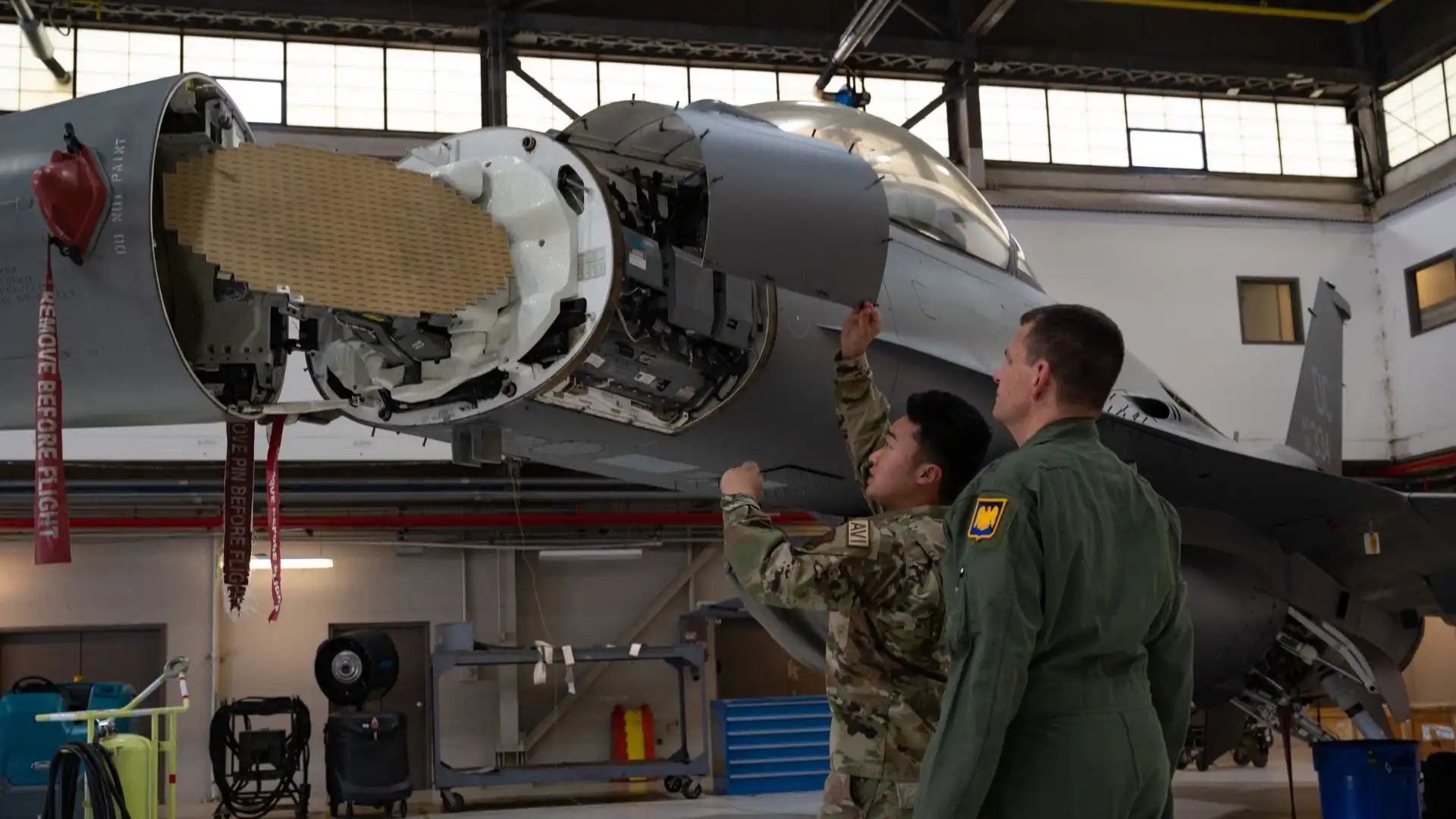
The APG-83 replaces the mechanically scanned AN/APG-66 and AN/APG-68 pulse-Doppler radars on legacy F-16s. Instead of a gimballed dish sweeping back and forth, it uses a fixed array of solid-state transmit/receive modules that steer the beam electronically. Removing the mechanical scan allows near-instantaneous beam repositioning and interleaved modes: the radar can maintain tracks on multiple air targets while generating high-resolution synthetic aperture radar (SAR) ground maps and tracking moving surface targets. According to Northrop Grumman, the design draws on technology from the AN/APG-77 on the F-22 Raptor and the AN/APG-81 on the F-35 Lightning II.
The company says SABR fits in the F-16 nose without changes to the aircraft’s structure, power or cooling. That drives the economics: radars can be installed at unit level, as the 480th Fighter Squadron at Spangdahlem Air Base, Germany, did in 2022 when it became the first active-duty squadron to field the upgrade. The radar is software-defined, allowing new modes through software updates without hardware changes, and is designed to operate alongside IVEWS for simultaneous detection and self-protection. For NORTHCOM, the operational value lies in holding tracks on small, low-flying targets against ground clutter; in theater, it adds electronic protection and longer-range targeting for beyond-visual-range engagements. Neither the Air Force nor Northrop Grumman has released detection ranges or module counts.
PoBIT Fleet Plan as APG-83 Production Passes 1,000 Units
Beyond the initial homeland defense buy, the APG-83 is central to the Post Block Integration Team (PoBIT) effort that AFLCMC announced in February 2022. PoBIT bundles up to 22 modifications for 608 Block 40/42 and Block 50/52 F-16s, involving six major commands, more than 18 bases and contracts totaling approximately $6.3 billion. The APG-83 is the lead item, alongside a Center Display Unit, an upgraded Link 16 datalink, a new mission computer and IVEWS.
The quantity math remains opaque. The 372-radar ceiling set in 2019 falls well short of 608 aircraft, and recent announcements have not said how many radars the contract now covers. Production itself is well established: Northrop Grumman delivered its 1,000th APG-83 on May 19, 2026, from its Baltimore facility. That total includes radars for export F-16V upgrades, with Taiwan as launch customer, and for new-build F-16 Block 70 and Block 72 aircraft, which carry the APG-83 as standard.
Analysis: Crossing $2 billion matters less as a milestone than as a picture of how the Air Force is funding fourth-generation relevance: incrementally, through a single contract vehicle that has absorbed an urgent homeland defense buy, a fleet-wide retrofit and related electronic warfare development and production. That approach keeps radars flowing without a new program start, but it obscures unit counts and unit cost, making progress toward 608 aircraft hard to track from public data. With the F-16 set to provide much of the service’s fighter mass into the 2040s, the APG-83 is effectively the sensor baseline for the service’s largest fighter fleet, and its shared configuration with export Vipers strengthens interoperability with allied F-16 operators.
Work under P00191 runs through December 31, 2027, while earlier modifications such as P00144 and P00178 carry completion dates of May 31, 2031, well beyond the May 2027 date attached to the 2019 expansion. The next indicators to watch are whether AFLCMC raises the radar quantity ceiling or awards a follow-on vehicle for the remaining PoBIT aircraft, how fiscal 2027 procurement funding is executed, whether further $14.2 million increments continue, and how much of the vehicle’s future growth goes to IVEWS rather than radars.