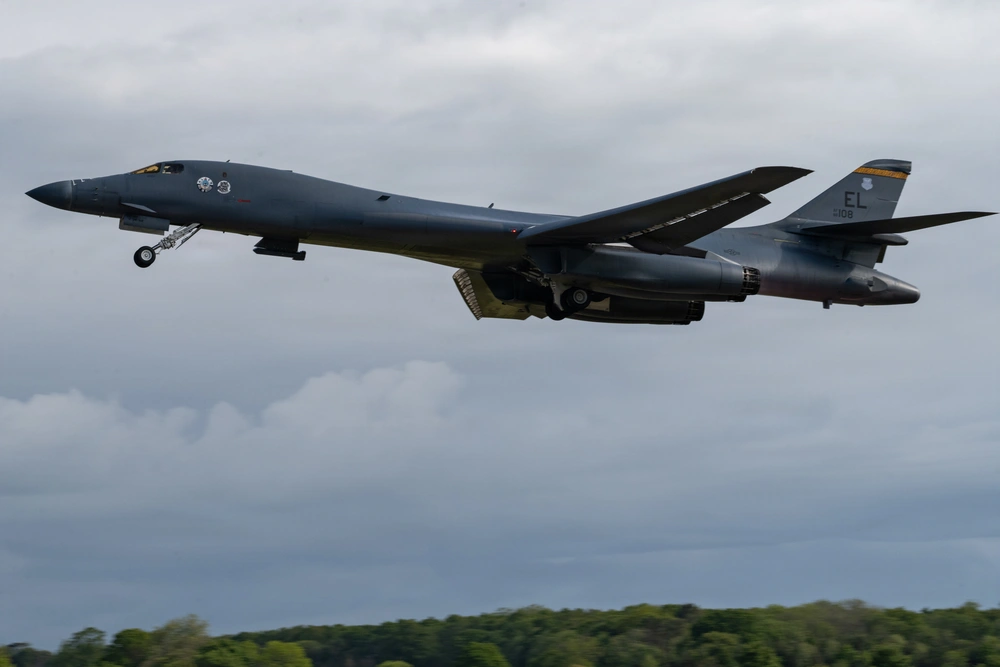
The United States has withdrawn every bomber it had deployed to RAF Fairford in Gloucestershire, England, the Pentagon confirmed on October 4, 2026, one week after British counterterrorism police disrupted what US and UK officials describe as an Iran-linked plot against the base. The departing force comprised 12 B-1B Lancers, the last American heavy bombers at the airfield after six B-52 Stratofortresses left earlier in the year.
Fairford has served as the primary European launch point for US bomber operations in the war with Iran. London initially refused to let Washington fly strike sorties from the base, then, after Iranian attacks on British allies and interests in the Gulf, approved what it termed defensive missions, including strikes on Iranian missile sites targeting shipping in the Strait of Hormuz. In July, the Islamic Revolutionary Guard Corps (IRGC) declared that any base used for aggression against Iranian territory was a “legitimate target” for its forces.
RAF Fairford Withdrawal Follows Suspected Iran-Linked Attack Plot
Police arrested five London men aged 23 to 25 in the early hours of September 27, after three vans were reported heading toward the base. Officers found quantities of fuel but no explosives. The men were held on suspicion of explosives offenses, then of preparing terrorist acts, before being released on police bail; one member of the group had reportedly alerted police himself. On October 1, counterterrorism officers arrested a sixth suspect, a 25-year-old UK-Iranian dual national, on suspicion of preparing terrorist acts. He has also been bailed.
Prime Minister Andy Burnham said on September 30 that there were “strong indications” of Iranian involvement. A senior US official has said an IRGC branch recruited UK nationals for a multi-step operation, including a diversion in a nearby neighborhood, intended to destroy bombers and kill personnel. Some British officials question how sophisticated the plan was. Tehran denies any role and summoned the British ambassador.
Neither the Pentagon nor US European Command (EUCOM) has stated a reason for the move. The Pentagon said operational security had precluded confirming the redeployment in real time, while US officials speaking on background linked it to security concerns. British government sources have not disputed that it responded to the Fairford incident, describing a military decision taken at the operational level and communicated directly to UK counterparts. The UK Ministry of Defence declined to comment.
B-1B Lancer Payload, Range, and the Cost of CONUS Launches
The 12 aircraft amount to roughly a quarter of a B-1B fleet of about 45 airframes, according to publicly available Air Force data. At least three had landed in South Dakota, home of the 28th Bomb Wing at Ellsworth Air Force Base, by October 4. The split between Ellsworth and the 7th Bomb Wing at Dyess Air Force Base, Texas, has not been confirmed.
Publicly available specifications indicate the B-1B is a four-crew, variable-sweep bomber powered by four General Electric F101-GE-102 afterburning turbofans, each producing more than 30,000 pounds of thrust in afterburner, for a top speed of about Mach 1.2 and a maximum takeoff weight of 477,000 pounds. Its three internal weapons bays carry the largest conventional payload in the Air Force inventory: up to 24 GBU-31 2,000-pound Joint Direct Attack Munitions or 24 AGM-158 Joint Air-to-Surface Standoff Missiles, a family that includes the extended-range JASSM-ER and the AGM-158C Long Range Anti-Ship Missile. The Integrated Battle Station upgrade added a Link 16 datalink and modernized cockpit displays, and crews routinely fly with the Sniper Advanced Targeting Pod.
Distance is where the withdrawal bites. The great-circle distance from Fairford to Tehran is about 4,500 kilometers; from Ellsworth it is roughly 10,800 kilometers, and from Dyess nearly 11,900 kilometers. Sorties launched from the continental United States (CONUS) against Iranian targets therefore more than double transit time, multiply aerial refueling requirements, and reduce sortie generation per airframe. The Pentagon says B-1, B-2 and B-52 crews “remain ready to deliver precision global strike capabilities” from CONUS. The June 2025 B-2 raid on Iranian nuclear sites, flown from Whiteman Air Force Base, Missouri, on missions of roughly 37 hours, proved the concept for a single strike package, not for a sustained campaign.
Force Protection Gaps at US-Hosting Air Bases in England
RAF Fairford’s value rests on a runway of roughly 3,000 meters, per publicly available airfield data, and on infrastructure supporting B-1B, B-2 Spirit and B-52 operations. Those same attributes make it a fixed, high-value target. British defense officials have since said protection around military bases must be upgraded, particularly against drones. Security alert levels have been raised at RAF Lakenheath, home to the 48th Fighter Wing’s F-35A and F-15E squadrons, and at nearby RAF Mildenhall, which hosts US Air Force KC-135 tankers.
The American presence remains politically contested in Britain. Secretary of State Marco Rubio said the incident clearly involved a foreign actor, while President Donald Trump publicly criticized the release of the suspects on bail, a step police described as an investigative decision.
Analysis: Whatever the plot’s real sophistication, a ground threat built around vans and fuel, with no explosives recovered, appears to have moved roughly a quarter of the B-1B fleet off RAF Fairford, its most efficient forward base, in the middle of an active campaign. If the Iranian link is confirmed, Tehran will have produced a measurable change in US force posture without a single munition reaching the airfield. For Washington, CONUS basing protects airframes but trades strike tempo for tanker hours and crew endurance. For London and every European ally hosting US strike assets, the episode reframes base security as a layered problem spanning counterintelligence, proxy recruitment and counter-drone defense, not perimeter policing alone.
The Pentagon has not said whether bombers will return to Fairford, and EUCOM described overseas bomber deployments as routine. The next markers are the UK counterterrorism investigation, including whether any of the six bailed suspects faces charges, the scope of British base-protection upgrades, and whether US Bomber Task Force rotations through England resume while the war with Iran continues.