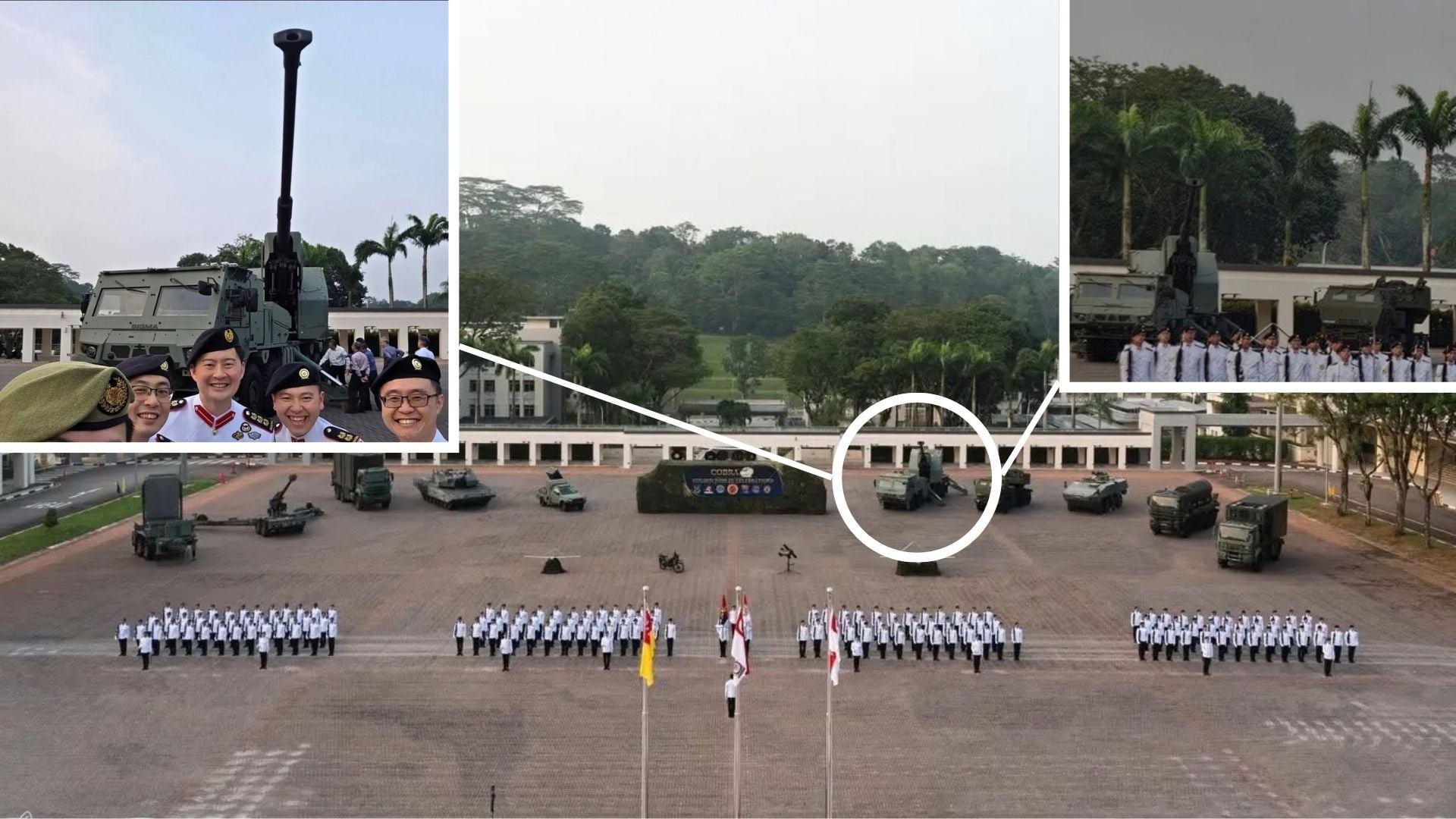
The Singapore Army has revealed two previously undisclosed fire-support systems: a fully automated 155mm truck-mounted howitzer that open-source imagery identifies as Elbit Systems’ SIGMA, and a soft-skinned Precision Land Shooter carrying a multi-canister missile pack. Both appeared alongside the Leopard 2SG main battle tank and the High Mobility Artillery Rocket System (HIMARS) in images of the Golden Jubilee parade marking the 50th anniversary of the 6th Singapore Division/Headquarters Sense and Strike, released on October 2, 2026.
Singapore’s Ministry of Defence (MINDEF) confirmed the roles of both systems on October 4 but disclosed neither manufacturers nor specifications. According to MINDEF, the truck-mounted gun is fully automated, will become the Army’s next-generation howitzer, and will progressively replace the Singapore Self-Propelled Howitzer (SSPH) 1 Primus and the Field Howitzer 2000 (FH-2000), both produced by ST Engineering. The clearest procurement trail dates to November 15, 2021, when Elbit announced a $106 million contract to supply SIGMA howitzers to an unnamed Asia-Pacific customer over five years. Neither Singapore nor Elbit has publicly linked that contract to the guns now on display.
The identification also rests on MINDEF’s own programme record. In 2018, MINDEF described the Next Generation Howitzer as a fully automated 155mm weapon operated by a three-man crew, far fewer than the FH-2000 detachment; in 2019, Defence Minister Ng Eng Hen specified a self-propelled 155mm/52-caliber system; and in 2022, the Army said deliveries were expected in 2024. Those parameters match the SIGMA as Elbit markets it, and the 2024 target falls within the five-year window of the November 2021 contract.
What Elbit’s SIGMA Howitzer Offers: Full Automation, Three-Person Crew
The SIGMA mounts a 155mm/52-caliber gun in an uncrewed, all-electric turret at the rear of a 10×10 wheeled chassis, with an armored cabin forward. Elbit’s published specifications list a crew of two to three who select projectiles, set fuzes, lay the gun, load, and fire without leaving the cabin. Automated magazines hold 40 projectiles, 216 modular charge units, and 45 primers, and the turret traverses 360 degrees, letting the crew shift targets without repositioning the vehicle.
Elbit rates the system at up to eight rounds per minute with Multiple Rounds Simultaneous Impact (MRSI) capability, and quotes ranges of up to 41 km with standard ammunition and up to 70 km with rocket-assisted projectiles. Moving into or out of a firing position takes approximately 30 seconds, a manual backup mode covers degraded conditions, and the chamber accepts NATO Joint Ballistics Memorandum of Understanding (JBMOU)-compliant ammunition. The Israel Defense Forces operate a configuration of the same family designated Ro’em.
These figures describe the manufacturer’s baseline, not confirmed Singapore Armed Forces (SAF) performance; Singapore’s ammunition package, fire-control integration, and local modifications remain undisclosed. The operational case rests on exposure time. Counter-battery radar and persistent drone surveillance shrink the window in which a gun can fire and survive, and a system that emplaces, fires a burst, and displaces with no crew outside the cabin addresses that problem directly.
Precision Land Shooter Resembles a Spike NLOS Launcher Configuration
The second system carries a launch pack that appears to hold nine canisters on an unarmored light truck. Its external configuration resembles launchers associated with the Spike non-line-of-sight (NLOS) family built by Rafael Advanced Defense Systems. MINDEF confirmed the vehicle’s precision-strike role but did not identify the missile.
If the identification holds, the capability is substantial. Rafael and its US partner Lockheed Martin describe Spike NLOS as an electro-optical and imaging infrared missile with a two-way radio frequency datalink that streams real-time video to the operator, allowing retargeting and mission abort in flight. Publicly available specifications indicate a ground-launched range of up to 32 km, up to 50 km from helicopters, and three warhead options. The sixth-generation variant adds salvos of up to four missiles under one operator and in-flight handover of control between platforms. Which variant, if any, Singapore has acquired is unconfirmed.
That profile would sit between the Army’s direct-fire anti-tank weapons and its HIMARS rockets: a weapon able to confirm and strike a concealed or moving target beyond line of sight with an operator watching the terminal phase. A soft-skinned truck suggests launches from beyond the target’s engagement envelope, but the proliferation of reconnaissance and attack drones leaves unprotected launchers exposed during reload and displacement.
Replacing SSPH Primus and FH-2000 With One Wheeled Fleet
The replacement plan consolidates two distinct artillery models. The Primus, developed by the SAF, the Defence Science and Technology Agency (DSTA), and ST Kinetics, entered service in 2003 as a tracked 155mm/39-caliber howitzer weighing 28.3 tonnes with a crew of four; published data credit it with about six rounds per minute out to roughly 30 km. The FH-2000, fielded in 1995, is a towed 155mm/52-caliber howitzer served by a detachment of about eight.
Against Primus, SIGMA brings a longer barrel, a smaller crew, a higher rate of fire, and wheeled road mobility, while giving up tracked cross-country performance. Against the FH-2000, the gain lies less in reach, since both use 52-caliber barrels, than in automation, crew protection, and the end of the separate gun and prime mover. The heli-portable Singapore Light Weight Howitzer (SLWH) Pegasus does not appear in the stated replacement plan. Quantities remain undisclosed, and because the contents of the 2021 Elbit award are not public, no reliable unit cost or fleet size can be derived from it.
Analysis: The pairing shows Singapore building its sense-and-strike formation around fewer, faster, and more automated shooters rather than more barrels. Since November 2020, the 6th Division has absorbed Headquarters Army Intelligence and Headquarters Singapore Artillery, and MINDEF has described its work integrating Army sensors and fires with the Republic of Singapore Air Force and the Digital and Intelligence Service. A three-person automated gun and an operator-guided NLOS missile both turn sensor data into effects with minimal manpower, a priority for a conscript force planning around shrinking national service cohorts. The limiting factor shifts from barrel length to the speed and resilience of the kill chain feeding these weapons, and to how long soft-skinned launchers survive in a drone-saturated battlespace.
Key questions remain open: the number of SIGMA guns ordered, their delivery schedule, whether the ammunition package includes rocket-assisted rounds, and the identity of the Precision Land Shooter’s missile. If the 2021 contract is Singapore’s, its five-year delivery window points to completion around late 2026. A formal commissioning ceremony, the usual venue for MINDEF disclosures on major platforms, would be the next opportunity for those details to emerge.