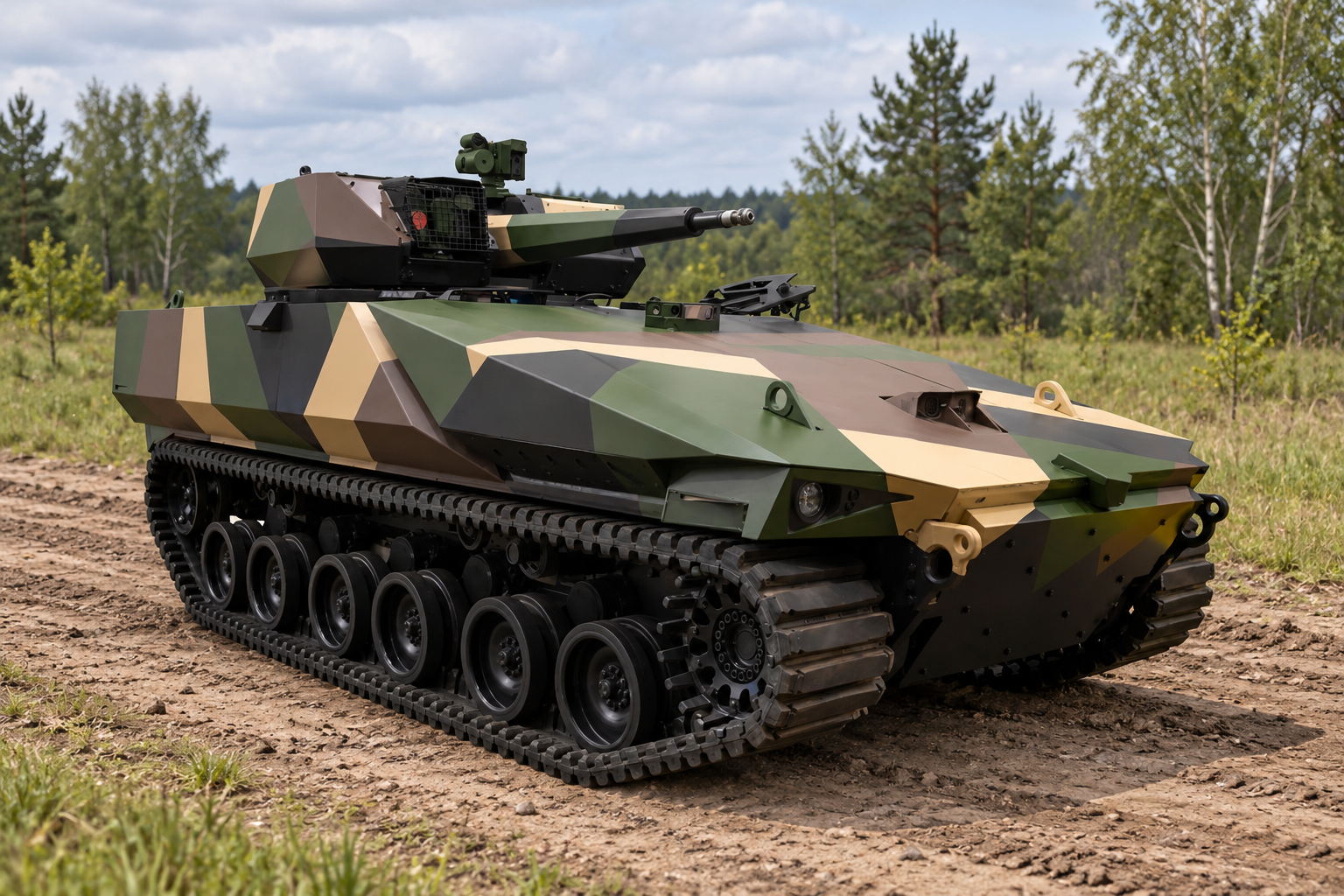
General Dynamics will show a one-eighth-scale model of its Wolf XM30 Mechanized Infantry Combat Vehicle, debut the PERCH 2.0 loitering munition kit and exhibit counter-unmanned aircraft systems (C-UAS) at the Association of the U.S. Army (AUSA) annual meeting and exposition in Washington, D.C., October 12 to 14, 2026. Four business units will exhibit, according to a company release issued October 5, 2026: Land Systems (GDLS), Mission Systems (GDMS), Ordnance and Tactical Systems (GDOTS) and Information Technology (GDIT).
The lineup lands at a sensitive moment for the Army’s Bradley replacement. GDLS delivered its first Wolf prototype to Aberdeen Proving Ground, Maryland, at the end of August 2026, days before American Rheinmetall Vehicles handed over its rival Lynx XM30. The competition continues even though Army leadership declined in February 2026 to finalize the program’s Milestone B decision, keeping a possible restructuring on the table. Most of the remaining display tracks the Army Transformation Initiative’s emphasis on drones, counter-drone defense and lighter formations.
Wolf XM30 Anchors the General Dynamics AUSA 2026 Display
GDLS presents the Wolf as a purpose-built replacement for the M2 Bradley, designed around the Army’s Modular Open Systems Approach (MOSA) for software and hardware. The company calls the vehicle born digital, with a single digital thread running from engineering through verification, production and sustainment. A shared digital model should shorten the loop between test findings and design changes if field evaluations force modifications before production.
GDLS says the scale model shows the Wolf in full for the first time, though physical prototypes are already in government hands. Per publicly available program information, GDLS is due to deliver eight vehicles: one to Aberdeen for instrumented testing and seven to Fort Hood, Texas.
Publicly available requirements set the baseline: a two-soldier crew, six dismounts, a remotely operated turret carrying the Northrop Grumman XM913 50mm cannon firing 50x228mm ammunition, a 7.62mm machine gun, an anti-tank guided missile launcher and hybrid-electric power. The jump from the Bradley’s 25mm M242 Bushmaster to a 50mm weapon with programmable airburst ammunition widens the engagement envelope against light armor and dismounts in defilade. The two-person crew shifts workload onto automation and sensor fusion, the area Fort Hood soldiers are most likely to stress. GDLS has not released combat weight, powerpack output or protection levels, the key unknowns in any comparison with the Lynx.
PERCH 2.0 and M-SHORAD Increment 4 Target the Drone Fight
PERCH 2.0 (Precision Effects & Reconnaissance, Canister-Housed) debuts at the show. Co-developed with AeroVironment, the modular kit mounts on M1A2 Abrams SEPv3 tanks and Stryker vehicles and launches Switchblade 300 loitering munitions for beyond-line-of-sight (BLOS) reconnaissance and over-the-horizon strikes. Publicly available specifications credit the Switchblade 300 with a range of roughly 10km. GDLS says the new version lets crews engage at extended range without opening hatches and reloads more easily, reflecting lessons from the Army’s Machine Assisted Rugged Sapper (MARS) event at Fort Hood in October 2025. Hatch-closed launch removes a key crew exposure point on a battlefield dense with first-person-view drones.
The maneuver short-range air defense (M-SHORAD) Increment 4 solution is GDLS’s answer to the Army’s requirement for air defense that moves with light forces. The company describes a platform-agnostic, Self-Loading Equipment Dock (SLED)-based system in light, medium and heavy variants, with sensors and effectors on remote weapon stations and Army command and control (C2) interoperability for networked or independent counter-drone operations. The release shows it on a Ford Ranger pickup. The Army’s FY2027 budget request includes $108.1 million to develop Increment 4 for Joint Forcible Entry and Mobile Brigade Combat Team (MBCT) forces, with initial operational capability targeted for late FY2029.
The F600 Leonidas pairs the Epirus Leonidas high-power microwave (HPM) weapon with a militarized Ford F600 chassis with upgraded suspension, drivetrain and power generation. It integrates with Forward Area Air Defense Command and Control (FAAD C2) and can carry kinetic effectors. The same chassis underpinned the Leonidas Autonomous Ground Vehicle unveiled with Epirus and Kodiak AI in March 2026; the release does not state whether the AUSA vehicle includes autonomy.
Assured PNT, Artillery Output and AI Round Out the Display
GDMS focuses on the transport layer behind the Army’s Next Generation Command and Control (NGC2) effort, linking its Mounted Command and Control (MC2) Hub, the PhantomLink free-space optical system and a Digital Radio Head, with the RAMPART CMOSS chassis providing edge computing. PhantomLink operates outside regulated spectrum, giving command posts a high-capacity, difficult-to-intercept link. RAMPART consolidates assured positioning, navigation and timing (A-PNT), radio and electronic warfare functions in a 3U OpenVPX chassis sized for the SINCGARS radio space. Its PNT offerings include MOHAWK, an M-Code anti-jam solution, and the GPS Source PNT Hub from the Army’s NorthStar program.
GDOTS brings the munitions industrial base: 155mm Load, Assemble and Pack capacity, Modular Artillery Charge System increments, M31A2 and Ball Powder propellants, and missile subsystems. It will also display the Iron Fist active protection system and the XM915 20mm Lightweight Gatling Gun, a C-UAS weapon designed for remote weapon stations. GDIT will demonstrate AI tools including voice-commanded drone fleet control and DOGMA, an aerial threat-detection system the company says cuts response times from minutes to milliseconds.
Analysis: The GD lineup is a bet on retrofit speed. PERCH, M-SHORAD Increment 4 and the F600 Leonidas all attach to vehicles the Army already owns or can buy commercially, which fits a service whose FY2027 M-SHORAD request of $460.9 million nearly doubles the FY2026 level. The Wolf is the exception: a clean-sheet program whose fate now depends less on GDLS engineering than on whether Army leadership restructures XM30 before production funding is committed.
The near-term test is Fort Hood, where soldier evaluations of both XM30 designs are slated to begin this fall, with operational testing at the National Training Center expected in spring 2027. A winner had been planned for 2027 before the Milestone B pause; whether that timeline holds remains unclear. For Increment 4, watch how the Army structures competition ahead of its FY2029 fielding target.