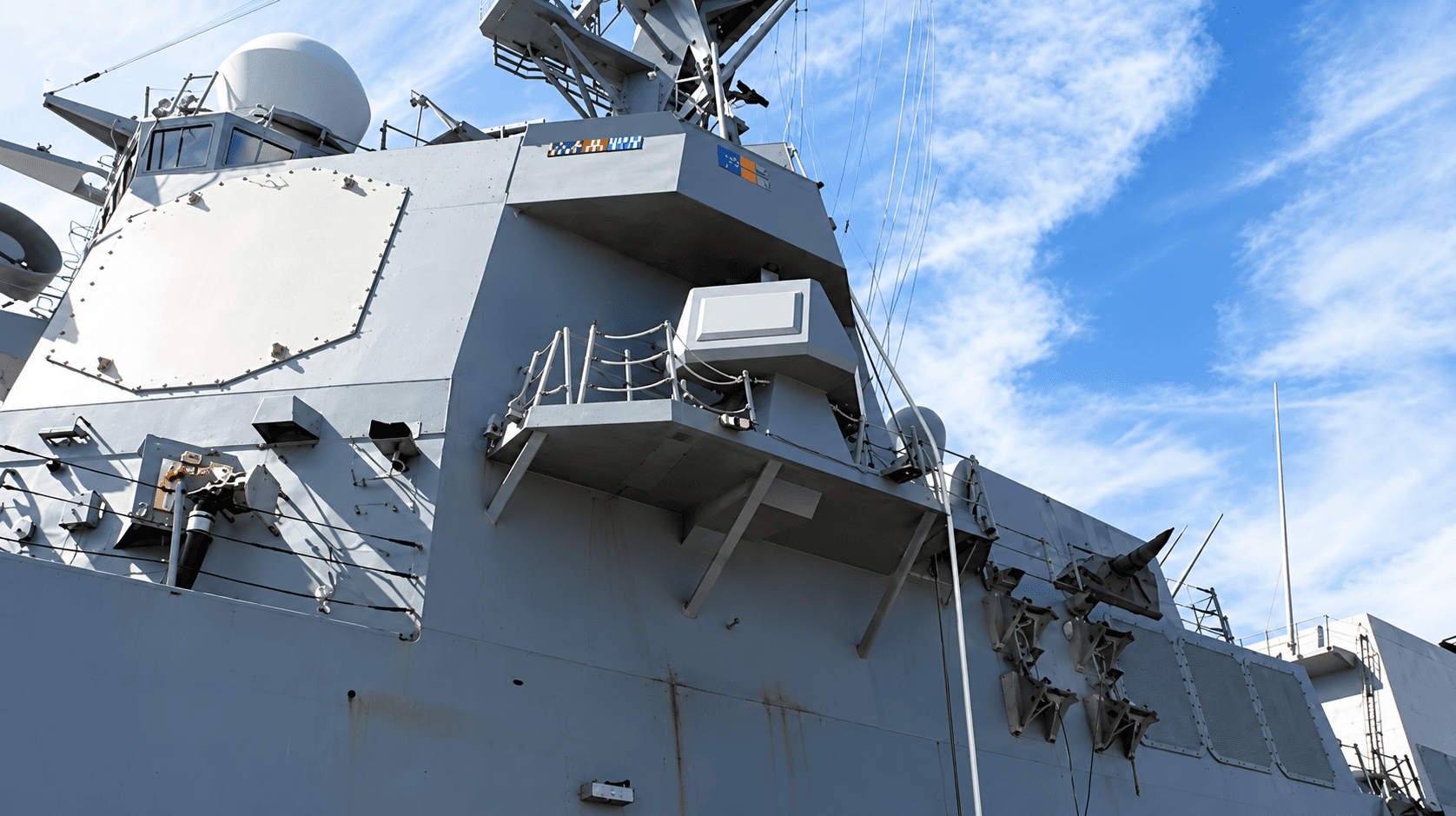
The U.S. Navy has awarded Lockheed Martin Rotary and Mission Systems a $208,962,712 firm-fixed-price modification to continue production of Surface Electronic Warfare Improvement Program (SEWIP) Block 2 AN/SLQ-32(V)6 systems, according to a Department of War announcement dated October 5, 2026. Naval Sea Systems Command (NAVSEA) awarded the action on September 30, 2026, the final day of fiscal 2026. Options in the modification would, if exercised, raise the cumulative value of contract N00024-20-C-5503 to $1,708,478,799.
The contract is the Navy’s second full-rate production vehicle for SEWIP Block 2, the increment that replaces the receiver and antenna group of the AN/SLQ-32(V) electronic warfare (EW) suite first fielded in the late 1970s. NAVSEA first awarded it on March 20, 2020, as a competitively procured, $185,025,000 follow-on deal covering the AN/SLQ-32(V)6, AN/SLQ-32A(V)6 and AN/SLQ-32C(V)6 configurations. At that time, all options would have brought the vehicle to $812,062,168, with work ending by September 2026. The new ceiling is more than double that figure, and the period of performance now runs three years longer.
SEWIP Block 2 Production Extended to 2029 Under NAVSEA Contract
Lockheed Martin will perform 78% of the work in Liverpool, New York, and 22% in Lansdale, Pennsylvania, with completion expected by September 2029. NAVSEA obligated the full amount at award from four appropriations: $129,492,886 in fiscal 2026 shipbuilding and conversion, Navy (SCN) funds (62%); $58,150,605 in fiscal 2026 other procurement, Navy (OPN) funds (28%); $20,306,407 in fiscal 2025 OPN funds (10%); and $1,012,814 in fiscal 2026 research, development, test and evaluation funds (under 1%).
The funding split carries operational meaning. SCN appropriations pay for equipment installed on ships still under construction, while OPN covers hardware for hulls already in service. A 62% SCN share indicates that most of this lot is tied to new-construction surface combatants, with the OPN portion supporting backfit installations on fleet ships. The announcement does not disclose the number of systems ordered, the receiving hull classes or a unit price, and the Navy has not released those figures. Unlike an October 2024 SEWIP Block 2 production modification, which bundled Japan’s first Foreign Military Sales purchase of the system, this action draws on Navy appropriations only.
The production record is long. Lockheed Martin won the Block 2 design and development contract in September 2009, delivered low-rate initial production units, and moved into full-rate production in September 2016. The first AN/SLQ-32(V)6 was installed aboard the Arleigh Burke-class destroyer USS Bainbridge (DDG 96), and the company reported more than 130 Block 2 units produced by late 2024. This modification keeps the Liverpool line running through the end of the decade.
How AN/SLQ-32(V)6 Underpins the SEWIP Block 3 Electronic Attack Upgrade
SEWIP Block 2 is a passive electronic support (ES) upgrade. It replaces the AN/SLQ-32’s ES antenna and ES receiver and adds an open combat system interface, giving the ship earlier detection, finer emitter analysis and more accurate threat warning against anti-ship cruise missile seekers and the targeting radars that cue them. Lockheed Martin built the design on its Integrated Common Electronic Warfare System (ICEWS) architecture, which relies on commercial off-the-shelf processing so hardware and software can be refreshed without a full redesign. Publicly available program information identifies Mercury Systems’ Echotek microwave tuners and digital receivers in the receiver chain, and the company describes Block 2 as the first sensor fully compliant with the Navy’s Product Line Architecture.
The fielded AN/SLQ-32(V)6 configuration pairs the Block 2 hardware with the High Gain High Sensitivity (HGHS) adjunct sensor developed by General Dynamics under SEWIP Block 1B3, which targets low-signature emitters that leave crews less warning time. The system exchanges data with the Aegis combat system. The compact AN/SLQ-32C(V)6, known as SEWIP Lite, targets smaller hulls, and the U.S. Coast Guard plans to bring Block 2 capability to its Offshore Patrol Cutters. The Navy has not published frequency coverage, sensitivity or direction-finding accuracy figures for any variant.
Block 2 is also the foundation for the next increment. Northrop Grumman’s SEWIP Block 3 adds a gallium nitride (GaN) active electronically scanned array electronic attack subsystem to the (V)6 architecture, creating the AN/SLQ-32(V)7. The first Block 3 system was fielded aboard USS Pinckney (DDG 91) in September 2023, and Northrop Grumman is under contract for up to 24 (V)7 systems in Hemisphere and Quadrant configurations if all options are exercised. A planned Block 4 would add electro-optical and infrared sensing, with no published schedule.
Analysis: Lockheed Martin’s Block 2 line is the load-bearing layer of the Navy’s surface EW modernization. Every AN/SLQ-32(V)7 jamming installation sits on a (V)6 electronic support suite, so the pace of Block 3 fielding depends on Block 2 deliveries as much as on Northrop Grumman’s transmitter output. Expanding a vehicle originally scoped for fiscal 2020 to 2024 buys, rather than recompeting it, favors schedule certainty over price competition. The surface fleet has reason to accept that trade after the Red Sea engagements that began in late 2023 put destroyer self-defense against anti-ship missiles to a combat test.
The next decision points are the option exercises that would carry cumulative contract value to the $1.708 billion ceiling, each subject to fiscal 2027 and later appropriations. Still unknown are the number of (V)6 systems the extended vehicle will buy, the split between new-construction and backfit installations, and whether NAVSEA will compete a follow-on production contract before work ends in September 2029. Further Foreign Military Sales orders remain possible.