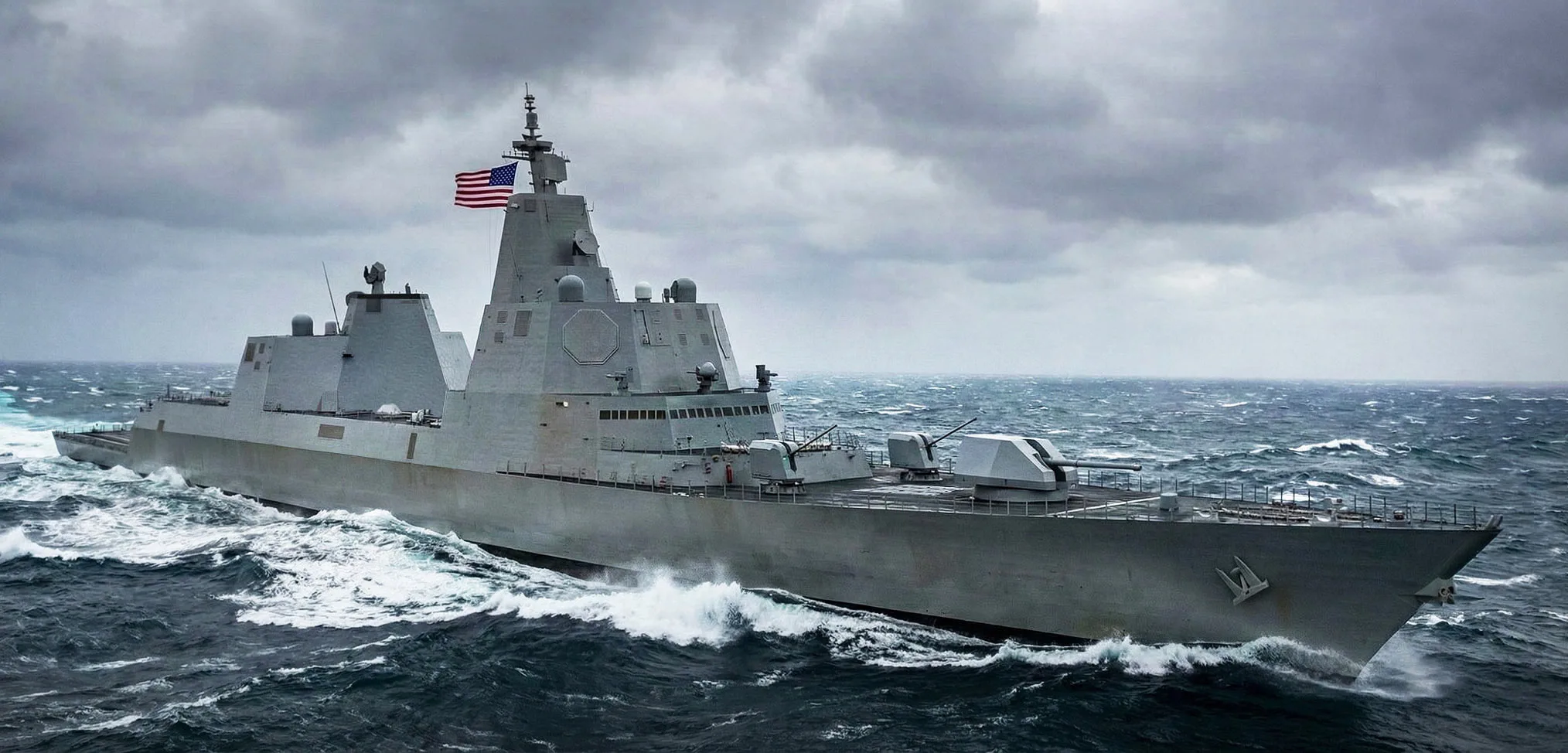
The Congressional Budget Office estimates that the US Navy’s planned Trump-class battleship program will cost $275 billion for 15 nuclear-powered ships built between fiscal years 2028 and 2056, with the lead ship, the future USS Defiant, at $23.4 billion. The figure, published August 5, 2026, runs well above the Navy’s own projection and sharpens a debate over whether a single, heavily armed capital ship fits a threat environment that increasingly rewards dispersion.
President Donald Trump announced the class on December 22, 2025, at his Mar-a-Lago estate, unveiling renderings of the USS Defiant (BBG-1) as the centerpiece of a broader Golden Fleet initiative. The program marks the first time the Navy has pursued a battleship since the Montana class was cancelled in 1943, and the first battleship in its plans since the Iowa-class USS Missouri left service on March 31, 1992. It arrives amid a widening naval balance: the People’s Liberation Army Navy fields more than 370 battle force ships, heading toward 435 by 2030, while the US Navy is set to fall to roughly 294.
Trump-class Battleship Design, Reactor, and Weapons Loadout
As currently envisioned, the Trump-class battleship displaces more than 35,000 tons, roughly three and a half times an Arleigh Burke-class destroyer, with a hull between 840 and 880 feet long and a beam of 105 to 115 feet. Those dimensions would make it the largest surface combatant in the world and the largest the Navy has built since World War II. Despite the battleship label, the ship relies on missiles rather than heavy armor and main-battery guns, placing it closer to a large cruiser or battlecruiser in traditional terms. The designation functions as branding more than technical classification.
The Navy plans to power the ship with the A1B reactor used in the Ford-class carrier, pulling through the carrier’s propulsion components, the AN/SPY-6 radar, and the Baseline 10 Aegis combat system to reduce technical risk. Reported configurations center on 128 Mk 41 vertical launch cells and 12 Conventional Prompt Strike hypersonic missiles, alongside nuclear-capable cruise missiles, anti-air, land-attack and anti-ship weapons, 5-inch guns, an electromagnetic railgun, and laser directed-energy systems. Budget documents describe the primary role as delivering high-volume, long-range offensive fires and serving as a survivable command-and-control node for manned and unmanned forces. The Navy turned to a new hull after concluding the smaller DDG(X) design could not carry the desired magazine depth alongside a gun mount, locking in the class’s size and cost from the outset.
CBO Puts the 15-Ship Program at $275 Billion
The Congressional Budget Office’s $23.4 billion estimate for the lead ship exceeds the roughly $17 billion the Navy requested for the first vessel in its fiscal 2027 budget, a gap the office attributes largely to nuclear propulsion and the ship’s size. The 14 follow-on ships would average $18 billion each in 2026 dollars, and a nuclear-powered class runs about 13 percent higher than a conventionally powered equivalent, which the office priced at $243 billion. Each battleship would therefore cost more than a Ford-class aircraft carrier, projected at roughly $13.3 billion per hull.
The office also flagged sensitivities that could drive the total higher. If displacement grows from 35,000 to 41,000 tons, per-hull cost rises about 16 percent. The plan would lift average annual procurement funding for large surface combatants from $6.9 billion under the fiscal 2025 blueprint to roughly $15.2 billion under the fiscal 2027 version. Sustaining the build rate, one battleship about every other year with two ordered back to back in fiscal 2030 and 2031, would require large surface combatant tonnage to rise by about 60 percent by 2058, which the office cautioned could strain an industry already struggling to meet existing demand.
Newport News Capacity and Unproven Railgun and Laser Systems
Nuclear-powered surface construction in the United States is concentrated at a single yard, Huntington Ingalls Industries’ Newport News Shipbuilding, which also builds the Ford-class carriers. That yard already carries pressure from carrier delays, the Columbia-class ballistic missile submarine program, and Virginia-class attack submarine production, including boats committed to Australia under the AUKUS agreement. Adding a nuclear battleship every other year concentrates further demand on the same workforce and supply chains, raising the risk of cascading delays across the carrier and submarine fleets.
The program also carries unresolved technical risk. The railgun and laser directed-energy weapons central to the ship’s offensive and defensive concept have absorbed years of development without reaching operational fielding, and the railgun was previously shelved. The Navy has acknowledged that its recurring error on past programs, including the Ford and the Littoral Combat Ship, was to begin construction before a design matured, and it says the Trump-class effort will prioritize design maturity first, adopting modular construction and tighter design-production integration drawn from Korean and Japanese shipbuilders. Congress has moved to restrict work on the class until its key weapons demonstrate maturity, and the program has not yet been authorized.
Analysis: The Trump-class battleship reopens an argument US naval doctrine had largely settled. Advocates, including Geoffrey Till of the S. Rajaratnam School of International Studies, contend that distributed lethality carries its own vulnerabilities: networked forces depend on unbroken data links that adversaries can disrupt, dispersed formations impose heavy logistics burdens, and network integration complicates allied interoperability. A large hull with deep magazines and abundant electrical power for sensors, lasers, and railguns concentrates capability that smaller platforms cannot individually match, and it speaks directly to the magazine gap with China. The counterargument is survivability. Placing $23.4 billion and hundreds of sailors in one hull creates a high-value target at a moment when anti-ship missiles, hypersonic weapons, and cheap drones have shown they can threaten major surface units, as the Black Sea has demonstrated. The open question is whether a platform built for concentration can endure a threat environment that rewards dispersion, and whether the class reflects a validated capability requirement or the political weight of its branding.
The Navy plans to award the lead-ship contract in fiscal 2028 and has requested $1 billion in advance procurement for fiscal 2027. Delivery of the USS Defiant is projected for 2036, a timeline the chief of naval operations has called realistic despite the president’s suggestion that the ship could be built in two and a half years. Because the design remains in its early stages, the displacement, magazine size, armament fit, and final supplier arrangement stay provisional. The near-term decision points are congressional authorization, maturity gates for the railgun and directed-energy weapons, and whether the Navy can hold the projected cost. Each will shape whether the Golden Fleet’s centerpiece reaches the water in its announced form.