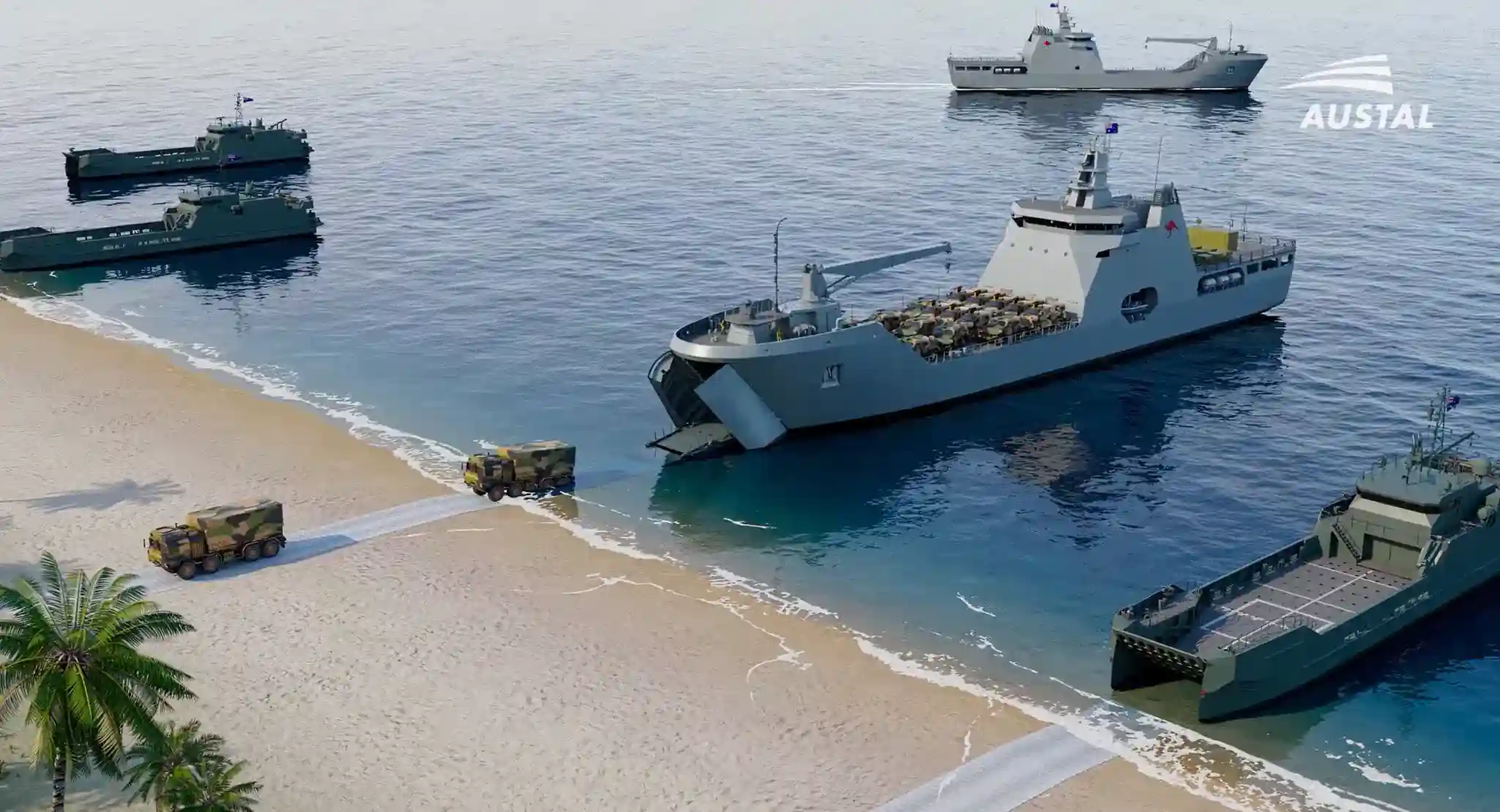
Austal Defence Shipbuilding Australia (Austal Defence Australia) has begun construction of the Australian Army’s Landing Craft Heavy (LCH), cutting steel on the first vessels at Henderson, Western Australia, in late October 2026, the Australian government announced on November 11, 2026. Canberra said the program is on schedule.
The milestone moves Project LAND 8710, the Army’s littoral maneuver program, from design into production. The government has awarded more than A$5 billion in contracts for 18 Landing Craft Medium (LCM) and eight LCH, the backbone of an Army being reshaped around amphibious operations and long-range strike under the 2024 National Defence Strategy. Canberra calls it the largest recapitalization of the Army’s littoral capability since the Second World War. The LCH restores a heavy beaching capability absent since 2014, when the last Balikpapan-class heavy landing craft left service. Minister for Defence Industry Pat Conroy said the work “marks the transition from design into delivery.”
Landing Craft Heavy Design: Damen LST100 Built at Henderson
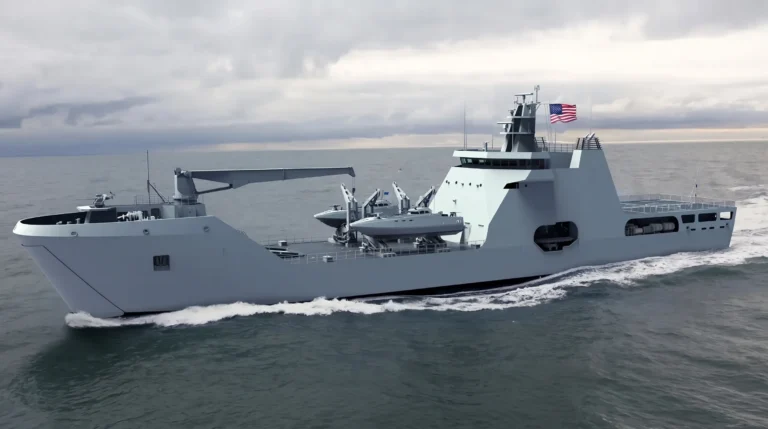
The LCH is based on Damen Shipyards Group’s Landing Ship Transport 100 (LST100), selected as the preferred design in November 2024 after a competitive tender. Austal Defence Australia received the construction contract, valued at approximately A$4 billion (about US$2.8 billion), on February 20, 2026, and signed an agreement with Damen the same day covering design support and licenses for local build.
Published Damen and Austal figures describe a ship 100 meters long with a 16-meter beam, displacing about 3,900 tonnes, with a speed of 15 knots and a range of 4,000 nautical miles. The design offers 1,020 square meters of roll-on/roll-off deck and a helicopter deck, and carries more than 500 tonnes of vehicles and equipment with a crew of 18 in its standard configuration. Australian-specific modifications to that baseline have not been publicly detailed.
Those figures define the role. A 4,000-nautical-mile range lets the LCH self-deploy across Australia’s northern approaches and into the Southeast Asian archipelago without a well-deck amphibious ship, and its payload covers the formations the government lists: Abrams main battle tanks, High Mobility Artillery Rocket Systems (HIMARS), and reconnaissance and infantry fighting vehicles. Eight ships are to be delivered over twelve years, with the final hull due in 2038. No first-of-class delivery date has been made public.
Landing Craft Medium: 18 Birdon-Designed Vessels Replace the LCM-8
The smaller LCM, contracted to Austal on December 18, 2025, under a A$1.029 billion design-and-build tasking, uses a steel-hulled Birdon Group design selected in November 2023 to replace the Army’s aging LCM-8 landing craft. Figures released in 2024 put the craft at about 55 meters long, with a 10.5-meter beam, a 1.4-meter draft, and a displacement of around 500 tonnes.
Payload figures vary by source. Austal’s contract announcement cited loads of up to 80 tonnes, while the company’s program material lists up to 90 tonnes, equal to four HIMARS launchers or one main battle tank. Austal also cites a range of up to 2,000 nautical miles when operating with the LCH. The shallow draft is the operational point: the LCM is sized for beaches, rivers, and reef-constrained coastlines where larger ships cannot operate.
Construction of the first LCM was scheduled to begin in 2026, with the 18th and final vessel due in 2032. The November 11 release did not update the LCM build status.
Henderson Industrial Base: NRFC Loan Funds Landing Craft Heavy Facilities
Both programs run under the Strategic Shipbuilding Agreement (SSA) signed in August 2025, a framework of up to 15 years that makes Austal Defence Australia the Commonwealth’s prime contractor for design, construction, testing, and acceptance at Henderson. The landing craft are the pilot for that model, and Canberra has tied further work to Austal’s performance.
On October 21, 2026, the National Reconstruction Fund Corporation (NRFC) announced a A$245 million loan to Austal to build and fit out dedicated LCH facilities within the Australian Marine Complex. Modules will be fabricated at existing and new Austal facilities, with assembly and launch at the complex. Under the SSA, the Commonwealth pays all funding costs on the loan, which remains subject to customary conditions precedent.
The government projects 1,100 direct and more than 2,000 indirect jobs across both programs. Austal built steel hulls for the Guardian-class Pacific patrol boats, but a 100-meter landing ship is a step up in scale, and Henderson is also slated to host local construction of the Navy’s future general purpose frigates, which will draw on the same skilled workforce.
Analysis: The LCH program’s most consequential feature may be its design baseline. In December 2025, the U.S. Navy and Marine Corps selected the same Damen LST100 as the basis for the McClung-class Landing Ship Medium, a program planned at up to 35 ships. That gives the Australian Army and the U.S. Marine Corps a common littoral lift platform in the same theater, opening the door to shared sustainment, spares, and training during combined operations. For Canberra, the LCH is less a transport than an enabler of its denial strategy: the means by which HIMARS batteries and future land-based maritime strike units reach, reposition across, and are sustained on dispersed terrain. The risk lies in execution. Eight ships over twelve years at a yard scaling into large steel construction leaves little margin, and without a public first-delivery date, schedule performance is hard to judge from outside.
Near-term milestones include LCH module production and keel laying, construction of the NRFC-funded facilities, and confirmation of the LCM build start. The government has not disclosed first-of-class delivery dates, crewing and basing arrangements, or the LCH mission systems fit. The fixed points remain 2032 for the final LCM and 2038 for the final LCH, and Austal’s record against them will shape what Henderson builds next.