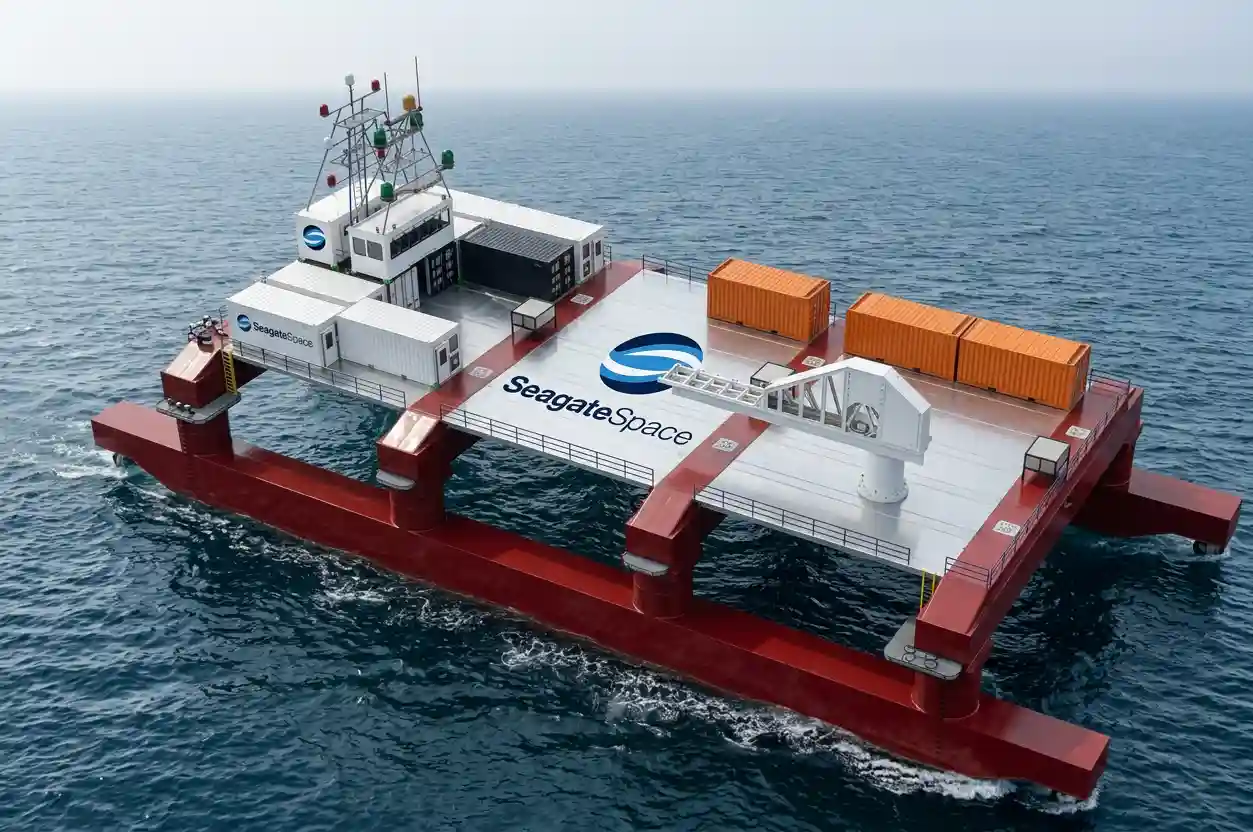
Kratos Defense & Security Solutions has signed a long-term agreement with St. Petersburg, Florida-based Seagate Space to use the company’s first Gateway offshore launch platform, the two firms announced on November 10, 2026. The deal supports Kratos’ first mission from the sea-based platform in 2027, with multiple additional launches planned in subsequent years. Neither company disclosed the financial value or the duration of the agreement.
The announcement lands as the Pentagon pushes to increase the pace of hypersonic flight testing. Kratos leads Task Area 1 of the Multi-Service Advanced Capability Hypersonic Test Bed (MACH-TB) 2.0 program under a five-year other transaction agreement worth up to $1.45 billion, awarded in January 2025. Program officials have described a goal of up to 50 hypersonic flight tests per year across the program’s task areas. In parallel, Seagate Space has executed its first Gateway construction contract, moving the platform from design into physical build.
Inside the Gateway Offshore Launch Platform Design
Gateway is a modular, uncrewed, semi-submersible platform purpose-built for launch and recovery operations rather than converted from an existing barge or offshore rig. Company material describes dynamic positioning, which allows the platform to hold station without anchoring, and a modular architecture intended to scale across a series of configurations. The baseline Gateway-S design received Approval in Principle (AIP) from the American Bureau of Shipping (ABS) on December 4, 2025, the first offshore asset to receive AIP under the classification society’s newly published Requirements for Offshore Spaceports.
Seagate Space has not released hull dimensions, displacement, deck load limits, propellant handling capacity, or sea-state launch limits for the first vessel, and the shipyard building it has not been named. Those parameters will determine which vehicles Gateway can realistically support. A platform rated for solid-propellant sounding rockets and target vehicles faces far simpler pad and propellant requirements than one cleared for liquid-fueled orbital rockets.
Seagate Space is pursuing both markets. It announced plans with Vaya Space in November 2025 to develop an offshore launch capability for the Dauntless hybrid rocket, followed by an April 6, 2026 memorandum of understanding (MOU) with Firefly Aerospace to adapt Gateway for the liquid-fueled Alpha small-lift launcher. Lockheed Martin joined the Firefly effort on May 4, 2026 to develop mission concepts and flight demonstrations, and Oceaneering International signed an MOU in April 2026 covering system development, engineering maturation, integration support, and future production opportunities. The Kratos agreement is the first of these partnerships tied to a dated mission. The concept recalls the Sea Launch venture, which flew Zenit-3SL rockets from a converted oil platform between 1999 and 2014, but Gateway targets responsive defense and small-lift work rather than heavy geostationary payloads.
How Kratos Plans to Use Gateway for Defense Launch and Target Missions
Kratos said it will initially use Gateway for defense-related launch and target missions, run by its Kratos Defense & Rocket Support Services division. The company has not identified the vehicle, the customer, or the operating area for the 2027 mission.
The candidate hardware is already in Kratos’ portfolio, which the company says spans hypersonic test vehicles, rocket systems, propulsion technologies, target vehicles, and launch services. Its Erinyes hypersonic test vehicle first flew on June 12, 2024 from NASA’s Wallops Flight Facility in Virginia as the Missile Defense Agency’s (MDA) Hypersonic Test Bed-1 (HTB-1), exceeding Mach 5, with Kratos supporting MDA and the Naval Surface Warfare Center. A second Erinyes flight followed in early 2025. Kratos has cited a unit cost of about $5 million for Erinyes, excluding the rocket motor. The company’s Zeus 1 and Zeus 2 solid rocket motors first flew together on October 24, 2024, also from Wallops, and are intended to provide affordable launch stages for hypersonic testing.
Moving these vehicles offshore addresses three constraints. A mobile platform can position a target or test article to fly trajectories that approximate a threat’s real approach azimuth, rather than whatever corridor a fixed coastal range permits. Open-ocean downrange corridors allow longer hypersonic flights without overflight restrictions. A relocatable pad also reduces competition for launch windows at shared national ranges. Dave Carter, president of Kratos Defense & Rocket Support Services, said Gateway “has the potential to provide our customers with additional launch flexibility, expanded operating locations, and responsive access to mission-relevant test environments.”
Analysis: The agreement matters less for any single 2027 launch than for what it signals about the US test enterprise. Missile defense developers need targets that replicate maneuvering and depressed-trajectory threats arriving from realistic directions, and hypersonic programs need volume; fixed ranges struggle to supply either. If Gateway performs as designed, Kratos secures a dedicated offshore launch route that complements its MACH-TB integration role, extending a vertically integrated test offering that already spans vehicles, motors, and mission execution. The risk sits on the maritime side: Seagate Space is an early-stage company building its first hull, and offshore operations add sea-state, range safety, and recovery challenges that land sites avoid.
The companies will now advance Gateway through construction, integration, and operational-readiness activities ahead of the planned 2027 mission. Key indicators to watch include disclosure of the build yard and delivery schedule, first sea trials, range safety and licensing approvals for launches from the platform, and Kratos’ choice of vehicle and operating area for the debut flight.