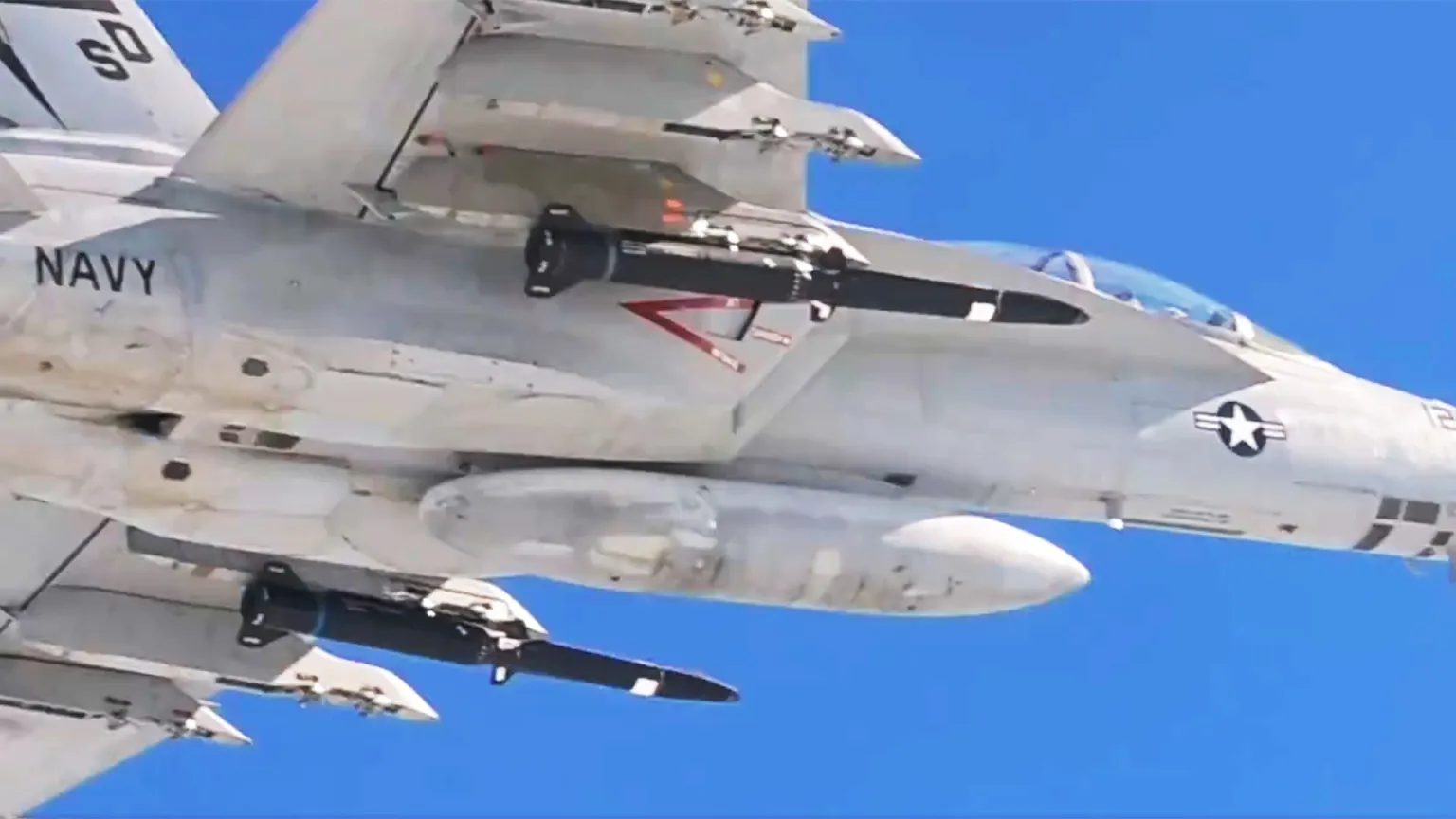
The U.S. Navy’s Naval Air Systems Command released video footage on September 25, 2026, showing Castelion’s Blackbeard hypersonic strike missile flying under the wing of an F/A-18E/F Super Hornet for the first time. The clip, distributed through NAVAIR’s official account and tagged to U.S. Central Command and U.S. Pacific Command, marks the program’s advance from static displays and captive-carry testing into actual flight, with the Navy targeting an early operational capability no later than 2028.
The flight test follows a rapid sequence of contract awards since the Navy selected Blackbeard in February 2026 as the first weapon under its Multi-mission Affordable Capacity Effector program. MACE was created after the Navy canceled the Hypersonic Air-Launched Offensive Anti-Surface Warfare weapon, an earlier air-launched anti-ship hypersonic effort, in the fall of 2024, citing budgetary constraints that prevented fielding the more expensive design on schedule. Castelion, a startup founded three years ago by former SpaceX engineers, has built its pitch around low-cost, mass-producible hardware, positioning it as MACE’s lead contender as the Pentagon pushes for rapid, affordable weapons production over small-batch, exquisite systems.
Blackbeard Hypersonic Missile Design and Boost-Glide Architecture
Publicly available imagery indicates Blackbeard uses a two-stage, boost-glide configuration: a ballistic missile-like rocket booster carries an upper stage, which may be an unpowered hypersonic glide vehicle or a stage retaining its own motor for sustained acceleration, a configuration also associated with Russia’s Zircon cruise missile. Both stages carry cruciform fins, and the upper stage’s wedge-shaped nose includes a visible aperture consistent with an imaging infrared seeker, a passive sensor immune to radio-frequency jamming that would suit a weapon built primarily to hold moving warships at risk. Castelion has not disclosed the guidance package in detail, and the Navy has not confirmed exact performance figures; the company has previously suggested a range approaching 500 miles, though this remains an attributed estimate rather than a confirmed specification.
The missiles seen in the new footage carry blue identification stripes, the standard marking for inert, non-explosive rounds used in flight test and captive-carry work, confirming these are functional test articles rather than static mockups. The footage also underscores the weapon’s compact size relative to the Super Hornet’s wing stations, a detail consistent with a design intended eventually to fit inside the internal weapons bays of the F-35A and F-35C.
The design philosophy behind Blackbeard trades some of the performance ceiling of programs like the Army’s Dark Eagle for speed to field and unit cost. Castelion has said it builds around automotive-grade electronics rather than space-qualified components with year-long lead times, a choice intended to let production scale quickly once the Navy commits to volume orders. That approach underpins MACE’s core requirement: a weapon cheap and simple enough to buy in the thousands rather than the dozens.
Castelion’s Contract Timeline Toward a 2028 Fielding Goal
The Navy selected Blackbeard for MACE in February 2026, then awarded a $105 million contract on April 24 to fund F/A-18E/F integration, flight testing, and the airworthiness certification needed for shipboard storage and carriage. A follow-on order on June 16 covered 50 early operational capability prototype missiles and their shipping and storage containers, for delivery in 2027. Contracting accelerated further on September 14, when the Pentagon awarded Castelion $43.65 million for a first production lot of 444 All-Up Rounds, fully assembled tactical missiles packaged in their own shipping containers, on top of a framework agreement reached in May covering as many as 12,000 missiles over five years. Congress has backed the pace with more than $140 million added to the program in the fiscal 2026 defense appropriations act.
MACE’s requirements call for the F-35A and F-35C to each carry four All-Up Rounds internally, a specification that would extend hypersonic strike to stealth aircraft without adding external stores that could compromise their low-observable profile. The Army is separately funding a ground-launched variant of the same missile. Castelion is also building a 1,000-acre manufacturing campus in Rio Rancho, New Mexico, called Project Ranger, aiming to produce roughly 500 Blackbeards a year there. That target, well above the output of established hypersonic programs, feeds the Pentagon’s wider push to rebuild munitions stockpiles officials have called too thin for a sustained, high-end fight.
Analysis: Blackbeard’s rapid progression from contract award to actual flight in under a year, on a schedule Congress has funded well ahead of the pace typical for hypersonic programs, could make it the first air-launched hypersonic weapon fielded by any U.S. service, ahead of the Air Force’s scramjet-powered Hypersonic Attack Cruise Missile, a program government auditors have flagged for schedule delays despite sharing the same fiscal 2027 target. For carrier air wings, an operational Blackbeard would narrow the capability gap against long-range Chinese anti-ship systems by giving the F/A-18 a standoff weapon that reaches contested waters faster than existing cruise missiles, while testing whether a defense startup can sustain production at a scale traditionally reserved for legacy primes.
The Navy has not detailed the specific milestones between the current flight test campaign and an early operational capability, though the pace of contract awards this year suggests further live-fire and integration milestones before the 2028 target. Whether the F-35 internal-carriage requirement survives into a formal specification, and whether the Air Force ultimately adopts a version of Blackbeard alongside or instead of HACM, remain open questions the Navy has not addressed publicly.