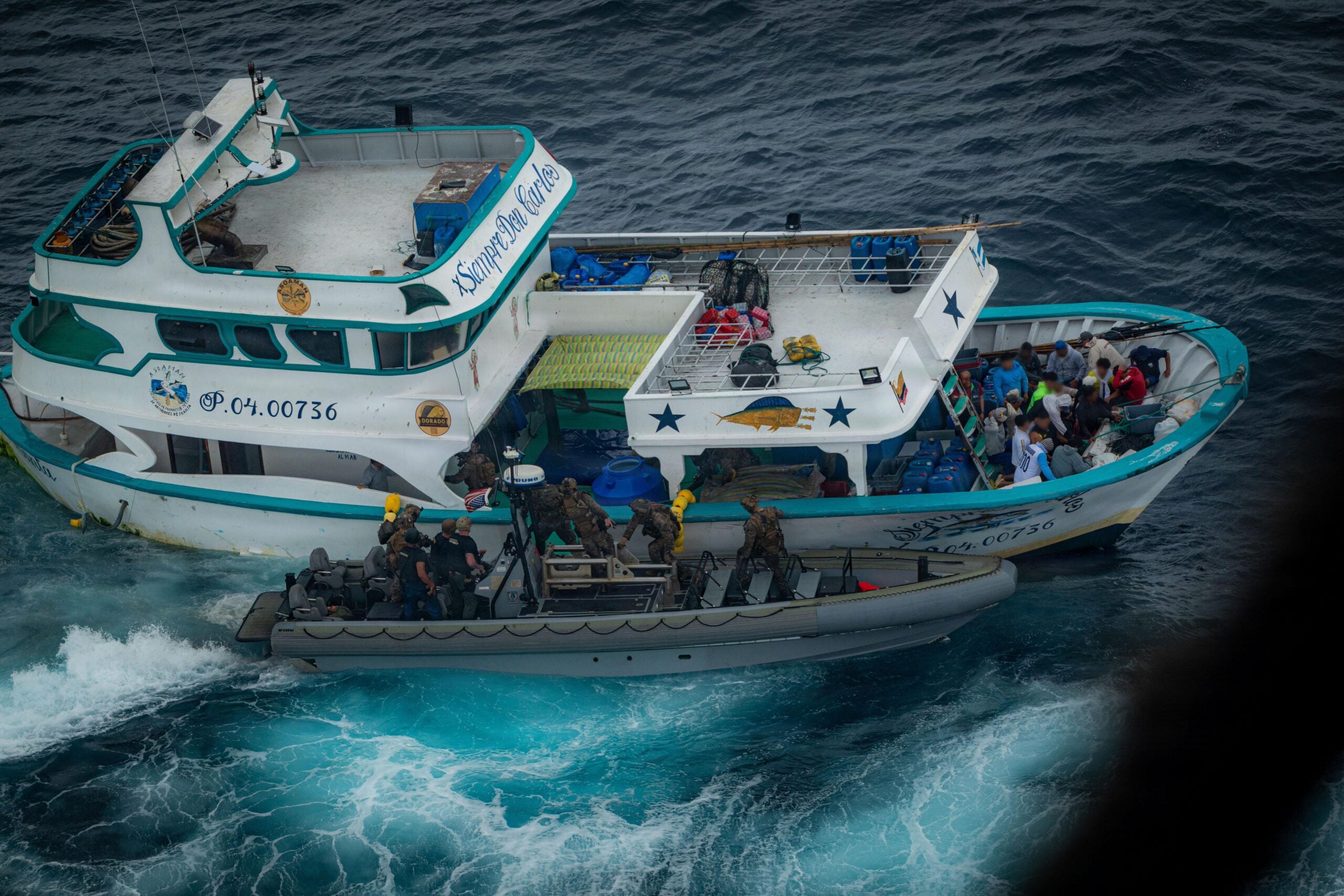
U.S. Marines and Navy sailors with Littoral Combat Force-24 (LCF-24) boarded, cleared and sank a vessel in the Eastern Pacific on September 15, 2026, that U.S. Southern Command (SOUTHCOM) identified as a floating refueling station supporting Los Choneros, the Ecuadorian trafficking organization. The crew was removed before the sinking and will be transferred to Ecuadorian authorities, according to SOUTHCOM.
The boarding was conducted under Joint Task Force Western Hemisphere (JTF-WHEM), which SOUTHCOM activated on August 4, 2026, to replace Joint Task Force Southern Spear (JTF 84-2) as its standing counter-cartel headquarters. SOUTHCOM has announced at least seven such interdictions since late August, including another on September 16, while lethal strikes on go-fast boats continue in the Caribbean. The State Department designated Los Choneros a Foreign Terrorist Organization in September 2025, citing links to the Sinaloa Cartel and the Jalisco New Generation Cartel.
How JTF-WHEM Is Dismantling the Los Choneros Floating Refueling Station Network
Floating refueling stations are larger vessels that loiter in international waters to refuel drug-laden go-fast boats moving north along Eastern Pacific routes, extending the smugglers’ reach without a port call. Imagery released by the Marine Corps shows the September 15 target as a multi-deck, fishing-type hull with blue drums stacked on deck and more than a dozen people gathered at the bow as a rigid-hull inflatable boat (RHIB) carrying the boarding team came alongside.
Ecuador’s Ministry of National Defense has tied earlier interdicted vessels to Los Choneros maritime infrastructure. The September 5 operation targeted a multi-vessel station, with the main hull and its attached support craft all sunk. The sequence is consistent across the series: board, clear, remove the crew, transfer detainees to Ecuador and sink the vessel. SOUTHCOM has not disclosed the September 15 vessel’s flag, the volume of fuel or narcotics found aboard, the number of people detained, or the method used to sink it.
How Littoral Combat Force-24 Executes Visit, Board, Search, and Seizure
LCF-24 is the 24th Marine Expeditionary Unit (MEU) operating under a littoral combat force designation. It took over the SOUTHCOM crisis-response mission from the 22nd MEU in late May 2026 with more than 1,300 Marines and sailors under Col. Ryan Lynch. Its aviation element is built around Marine Medium Tiltrotor Squadron 365 (Reinforced), an MV-22B Osprey unit, with a UH-1Y Venom detachment from Marine Light Attack Helicopter Squadron 269. Boarding teams come from the MEU’s Maritime Raid Force.
The force operates from shore nodes including Roosevelt Roads, Puerto Rico, and from San Antonio-class amphibious transport docks, with USS Fort Lauderdale (LPD 28) in the Caribbean and USS San Antonio (LPD 17) in the Eastern Pacific. SOUTHCOM confirmed that San Antonio launched the September 3 interdiction, and open-source fleet tracking placed the ship off Ecuador with destroyer USS Gridley (DDG 101) on September 14. The platform supporting the September 15 boarding has not been confirmed. LCF-24 rehearsed helicopter-supported boardings in May with the Coast Guard’s Tactical Law Enforcement Team Pacific, but SOUTHCOM has not said whether Coast Guard law enforcement detachments embarked for this operation. The detail carries legal weight, since those teams have traditionally supplied arrest authority on Navy counterdrug boardings.
Analysis: The refueling-station campaign extends SOUTHCOM’s targeting from expendable go-fast boats to logistics nodes that are larger, slower and costlier for traffickers to replace. Boarding instead of striking also produces detainees and, potentially, evidence for Ecuadorian prosecutors, giving Quito a visible stake in operations conducted by U.S. forces. For the Marine Corps, the series is a live test of the littoral combat force construct in a persistent, low-end mission, but it commits two San Antonio-class ships to a counterdrug theater while amphibious availability remains a recurring concern for Navy and Marine Corps leadership.
Open questions include how many detainees Ecuadorian courts will prosecute, whether JTF-WHEM will extend the board-and-sink model to the Caribbean, where recent operations have relied on lethal strikes, and how long San Antonio will remain on station. The interdiction tempo over the coming weeks will show whether Los Choneros can regenerate its at-sea fuel network faster than JTF-WHEM can remove it.