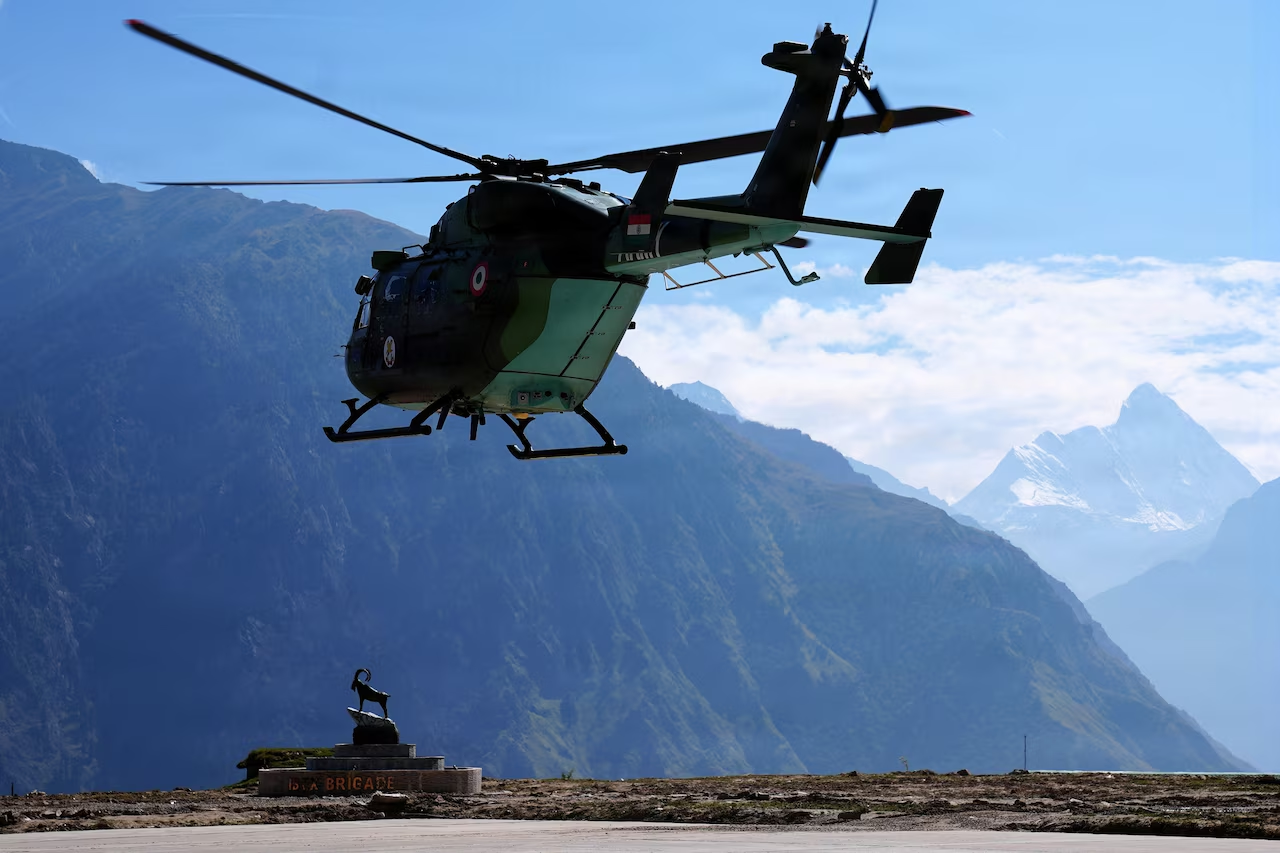
US and Indian Army forces executed a combined air assault near Auli, India, on September 25, 2026, seizing two objectives during Exercise Yudh Abhyas 2026 in a mission that placed soldiers from both armies in the same maneuver formations, according to the US Army. The assault force flew aboard the Indian Army’s Advanced Light Helicopter Mk III, known as the Dhruv Mk III.
Yudh Abhyas is a bilateral exercise sponsored by US Army Pacific and held annually since 2004; the 2026 iteration is the 22nd. It opened on September 15, 2026, at Auli in Uttarakhand with about 600 personnel from each army, with parallel training at Mahajan Field Firing Range in Rajasthan. The Indian Ministry of Defence said the exercise aims to improve Integrated Battle Group employment in mountainous and semi-mountainous terrain, with emphasis on infantry-dominated operations. It comes less than a year after Secretary of War Pete Hegseth and Indian Defence Minister Rajnath Singh signed a 10-year framework for the US-India Major Defense Partnership on October 31, 2025.
Yudh Abhyas 2026 Air Assault Sequence and Mixed Task Organization
The operation began with battalion scouts reconnoitering the objective area, said Capt. Gaston Adam, deputy operations officer for 1st Mobile Brigade Combat Team, 11th Airborne Division. The lead company moved into assault positions, then isolated and secured the first objective. A second company isolated the second objective ahead of the air assault. Soldiers then flew aboard the Dhruv Mk III onto a landing zone near that objective, dismounted, and moved into position. Indian Army soldiers followed with their own air assault, fast-roping from a helicopter to join the force and seize the objective. Both objectives were secured before the combined force transitioned into a hasty defense.
Task organization reflected the exercise’s emphasis on interoperability. A US company commander led the lead company, which included two US platoons and one Indian Army platoon. The second company, under US command, was built the same way. A separate Indian Army company served as a decoy element, with two Indian platoons and one US platoon. Adam said later repetitions may put an Indian Army company commander in charge of a mixed formation.
Coordination with Indian Army aviation began the day before. The aviation task force and ground force task force held an air mission coordination meeting, then ran cold load training and aircraft familiarization so soldiers could practice entering and exiting the Dhruv Mk III safely. Adam said soldiers must be able to “look that pilot in the eye and trust” the aircrew, and credited shared systems and checklists, codified by the US Army and understood by its partners, for the operation’s success.
Dhruv Mk III Specifications and High-Altitude Insertion Role
The Dhruv Mk III is a twin-engine, multi-role helicopter in the 5.5-ton class, designed and built by Hindustan Aeronautics Limited (HAL). It introduced the Shakti powerplant: two Shakti (Ardiden 1H1) turboshafts, co-developed with Safran Helicopter Engines, replace the roughly 1,100 shaft horsepower TM333-2B2 engines of the Mk I and Mk II. Publicly available specifications indicate about 1,200 shaft horsepower per Shakti, with an emergency rating the manufacturer put 30 percent above the TM333’s. Maximum takeoff weight is 5,500 kilograms and the main rotor spans 13.2 meters. The Indian Ministry of Defence lists a range of 630 kilometers and a service ceiling of 6,500 meters, though some open sources cite lower ceilings. HAL fits a glass cockpit, advanced avionics, dual controls, and night-flying capability, and open sources indicate a cabin for 12 to 14 passengers in addition to two pilots.
Those figures matter at Auli, which sits at roughly 2,800 meters (9,200 feet) above sea level, according to Indian government tourism data. Thinner air at that elevation reduces rotor lift and engine output, so the power margin of a twin-engine helicopter largely determines the troop load it can place into a confined landing zone. The ministry’s product listing describes the type as able to operate from unprepared terrain, makeshift helipads, and high-altitude sites, and says HAL has produced more than 350 Advanced Light Helicopters across variants. The Army account does not give the landing zone’s elevation, the number of aircraft, the troop load per sortie, or which helicopter type was used for the fast-rope insertion.
Analysis: The mission tests command procedures more than hardware. US company commanders led formations that included Indian platoons, an Indian company carried a US platoon in a decoy role, and Indian aviators provided the lift. That exposes gaps in air mission planning, communications, and rehearsal discipline at company level. It matches the objective the Indian Ministry of Defence set for the exercise, integrated battle groups in mountain terrain, and gives US Army Pacific repetitions in partner-enabled infantry operations at altitude. The Army account describes no opposing force, so it says little about performance under contact.
The Army account lists September 25, 2026, as the first of three repetitions, with air assaults scheduled for September 26 and 27, 2026, under different task organizations. It does not report their results or say whether an Indian commander led a mixed formation. US Army releases place the closing ceremony at Auli on September 27, 2026. The Indian Ministry of Defence describes Yudh Abhyas as alternating annually between India and the United States, which would point to a US venue in 2027, but no dates or location appear in the releases reviewed.