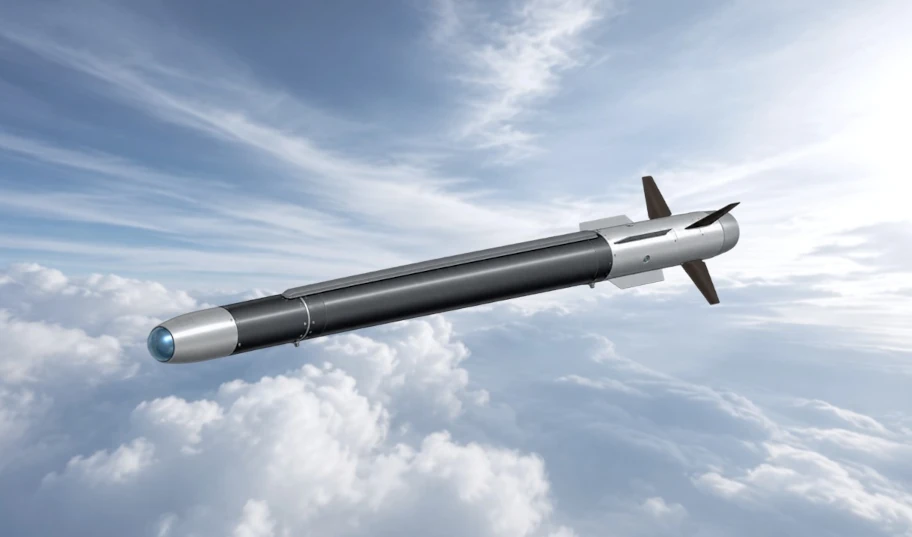
MBDA and Poland’s Military Institute of Armament Technology (WITU) announced on September 9, 2026, at the MSPO defense exhibition in Kielce that they are jointly developing the Counter Mass Interceptor (CMI), a supersonic, low-cost surface-to-air missile designed to defeat saturation attacks by one-way attack drones, intelligence, surveillance and reconnaissance (ISR) drones, helicopters and cruise missiles.
The cooperation turns a British-led concept into a Polish-designed missile less than two months after MBDA unveiled CMI at the Farnborough International Airshow in July 2026. It rests on a broader memorandum of understanding (MoU) on missile research signed at MSPO, which both parties tie to the Northolt Treaty, the UK-Poland defense pact signed by Prime Ministers Keir Starmer and Donald Tusk on May 27, 2026. The stated goal: a sovereign Polish solution and an affordable European capability for allied forces.
Inside the Counter Mass Interceptor: Seeker, Warhead, and Engagement Envelope
MBDA pitches CMI as a mass-producible effector meant to narrow the cost gap between cheap aerial threats and conventional interceptors. Publicly available specifications released at Farnborough indicate a 122 mm airframe roughly 2.3 m long, weighing about 53 kg at launch. The missile carries a blast-fragmentation warhead triggered by a proximity fuze, steers through forward canards, and homes using an infrared seeker with a fixed field of view. MBDA rates the engagement envelope at ranges and altitudes beyond 6 km.
CMI locks on before launch and flies fire-and-forget, allowing the launcher to displace immediately after firing. A fully passive engagement mode removes radar emissions from the firing unit, reducing its exposure to enemy direction-finding and targeting. The round is designed to be platform-agnostic: MBDA proposes tactical vehicles, uncrewed surface vessels and containerized launchers for fixed-site protection, where magazine depth matters more than mobility. It can also plug into MBDA’s Sky Warden counter-drone architecture.
Size defines the concept. At 53 kg, CMI sits well above the 70 mm guided rockets and interceptor drones many armies field against small unmanned aircraft, and well below the surface-launched Advanced Short Range Air-to-Air Missile (SL-ASRAAM), which publicly available specifications put at 88 kg and 166 mm in diameter. At Farnborough, MBDA paired two CMI rounds with two SL-ASRAAMs on a Raven short-range air defense (SHORAD) vehicle, reserving the costlier missile for harder targets. MBDA has not disclosed CMI’s unit price, top speed or propulsion details, and infrared-only guidance limits performance in poor weather. The company has said a longer-range, all-weather follow-on will come later.
WITU Airframe, MBDA Seeker: Field Trials and the 2027 Firing Campaign
The division of labor is clear. WITU, the Polish Ministry of National Defense’s armament research institute in Zielonka, designs the missile; MBDA supplies the seeker. In September 2026, the partners completed field trials at a Polish test range, evaluating seeker performance across multiple engagement scenarios against several representative drone target types. According to MBDA, the results clear the way for joint integration of the seeker into the WITU-designed prototype, ahead of an initial firing campaign planned for 2027.
“This cooperation enables the exploitation of a fully Polish missile design paired with a state-of-the-art seeker,” said Colonel Paweł Sweklej, chief executive of WITU. He linked the effort to WITU’s existing work with MBDA on HYDIS, the European hypersonic defense interceptor effort MBDA leads with European Defence Fund backing.
The schedule is compressed. MBDA has indicated that an initial CMI version could be available as early as 2028, built by industrial partners or on existing and repurposed MBDA production lines. Development has so far been led by MBDA’s UK teams, and the company has signaled that a later iteration could be led by its French teams. What the MoU does not cover matters as much: it is a research agreement, not a procurement contract. No Polish order, funded development contract or production work share has been announced, and where CMI would be manufactured remains open.
Where CMI Fits in Poland’s Layered Air Defense Architecture
Poland is building one of NATO’s densest air defense networks. Patriot batteries under the Wisła program cover the upper tier. The NAREW short-range program relies on MBDA’s Common Anti-air Modular Missile Extended Range (CAMM-ER), with Warsaw ordering more than 1,000 missiles and over 100 launchers in a 2024 deal worth roughly £4 billion. PILICA+ pairs CAMM with gun systems for point defense, and MBDA opened its first industrial facility in Poland in September 2026 to support that program.
Below that sits SAN, the counter-drone system ordered on January 30, 2026, from Polska Grupa Zbrojeniowa (PGZ) and Kongsberg. Valued at about PLN 15 billion ($4.2 billion), it covers 18 batteries combining 35 mm, 30 mm and 12.7 mm guns, 70 mm guided rockets and interceptor drones. CMI targets the band between that layer and CAMM: threats that outrange guns but do not justify a CAMM round. The September 2025 incursion of Russian drones into Polish airspace, which prompted NATO’s Eastern Sentry mission, underscored that cost problem. MBDA UK Managing Director Chris Allam said the cooperation “demonstrates MBDA’s commitment to Poland and expands on our strong support to Poland’s world leading layered air defence capability.”
Analysis: CMI is less a technology leap than an industrial and economic one. The infrared seeker, fragmentation warhead and lock-on-before-launch logic are mature; the novelty is pairing an MBDA seeker with a Polish-designed airframe, giving Warsaw design authority rather than licensed assembly. For MBDA, the arrangement secures a sovereign-production narrative in Europe’s largest air defense market and a potential second production base for a round that must be built in volume. Until a unit price is published, however, CMI’s value against guns, guided rockets and interceptor drones cannot be assessed.
Next come seeker integration into the WITU prototype and the 2027 firing campaign. Three decision points will then determine whether CMI becomes a program of record: a funded contract from Poland’s Armaments Agency, disclosure of a target unit price, and integration with NAREW and SAN command and control.