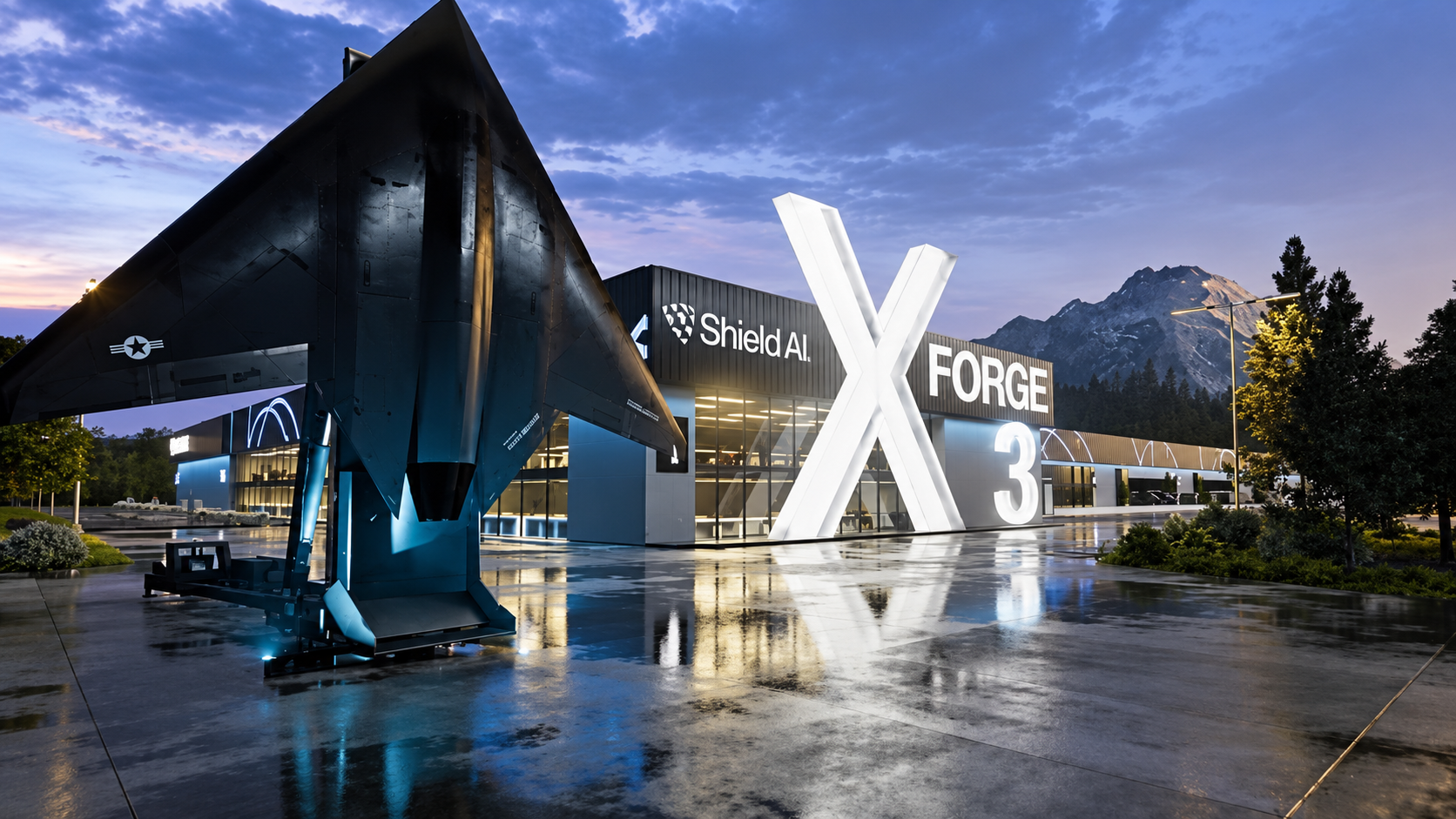
Shield AI named Des Moines, Washington, as the production home of its X-BAT AI-piloted vertical takeoff and landing (VTOL) fighter on September 30, 2026, and assigned flight testing and fleet sustainment to Newton, Kansas. Every aircraft built at X-Forge 3 south of Seattle will complete production acceptance testing at X-Forge 2, at Newton City-County Airport, before delivery, and Newton will host maintenance, repair and overhaul (MRO) for the entire fleet.
The decision gives Shield AI a defined route from prototype to fielded fleet before X-BAT has flown. It follows a $50 million investment announced on August 13, 2026, by the Department of the Navy Rapid Capabilities Office (DONRCO) and PAE Aviation, with the Defense Innovation Unit (DIU), under the Runway Independent Maritime Expeditionary Strike (RIMES) effort, and a five-year letter of intent signed on September 8 with Poland’s Polska Grupa Zbrojeniowa (PGZ) and Wojskowe Zakłady Lotnicze Nr 2 (WZL-2). Production is planned for 2029, with full rate in the early 2030s.
How X-BAT Production Splits Across Kansas, Washington, and Texas
Newton carries the widest remit. Shield AI leases hangar and office space and about 10 acres at the airport and is working with the City of Newton and Harvey County to expand the site and build a larger hangar. Selected in 2025, when X-BAT was first shown publicly, the location will also support development flight testing, and customers will fly their own acceptance sorties there. Its labor pipeline draws on Wichita State University, WSU Tech, the National Center for Aviation Training and Hutchinson Community College.
“Flight test is where an airplane earns its way,” said Armor Harris, Shield AI’s senior vice president of aircraft, citing the state’s airspace, hangars and workforce.
In Des Moines, its first Puget Sound site, the company has signed its lease, begun the build-out and moved program hiring to the region. Shield AI cites King County’s more than 45,000 aerospace workers at over 400 companies and a statewide supplier base above 1,500 firms, and expects to expand as production rates climb. X-Forge 1 in Frisco, Texas, remains the prototyping site and home of the V-BAT, while Texas suppliers handle much of the propulsion and mission systems work.
An economic analysis built on the IMPLAN model, using inputs supplied by Shield AI, projects about 9,800 jobs across the Newton and Seattle regions by the early 2030s and roughly $78 billion in added activity through 2046. Seattle-Tacoma-Bellevue accounts for the bulk, at about 8,000 jobs rising to 27,000, against 1,800 rising to 2,900 around Newton. The figures include supplier and induced employment and assume the program reaches full rate; they are company-commissioned projections, not contracted workload.
F110 Thrust and Hivemind Autonomy Behind a Runway-Free Strike Fighter
X-BAT is a low-observable, single-engine strike fighter that launches and recovers vertically in a tail-sitter configuration from a mobile launch and recovery vehicle, removing the need for a runway at sea, on islands or at dispersed land sites. Power comes from a GE Aerospace F110 afterburning turbofan, the engine family of the F-15EX and late-model F-16s; publicly available specifications place the F110-GE-129 in the 29,000-pound-thrust class. Shield AI reported completing afterburner tests with GE’s Axisymmetric Vectoring Exhaust Nozzle (AVEN), validating the thrust and control authority vertical flight requires. The exact F110 variant has not been disclosed.
Company figures list a 39-foot wingspan, a stowed footprint of 40 by 14 by 6 feet, maximum range above 2,000 nautical miles, an objective combat radius of 1,000 nautical miles, a ceiling above 50,000 feet and a maneuver load factor above 4 g. Internal bays comparable in size to the F-35’s carry stores up to the 2,000-pound class, with external hardpoints for larger strike weapons and power margin for electronic warfare (EW) and intelligence, surveillance and reconnaissance (ISR) payloads. Shield AI claims three X-BATs fit in the deck space of one legacy fighter.
Hivemind, Shield AI’s autonomy software, flies the aircraft and is designed to operate without GPS or communications links; it already flies on Anduril’s YFQ-44A Collaborative Combat Aircraft (CCA) prototype. The F110 choice ties directly to the sustainment plan, plugging X-BAT into an established global depot and spares ecosystem that WZL-2 is preparing to serve with new F110 capability in Poland. Runway independence also separates X-BAT from the U.S. Air Force’s Increment 1 CCAs, the YFQ-42A and YFQ-44A, which operate from conventional airfields.
Analysis: Shield AI is standing up a production, acceptance and sustainment chain for an aircraft that has not flown and is not a U.S. program of record. RIMES money funds development toward runway-independent strike from Navy surface ships, not procurement, and the PGZ letter carries no order. Naming sites now signals industrial credibility to export prospects, which company officials say include F-35 operators, and secures two deep aerospace labor pools early. Co-locating MRO with flight test also concentrates fleet data in one place, a logical fit for an autonomous platform whose software will keep evolving. The jobs projections still hinge on a full-rate decision that requires flight data and a launch customer.
The next milestone is the first VTOL flight, which Shield AI still schedules for 2026 from Newton, though industry reporting points to a window extending into early 2027. Mission capability is targeted for 2028. Unanswered: planned production rate, unit cost, a launch customer and the timing of the Newton hangar expansion. In Poland, any local final assembly line depends on a Warsaw procurement decision.