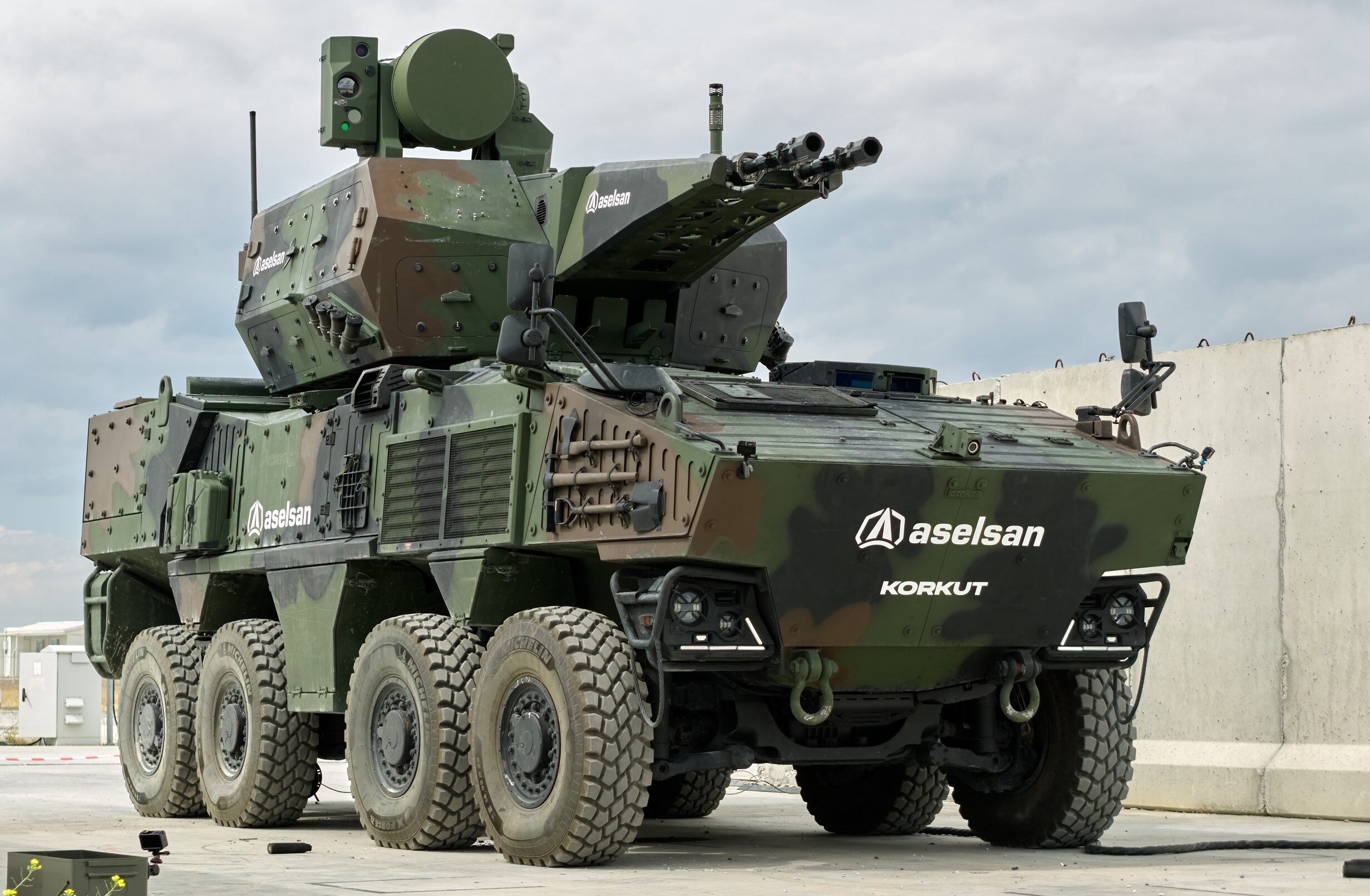
Aselsan, Türkiye’s largest state-linked defense company, is seeking partnerships with Japanese firms on air defense systems and on protecting warships against underwater drones, President and CEO Ahmet Akyol said in a media interview published October 4, 2026, as the company pushes into Asian markets amid a deteriorating regional security environment.
The outreach follows a September 22 meeting in New York between Prime Minister Sanae Takaichi and President Recep Tayyip Erdoğan, held on the sidelines of the United Nations General Assembly, at which Takaichi called for deeper cooperation in defense equipment and technology. It builds on the first visit to Türkiye by a Japanese defense minister in August 2025 and on a letter of intent signed May 6, 2026, at the SAHA 2026 exhibition in Istanbul, under which Japan’s Acquisition, Technology and Logistics Agency (ATLA) and Türkiye’s Presidency of Defense Industries (SSB) agreed to form a working-level group.
Counter-Drone Air Defense Leads Aselsan’s Japan Defense Cooperation Pitch
Akyol framed the offer around speed and price. “What we offer is faster delivery, cost-effectiveness, high performance, and systems proven in different contexts,” he said, naming cost-effective air defense against suicide drones as a priority. The company intends to use operational data from its fielded air defense systems as a selling point in Asia.
That data comes largely from Steel Dome, Türkiye’s multilayered integrated air and missile defense architecture, for which Aselsan supplies radars, electronic warfare (EW) payloads, command-and-control nodes and effectors. On August 27, 2025, it delivered 47 systems worth $460 million, including Siper long-range and Hisar medium-range air defense systems, Korkut guns, ALP radars and PUHU EW assets, and Akyol has said Steel Dome deliveries will rise 50% in 2026. Aselsan’s defense revenue climbed 26% to $4.46 billion in 2025, and its backlog stood at $23.2 billion at the end of June 2026.
Korkut is the most relevant product for the drone mission. Publicly available specifications indicate each weapon vehicle mounts twin 35mm KDC-02 cannons built under license by MKEK, firing a combined 1,100 rounds per minute to an effective range of 4 km, with three gun vehicles and one radar-equipped command vehicle per battery on the FNSS ACV-30 tracked chassis. The key enabler is ATOM 35mm programmable airburst ammunition, which releases tungsten pellets ahead of the target; Aselsan has reported trial kills against loitering munitions beyond 3 km with minimal ammunition expenditure. An Otokar Arma 8×8 wheeled variant and the 25mm Korkut 100/25 counter-drone system extend the family.
The gun-based model fits Tokyo’s stated requirements. Japan’s record fiscal 2027 defense request of ¥8,890.8 billion, filed August 31, 2026, seeks funding for a new close-range air defense system against drone swarms combining missiles, autocannons and lasers, alongside interceptor drones.
Ship Defense Against Underwater Drones Meets Japan’s Transfer Rules
The second area Akyol named, defending ships from underwater drone attacks, addresses a threat sharpened in the Black Sea, where Ukrainian uncrewed maritime systems and missile strikes pushed much of Russia’s fleet out of Sevastopol. Aselsan has not said which products it would offer Japan. Its marketed undersea portfolio includes the DÜFAS 100/LR, a variable-depth, low-frequency towed active and passive sonar with bistatic and multistatic modes, pitched for detecting submarines, torpedoes and unmanned underwater vehicles (UUVs) and for recommending evasive maneuvers and decoy employment. It sits alongside the HIZIR torpedo countermeasure family and the DERİNGÖZ 100M/600 autonomous underwater vehicle for mine countermeasures.
The interest runs both ways. During the August 2025 ministerial visit, Ankara signaled interest in Japan’s minesweeping capabilities, while Tokyo expressed interest in Türkiye’s drone industry.
Japan’s legal framework will shape what is possible. The April 21, 2026 revision of its defense equipment transfer principles scrapped the five noncombat export categories and split equipment into weapons and non-weapons: non-weapons such as radars face no destination limits, while lethal systems may go only to the 17 countries holding a defense equipment and technology transfer agreement with Tokyo. No such agreement with Ankara has been announced, and because the rules govern Japanese transfers, they would apply to any co-development in which Japanese technology flows to Türkiye.
“Politically, there is alignment between Türkiye and Japan,” Akyol said. “From our side, together with Japanese companies and the Japanese government, we have to find a way to build areas of cooperation.”
Analysis: The industrial fit is complementary. An ATLA official has identified components, materials and communications as Japan’s strengths, while Japanese industry faces skilled-labor shortages and high start-up costs for new production lines; Aselsan brings high-rate serial production and feedback from a domestic integrated air defense build-out. The binding constraint is legal rather than technical. Without a transfer agreement, joint work on lethal effectors such as Korkut cannot move forward, which makes sensors, sonar, EW and command-and-control the realistic entry points, and Aselsan’s undersea detection offer sits squarely in that category. Its claim of systems “proven in different contexts” will also have to survive Japanese evaluation in a market long served by domestic primes and US Foreign Military Sales.
The next markers are the first sessions of the ATLA-SSB working group, for which no date has been disclosed, and any move to open talks on a transfer agreement. Japan’s revision of its three core security documents and the final fiscal 2027 budget, both due by year-end, will set requirements and funding for the close-range air defense program. Aselsan has not named prospective Japanese partners, products or contract values.