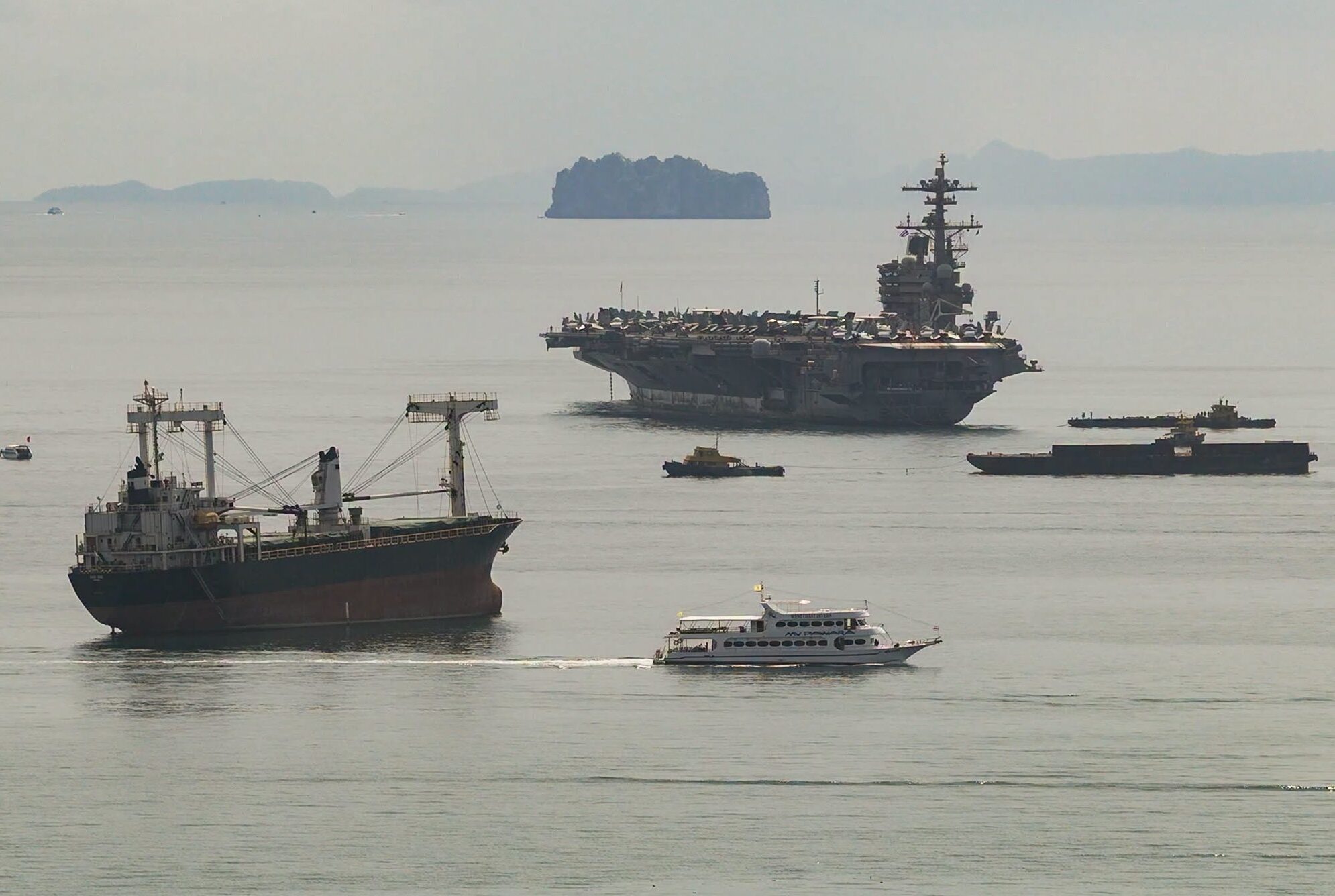
The Nimitz-class aircraft carrier USS George H.W. Bush (CVN 77) anchored off Phuket, Thailand, on October 4, 2026, with the Arleigh Burke-class guided-missile destroyer USS Delbert D. Black (DDG 119), marking the first port visit for the George H.W. Bush Carrier Strike Group since it left Norfolk, Virginia, and Mayport, Florida, in March. According to the US Navy, it spent six months supporting Operation Epic Fury and the US naval blockade of Iran in the US Central Command (CENTCOM) area of responsibility.
Bush sailed from Norfolk on March 31, a month into the US-Israeli campaign against Iran. Avoiding the Suez Canal and the Houthi threat in the Bab el-Mandeb, the strike group sailed around Africa and entered CENTCOM in late April, after the blockade took effect on April 13. Its departure, which a US official called temporary, leaves USS George Washington (CVN 73) as the only American carrier in CENTCOM, while USS Theodore Roosevelt (CVN 71) left San Diego on September 27 bound for the Middle East.
Inside the Bush Carrier Strike Group: Hull, Air Wing, and Escorts
George H.W. Bush is the 10th and final Nimitz-class carrier, commissioned on January 10, 2009, and built as a transition hull toward the Gerald R. Ford class, with a redesigned island. Publicly available specifications list an overall length of 1,092 feet (333 meters), a full-load displacement above 100,000 long tons, and two Westinghouse A4W reactors driving four shafts for speeds above 30 knots. Point defense rests on RIM-162 Evolved SeaSparrow Missile and RIM-116 Rolling Airframe Missile launchers.
Carrier Air Wing 7 embarks nine squadrons. Strike capacity sits with four F/A-18E/F Super Hornet units, Strike Fighter Squadrons (VFA) 103, 83, 105 and 131, backed by Electronic Attack Squadron (VAQ) 140 flying the EA-18G Growler, an E-2 Hawkeye airborne early warning squadron, CMV-22B Ospreys of Fleet Logistics Multi-Mission Squadron (VRM) 40, and MH-60R and MH-60S helicopters of Helicopter Maritime Strike Squadron (HSM) 46 and Helicopter Sea Combat Squadron (HSC) 5. Unlike the wings aboard USS Abraham Lincoln (CVN 72) and George Washington, which each include an F-35C squadron, Carrier Air Wing 7 deployed without one, leaving the Growler to carry electronic attack for an all-Super Hornet strike force.
The Navy lists the strike group’s escorts as USS Mason (DDG 87) and Destroyer Squadron 22 with USS Ross (DDG 71) and USS Donald Cook (DDG 75). None accompanied the carrier to Phuket, and the Navy has not disclosed their positions. Delbert D. Black, absent from the formal order of battle, operated independently in the region in late September. The Flight IIA destroyer, commissioned in 2020, fields the Aegis combat system and, per publicly available specifications, 96 Mark 41 Vertical Launching System cells, covering the anchored carrier’s air and missile defense.
Phuket Follows Laem Chabang as Carriers Rotate Out of CENTCOM
The carrier anchored offshore, with liberty parties moving ashore through Phuket Deep Sea Port. Local authorities expect the visit to run through October 9 and put the carrier’s complement, including its air wing, at about 4,800, with roughly 320 more aboard Delbert D. Black. US Embassy defense attaché staff met Patong police beforehand to coordinate security, and Thai officials reminded visiting personnel to comply with Thai law. The program includes sightseeing tours, community relations events and a US-Thailand soccer match organized by the carrier’s Morale, Welfare and Recreation committee, and senior officers are scheduled to meet Thai civilian and military officials.
Phuket is the second Thai liberty port in a month for a carrier coming off Iran operations. Abraham Lincoln called at Laem Chabang from September 2 to 6 with about 5,000 sailors and Marines, also its first port visit of the deployment, while escorts USS Frank E. Petersen Jr. (DDG 121) and USS Robert Smalls (CG 62) berthed at nearby Sriracha and Map Ta Phut. A local mayor estimated at the time that each sailor could spend up to 3,000 baht, roughly $90, a day ashore.
Thailand is Washington’s oldest partner in the region, a relationship dating to the 1833 Treaty of Amity and Commerce, its only treaty ally on mainland Southeast Asia, a major non-NATO ally since 2003, and co-host of the annual Cobra Gold exercise. Geography also counts: Phuket sits on the Andaman Sea, west of the Malay Peninsula, sparing a carrier the Strait of Malacca transit that Laem Chabang, on the Gulf of Thailand, requires.
Analysis: The Phuket call is a mid-deployment rest period, not a homecoming, and it shows how thin carrier coverage of the Iran campaign has become. Bush went 187 days without a liberty port. USS Gerald R. Ford (CVN 78) was pulled from combat operations after a shipboard fire earlier this year, Lincoln is heading home, and George Washington, the Navy’s Japan-based carrier, now holds the CENTCOM line alone, leaving the Western Pacific without its resident flattop. Each rest window opens a gap elsewhere, and Roosevelt’s movement indicates the Navy intends to rebuild a multi-carrier presence near Iran rather than accept a single-carrier posture.
The Navy has not said whether Bush will return to the Arabian Sea after October 9 or remain in the 7th Fleet area of operations. The positions of Mason, Ross and Donald Cook remain undisclosed, as does the strike group’s planned deployment length. The next decision points are Roosevelt’s arrival in CENTCOM and the November 3 midterm elections, after which President Donald Trump has said increased strikes on Iran are possible.