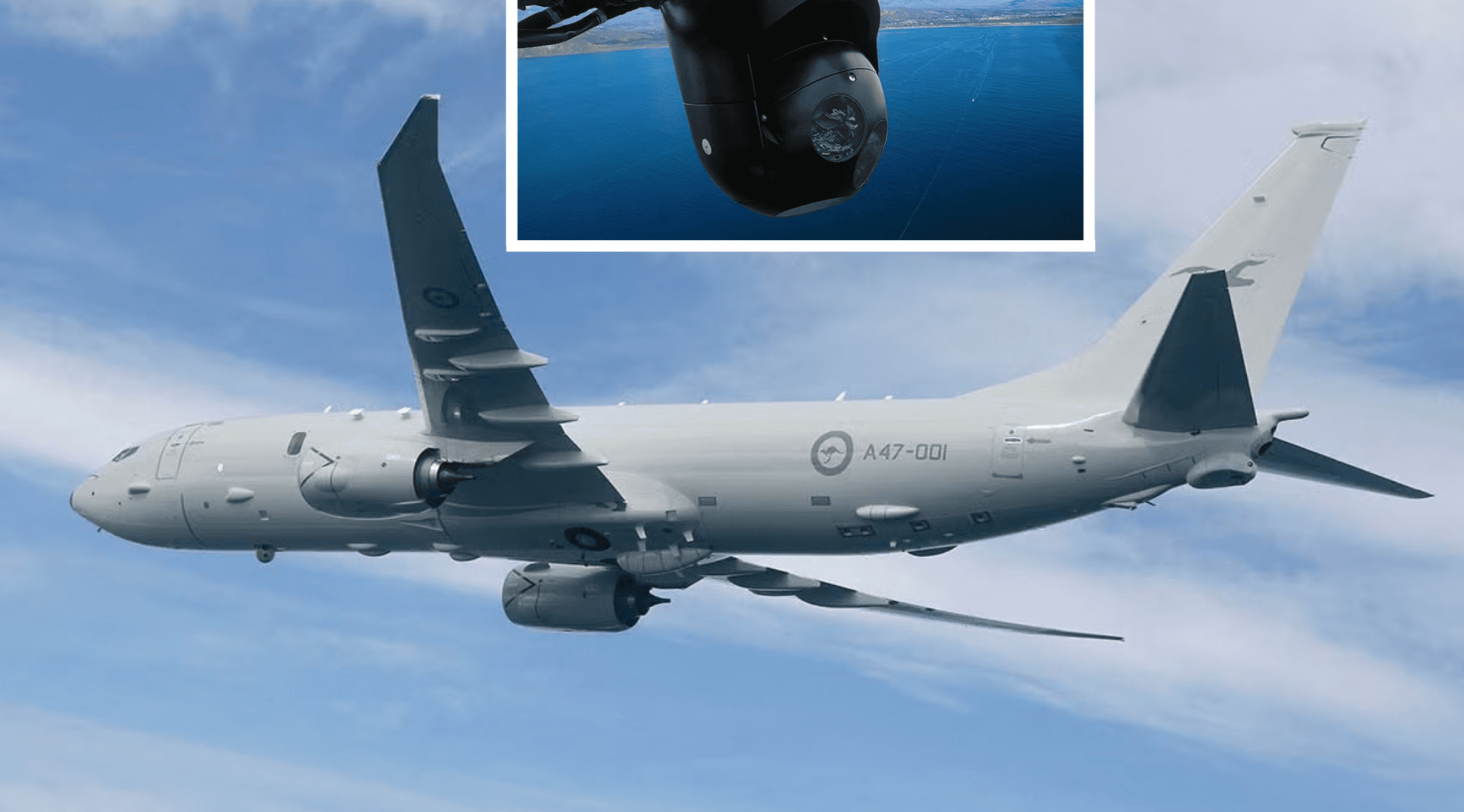
SYPAQ Systems, the Melbourne-based integrator behind the Corvo family of uncrewed aircraft, has integrated L3Harris Technologies’ WESCAM MX-10 electro-optical/infrared (EO/IR) imaging and targeting system into its light fixed-wing surveillance fleet, according to a company editorial L3Harris published on October 4, 2026. Neither company has disclosed the airframe type, the number of turrets involved, the end customer or a contract value.
The integration lands as Canberra reshapes airborne surveillance over a continent and maritime zone of exceptional scale. Australia’s exclusive economic zone covers roughly 8.2 million square kilometers, and on May 22, 2026, the Australian Border Force (ABF) confirmed that Metrea Australia will take over fixed-wing aerial surveillance from the Leidos-operated Dash 8 fleet with 11 fully crewed aircraft, with services due to start on January 1, 2028. Bombardier said on May 26 that three of those aircraft will be Global 6500 jets. L3Harris framed the MX-10 work around that geography, citing long transits, remote infrastructure and missions ranging from border security to disaster response and search and rescue.
WESCAM MX-10 Sensor Suite, Stabilization and Geolocation Performance
The MX-10 is the 10-inch class member of the WESCAM MX-Series, introduced in 2009 according to publicly available data and derived from technology fielded on the larger MX-15 and MX-20. The turret measures 260 mm in diameter and 355 mm in height and weighs less than 17.3 kg (38 lb) with all sensors fitted, per L3Harris specifications. Its height of under 14 inches preserves ground clearance on belly installations, a practical constraint for light aircraft operating from short regional strips.
The gimbal carries up to six sensors simultaneously. Current configurations include a high-definition EO camera, a high-sensitivity color camera for low-light work and a high-definition infrared imager with pseudo-color display. Earlier manufacturer datasheets also list a high-magnification spotter, an eyesafe laser rangefinder and a laser illuminator in narrow or wide divergence. An advanced video tracker and embedded moving target indication (MTI) let a single operator hold a vehicle or vessel while scanning a wider sector, and Enhanced Local Area Processing (ELAP) applies real-time image enhancement across the day, night and infrared channels.
Stabilization is the defining parameter at this size. The MX-10 uses a fully active four-axis gimbal with an internal inertial measurement unit (IMU) and built-in passive isolation; a 2018 manufacturer datasheet rated line-of-sight stability typically below 15 microradians on fixed-wing installations. The IMU feeds the MX-GEO software suite, which aligns automatically to the aircraft and generates target coordinates. For Australian operators, that geolocation function converts imagery into a cueing product that ground teams, patrol vessels or police units can act on without a second sensor pass. The turret draws 28 VDC at 10 amps maximum under MIL-STD-704E, compatible with the 28-volt electrical systems common on light aircraft.
How SYPAQ Fits Between Corvo Drones and Australia’s P-8A Fleet
SYPAQ has supplied the Australian Department of Defence since 1992, and its airborne systems business covers ISR, EO and IR sensor integration and mission management, with prior work on programs including AIR 5349 Phase 6, AIR 5431 and AIR 9000, according to the company. It is better known for uncrewed systems. The Corvo X small uncrewed aerial system entered service with the Australian Army under the DEF 129 program, with SYPAQ announcing completion of the acquisition on May 12, 2026, and the company has received Advanced Strategic Capabilities Accelerator (ASCA) funding under Mission Syracuse to develop the Corvo Strike counter-drone interceptor.
A crewed light fixed-wing fleet with 10-inch turrets occupies the middle of the Australian ISR stack. Above it, the Royal Australian Air Force (RAAF) flies the P-8A Poseidon, whose WESCAM MX-20HD turret can carry up to seven sensors, and the incoming civil maritime fleet will rely on long-range business jets. Below it, man-portable systems such as Corvo X provide tactical overwatch at section and platoon level. Light aircraft trade speed for lower acquisition and operating costs while keeping a trained sensor operator in the loop, and MX-Series commonality in hand controllers, operator interfaces and video overlays reduces the training burden for crews moving between platforms.
The MX-10 also faces sovereign competition. Australian firm Trakka Systems markets the TC-300, a 300 mm gimbal weighing roughly 19 to 22 kg depending on configuration, with a cooled mid-wave infrared imager at 640×512 or 1280×720 resolution and up to seven payload options, per published datasheets. L3Harris has not said why SYPAQ selected the MX-10 over domestic or foreign alternatives.
Analysis: The substance here is less the sensor than the delivery model. Contractor-delivered airborne surveillance is already the norm for Australia’s civil maritime mission, and the Metrea award renews that model with long-range jets and round-the-clock national coverage. The 2024 National Defence Strategy’s emphasis on northern bases also raises demand for persistent coverage of infrastructure and approaches that high-end assets cannot service continuously. A sovereign integrator flying a proven, Canadian-built L3Harris turret on light aircraft positions SYPAQ to sell ISR as a service to Defence, Home Affairs and state agencies while giving L3Harris a local sustainment partner. The editorial is also a marketing document: without an identified customer, airframe or fleet size, it signals intent rather than confirmed operational capability.
The next disclosures to watch are the platform type, turret count and tasking customer for the SYPAQ fleet, and whether the aircraft surface in Defence or Home Affairs procurement records. The ABF transition to Metrea runs through January 1, 2028. Until either company publishes contract detail, the MX-10 integration reads as an industrial positioning move in a market Canberra is actively restructuring.