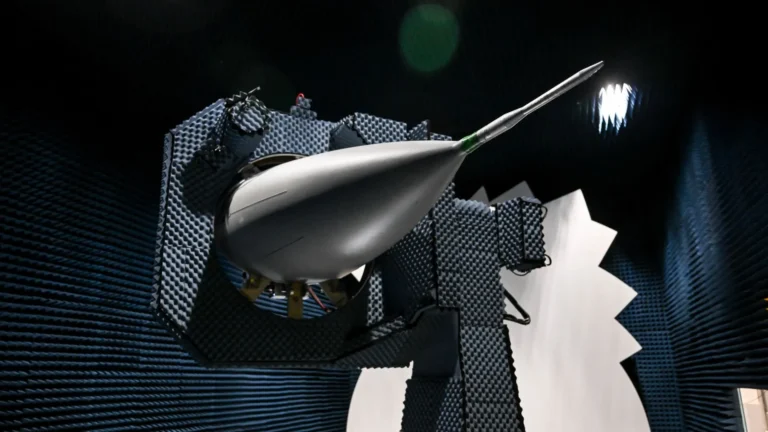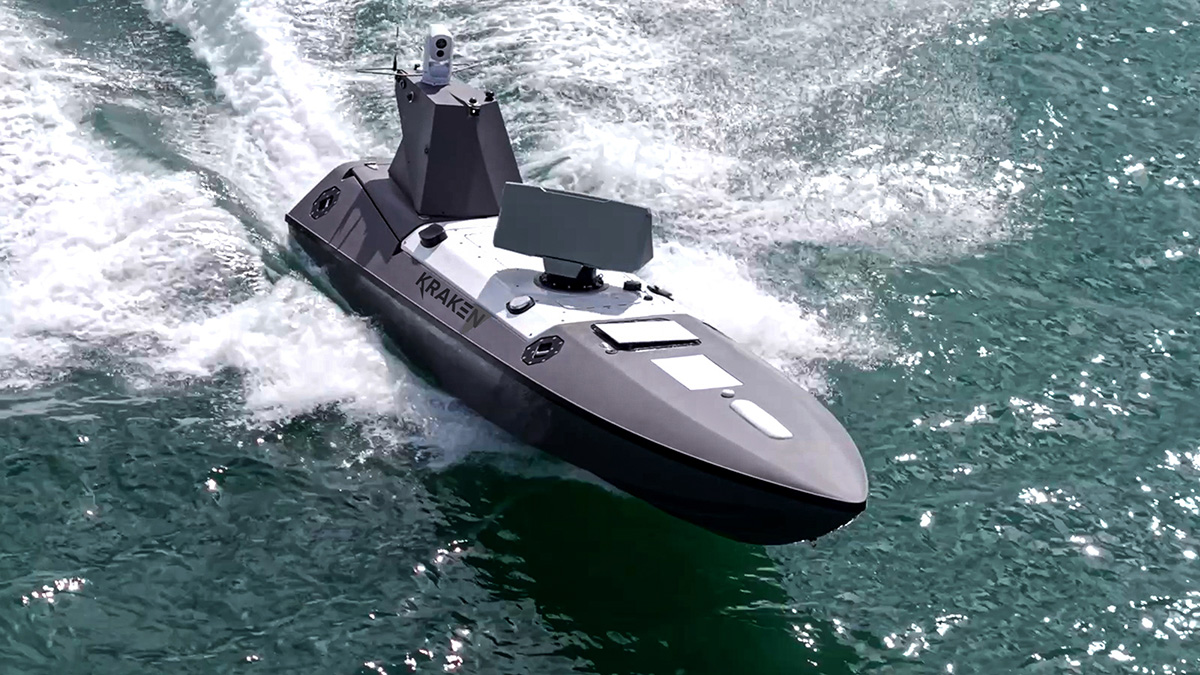
Kraken Technology Group and Saab UK have developed and sea-tested a prototype autonomous “drone seeker” vessel that integrates Saab’s Giraffe 1X three-dimensional air surveillance radar into Kraken’s K3 SCOUT uncrewed surface vessel (USV), the two Fareham-based companies announced on October 5, 2026. The experimental system is designed to provide rapidly deployable early warning against small drones threatening shipping, ports, offshore energy assets and critical national infrastructure.
The prototype arrives as maritime counter-uncrewed aircraft systems (C-UAS) coverage becomes a pressing gap for the Royal Navy and its NATO allies. One-way attack drones launched at merchant shipping in the Red Sea since late 2023, and repeated drone incursions over airports and military sites in northern Europe during 2025, have shown how thinly air surveillance is spread around maritime infrastructure. The Royal Navy is meanwhile building a “hybrid navy” of crewed and uncrewed platforms, and in March 2026 the UK Ministry of Defence (MoD) awarded Kraken a £10.25 million contract for 20 Medium K3 SCOUT vessels under Project BEEHIVE.
Inside the Drone Seeker USV: Giraffe 1X Radar Integration
The Giraffe 1X sits inside the K3 SCOUT’s modular payload bay, turning a vessel marketed for reconnaissance, force protection and strike into a dedicated air surveillance node. According to Saab, the radar uses a gallium nitride (GaN) active electronically scanned array (AESA) operating in X-band, delivering 360-degree coverage with its full search volume refreshed every second. Saab states the sensor detects targets with a radar cross-section below 0.01 square meters at an instrumented range of approximately 75 km, and earlier company material cited detection of a UAV lighter than a milk carton at up to 4 km.
Weight is what makes the integration possible. Publicly available specifications indicate the Giraffe 1X weighs less than 150 kg, with roughly 100 kg mounted topside, light enough for a small craft’s payload allowance. The radar combines air defense target data, drone detection and counter-rocket, artillery and mortar (C-RAM) sense-and-warn functions, and Sweden has ordered it for ground-based air defense on Sisu GTP 4×4 armored vehicles.
Geometry, not instrumented range, will set the practical limit at sea. Kraken and Saab have not disclosed the antenna height, but standard radar horizon calculations show that an array mounted about 3 meters above the waterline would see a drone flying at 30 meters only out to roughly 30 km. Nor have they released trial detection ranges, the sea states tested, or how the array is stabilized against hull motion.
K3 SCOUT Hull, Speed, and Endurance Behind the Sensor
The companies have not specified which K3 SCOUT variant carried the radar. The family spans Light, Medium, Heavy and Max configurations; the Medium is the version the Royal Navy ordered. Publicly available specifications for the Medium indicate a composite hull 8.4 meters long, with a 1.93-meter beam, a 0.8-meter draught and a maximum displacement of 2,500 kg. An inboard diesel engine with a stern drive pushes the craft to 55 knots, and the manufacturer quotes a range of 650 nautical miles at 25 to 28 knots and endurance of up to 30 days depending on mission profile.
The Medium’s 600 kg payload allowance leaves ample margin above the radar’s weight for power generation and communications equipment, though the companies have not described either. High dash speed allows rapid repositioning toward a new threat axis, while a persistent radar watch would depend on loitering performance that has not been detailed. The vessel runs the Auterion operating system with open interfaces, supporting modes from supervised autonomy to remote piloting.
Deployment options are also expanding. In July 2026, Kraken and Capewell, supported by the Royal Navy through Project BEEHIVE, airdropped a K3 SCOUT from an A400M transport at 1,300 feet using an extracted-load system. With a radar aboard, that method could insert air surveillance coverage into remote waters without waiting for a ship.
Hybrid Navy Air Surveillance Without Another Crewed Platform
The prototype carries no effector. The companies position it as a way to extend sensing and early warning, operating independently or alongside conventional surface vessels, rather than as a replacement for shipborne air defense radars. Engagement would depend on cueing guns, missiles, electronic warfare or interceptor drones elsewhere in the network; the companies have not said which datalink or combat management system receives the tracks.
Saab UK managing director Andy Fraser said the partners took the capability from concept to working prototype in less than seven months, sea trials included. Kraken founder and chief executive Mal Crease said integrating mission payloads for austere maritime operations is the role the K3 SCOUT was built for.
Both systems are manufactured in Fareham. Kraken, founded in 2020, is scaling toward production of 1,000 vessels per year at a new 35,000-square-foot facility following a $175 million Series B round that valued the company at $1 billion.
Analysis: The relevant innovation is the payload model rather than either component. Moving a mature, already-ordered land C-UAS radar onto a low-cost USV in under seven months shows that maritime drone surveillance can be added at commercial tempo, without a new ship program. For a Royal Navy with a limited escort fleet and a long list of ports, offshore wind farms and subsea cable landing sites to watch, networked radar pickets offer a way to push detection outward without committing crewed hulls. The open tests are whether a small-craft radar can hold track quality in a seaway and whether its data reaches an effector fast enough to matter. Until then, the drone seeker is a sensor node, not an air defense capability.
No customer, contract or delivery schedule has been announced, and the configuration remains an experimental prototype. The next indicators to watch are whether the Royal Navy adds the radar-equipped K3 SCOUT to Project BEEHIVE trials with the Coastal Forces Squadron, whether trials data on detection ranges and sea-state limits is released, and whether the sensor is paired with an effector in a detect-to-engage demonstration.