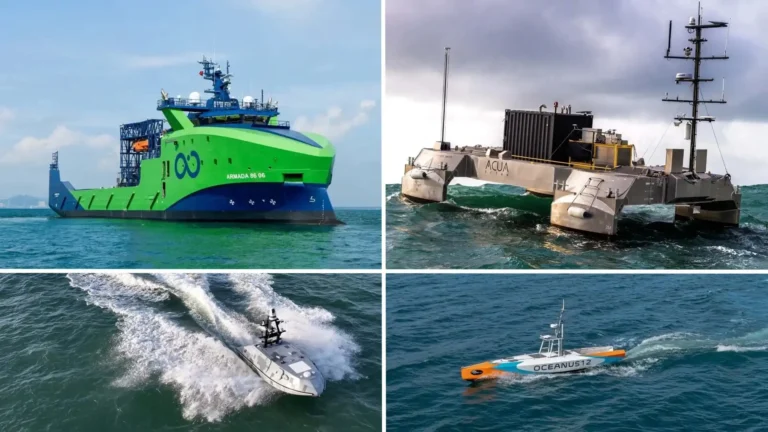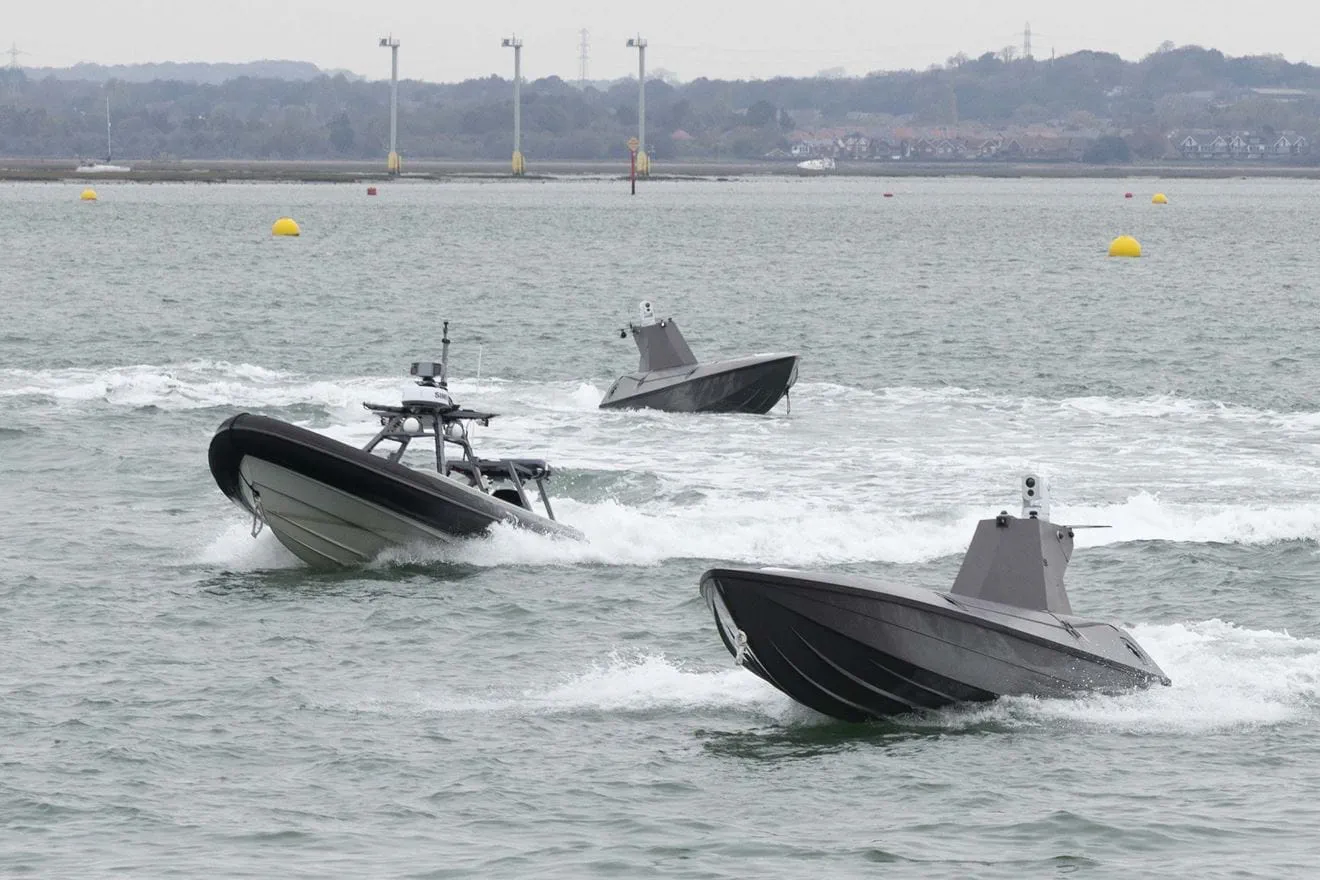
The Royal Navy commissioned its first autonomous squadron on November 5, 2026, at His Majesty’s Naval Base (HMNB) Portsmouth, creating a dedicated unit of around 180 personnel to operate uncrewed surface vessels (USVs) on front-line operations. Kraken and Rattler boats maneuvered around Portsmouth Harbour from a control hub during the ceremony, the service announced on November 9.
The commissioning moves the service’s Hybrid Navy concept, which pairs crewed warships with uncrewed and autonomous systems, from experimentation into standing force structure. The Ministry of Defence has committed at least £1.5 billion over four years to the effort. The announcement came as allied military and political leaders prepared to meet in Oslo for the Atlantic Future Forum and the International Sea Power Conference, with Northern European security on the agenda. Defence Secretary Wes Streeting tied the investment to deterrence and to the speed of military innovation.
How the Royal Navy Autonomous Squadron Replaces Project Beehive
The 1st Autonomous Squadron replaces Project Beehive, the navy’s initial effort to procure crewless boats as a proving ground for hybrid technologies. Its strength matches the crew of a Type 23 frigate, according to the navy, and personnel are divided into two watches to sustain round-the-clock operations.
Commander Helen Coxon commands the unit, which will employ USVs singly or within task groups alongside allies while bringing additional systems into service. That dual mandate makes the squadron both an operating unit and the navy’s route for introducing new uncrewed craft.
Expansion will be coordinated with Navy Develop, the Disruptive Capabilities and Technologies Office, and the Capability Accelerator. The Accelerator, established in 2025 and partly funded by UK Defence Innovation, has formally opened a new hub at HMNB Portsmouth, which the navy says will allow it to deliver more programs. Commander James Wagstaffe, its team leader, said the organization exists to help the National Armaments Group shorten the interval between identifying an operational need and fielding a capability. The Kraken and Rattler boats illustrate that model: off-the-shelf technology adapted for military use on a compressed timeline.
Fleet Commander Vice Admiral Steve Moorhouse described the hybrid force as offering “more reach, more striking power and more options,” while stressing that people remain central to it.
Kraken K3 Scout and Rattler USVs: Range, Payload, and Control
The Ministry of Defence awarded Kraken Technology Group a £12.3 million contract in March 2026 for 20 K3 Scout Medium USVs under Project Beehive, initially assigned to the Coastal Forces Squadron and 47 Commando Royal Marines. Delivery of the 20 boats was reported by the end of April. Manufacturer data lists an 8.4-meter hull with a 1.93-meter beam, 0.8-meter draft, and 2,500-kilogram maximum displacement. An inboard diesel with stern drive powers the twin-stepped hull to 55 knots, with a range of 650 nautical miles at 25 knots and mission-dependent endurance of up to 30 days.
The K3’s modular bay accepts 600 kilograms of payload. Kraken has not published a range at maximum speed, so the 650-nautical-mile figure should be read as a cruise value, which limits how far the boat can sprint to an intercept. The K3 can operate over beyond-visual-line-of-sight communications or local mesh networks. A Beehive-specification boat was also airdropped from an A400M transport in trials reported in July 2026, offering a way to place USVs in distant waters without a host ship.
Rattler, built by SYOS Aerospace, is a 7.2-meter boat first trialed as a seven-craft flotilla. In October 2025, operators aboard the experimental vessel XV Patrick Blackett in Portsmouth remotely piloted five Rattlers alongside HMS Tyne off Scotland from about 500 miles away. The navy’s announcement does not state how many boats of either type the squadron holds, what payloads they will carry, or whether any will be armed.
Analysis: The commissioning sets an organizational precedent more than a technical one. Assigning frigate-level manpower to a small-craft squadron tests the assumption that uncrewed mass saves personnel; at this stage, the navy is investing sailors to generate continuous control and a development pipeline. For NATO, a standing unit built to work with allied task groups gives the Royal Navy a formal interface for uncrewed operations in Northern European waters.
Next markers include the squadron’s first operational tasking, its force mix, and any new USV classes it absorbs. First Sea Lord General Sir Gwyn Jenkins said in an April 29 speech that he aims to have uncrewed escorts sailing with warships within two years, and the Ministry of Defence plans a prototype uncrewed missile platform by 2030. The split of hybrid funding across vessel types remains to be worked out with industry.