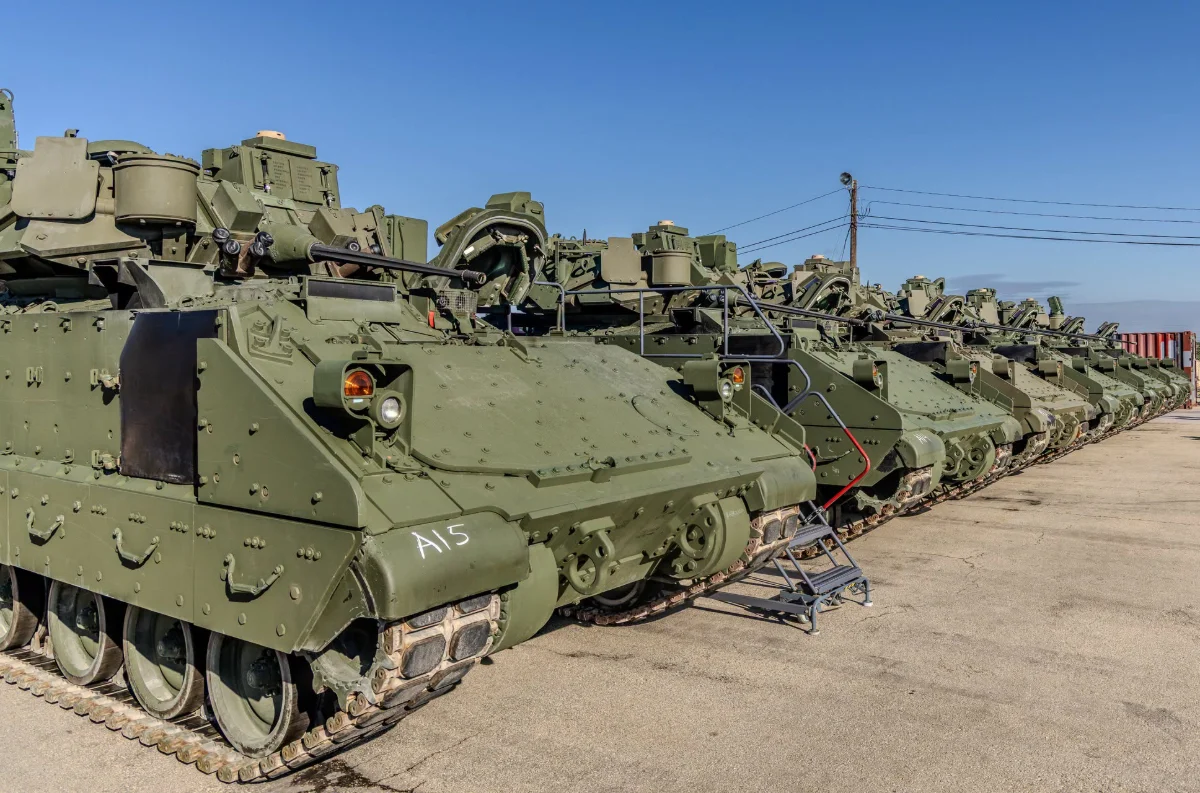
The U.S. Army’s 1st Cavalry Division has begun fielding the M2A4E1 Bradley Fighting Vehicle, the first Bradley variant equipped with a hard-kill active protection system (APS), to its 6th Squadron, 9th Cavalry Regiment at Fort Hood, Texas. The division announced the deliveries on October 5, 2026, alongside the M7A4E1 Bradley Fire Support Team Vehicle (BFIST) fielding to the 2nd Battalion, 82nd Field Artillery Regiment.
Both units belong to the division’s 3rd Armored Brigade Combat Team (ABCT), “Greywolf.” Congress added funding in fiscal 2022 toward equipping a full Bradley brigade with Iron Fist in 2025; this fielding arrives more than a year after that target. The Army unveiled the M2A4E1 in April 2024 in Saco, Maine, where the Program Executive Office for Ground Combat Systems (PEO GCS) said it had funding to buy one for every Bradley donated to Ukraine. The division has not disclosed how many vehicles the squadron received or when brigade fielding will be complete.
Inside the M2A4E1 Bradley: Iron Fist, Power, and Sensor Upgrades
According to PEO GCS, the E1 configuration adds three elements to the M2A4 baseline: Elbit Systems’ Iron Fist Light Decoupled (IF-LD) APS, an improved high-definition forward-looking infrared (FLIR) gunner’s sight, and an environmental control unit that reduces heat stress on the dismounted squad.
Iron Fist places four detection blocks on the turret, combining radar with electro-optical and infrared sensors, and two trainable launchers. Once the system calculates that an incoming round is on an impact trajectory, a launcher fires an explosive interceptor that detonates near the threat. Elbit markets the system against anti-tank guided missiles (ATGMs), rocket-propelled grenades, loitering munitions, small drones and kinetic energy tank rounds, and says the interceptor’s combustible casing limits fragmentation risk to nearby infantry.
That protection layer depends on the power margin the A4 recovered. The M2A4 bundles two engineering change proposals: ECP1 restored suspension capacity with stronger torsion bars, new shock absorbers and lighter track, while ECP2 installed a 675 hp Cummins VTA903E-T675 diesel, up from 600 hp on the M2A3, coupled to an HMPT-800-3ECB transmission with integrated power management and an upgraded generator. BAE Systems lists the A4 at a combat weight of 80,000 lb (36,287 kg), a top speed of 66 km/h and a range of 402 km. GD-OTS figures put the IF-LD installation at roughly 329 kg, with a power draw of 610 to 820 W in operation.
Firepower is unchanged: the three-person crew retains the M242 25 mm Bushmaster, the M240C 7.62 mm coaxial machine gun and the twin TOW launcher. The E1 buys survivability, not lethality, after the losses ATGMs and first-person-view (FPV) drones have inflicted on armored vehicles in Ukraine, including U.S.-supplied Bradleys.
Iron Fist Test Record, Contracts, and the M7A4E1 Fire Support Variant
Iron Fist testing on the Bradley began in 2018 and exposed power-related failures and a fault in the interceptor’s ignition train. Elbit and lead integrator General Dynamics Ordnance and Tactical Systems (GD-OTS) then reworked the installation, changing sensor placement, cabling, the countermeasure and the intercept software. The redesigned IF-LD completed live-fire testing in October 2022, including at Aberdeen Test Center in Maryland, and defeated threats about 70% of the time, according to the Bradley program office. Elbit also demonstrated counter-drone engagements in Israel with the same configuration.
During a September 2022 soldier touchpoint, senior noncommissioned officers asked that commanders be able to place protection zones in standby while dismounts load and unload, according to the Pentagon’s test office, which expected the Army to repeat the testing with production-representative kits before a limited user test in fiscal 2025.
Elbit received two Bradley Iron Fist orders through GD-OTS in 2024, then announced on January 26, 2026, a $228 million follow-on subcontract to be executed over three years, tied to a September 29, 2025, government award to GD-OTS for the Bradley APS effort. Published details of the program describe an eight-year GD-OTS effort that could cover more than 1,200 vehicles.
The M7A4E1 shares the A4 chassis and power architecture. The BFIST carries the fire support teams that locate targets and coordinate artillery and air strikes for Abrams and Bradley formations, with targeting and designation equipment in place of the TOW launcher. The division cited improved mobility, power and digital systems for the variant but did not say whether its vehicles carry Iron Fist.
Analysis: The fielding turns Bradley active protection from a test article into brigade equipment, but coverage stays partial. The Army’s reported procurement objective of 1,329 M2A4 and M7A4 vehicles spans nine ABCTs, and Iron Fist is tied to the A4 rather than older M2A3s. Inside protected units, a 70% defeat rate in 2022 testing, a finite interceptor load and the slow, steep, repeated attack profiles of FPV drones mean the system raises the cost of killing a Bradley without closing the drone threat. Short-range air defense, electronic warfare and dispersion still carry most of that burden.
The next markers are the scale of the Greywolf fielding, published results from production-kit testing, and which brigades follow. The successor program runs in parallel: General Dynamics Land Systems and American Rheinmetall Vehicles delivered their first XM30 Mechanized Infantry Combat Vehicle prototypes in late August and on September 1, 2026, respectively, for operational testing at Fort Hood this fall, after Army leadership declined to sign off on a Milestone B decision in February 2026. Until the XM30 is settled, the M2A4E1 remains, by the Army’s own description, its most survivable Bradley.