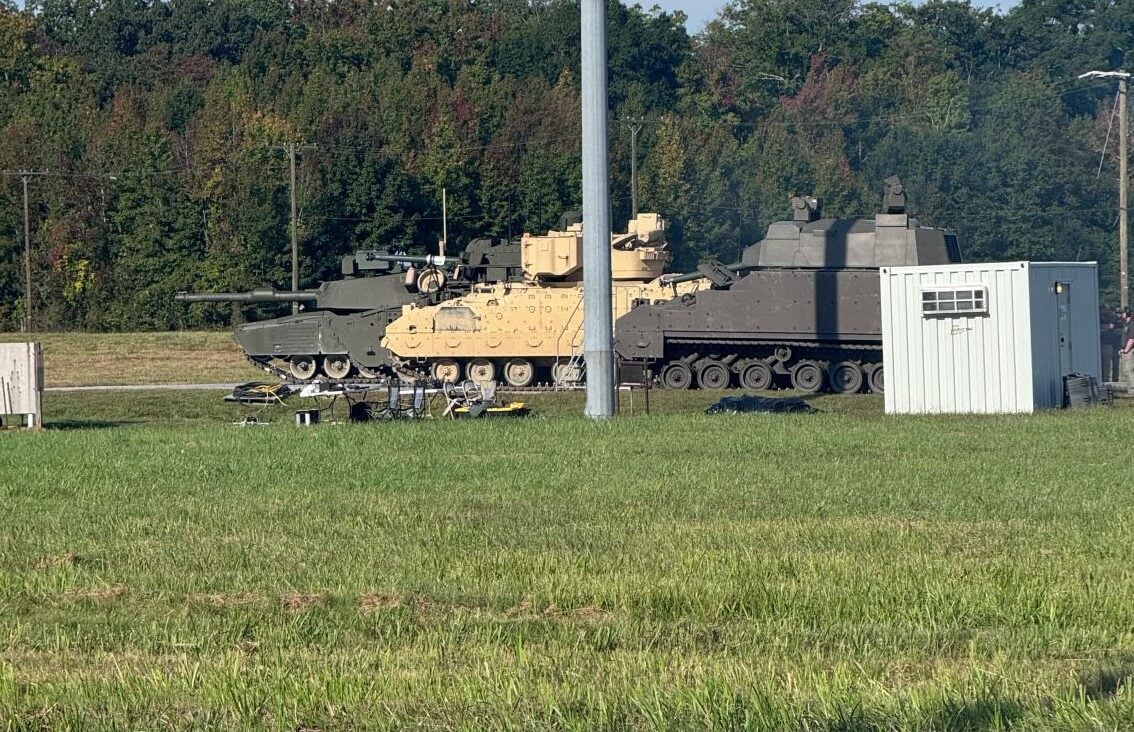
The U.S. Army’s M1E3 Abrams pre-prototype and XM30 Mechanized Infantry Combat Vehicle prototypes fired live rounds on October 2, 2026, during an event attended by Alexander Miller, chief technology officer to the Army chief of staff, according to footage Miller posted on LinkedIn the following day. Miller wrote that he went hands-on with the M1E3, one of the XM30 offerings, the Mobile Tactical Cannon and new optics, and watched robots from Operation Jailbreak Falcon Fury shoot down drones. He did not disclose the location or the units involved.
The event paired three top ground modernization programs with the Army’s counter-drone integration push as the first M1E3 and XM30 prototypes prepare to reach soldiers at Fort Hood, Texas, this fall. “Mass still matters,” Miller wrote, arguing that taking and holding ground requires affordable mass paired with autonomy, mission planning at machine speed and scale, and execution at echelon, inside what he called the high-low mix.
M1E3 Abrams and XM30 Prototypes Head to the Iron Horse Brigade
The M1E3 replaced the M1A2 System Enhancement Package version 4 (SEPv4) upgrade, cancelled in September 2023 over weight growth. The early prototype shown at the North American International Auto Show in Detroit on January 14, 2026, was built by Roush Defense with General Dynamics Land Systems (GDLS). Publicly available specifications indicate a modified Caterpillar C13D inline six-cylinder diesel rated at 1,100 hp, paired with a SAPA ACT1075LP transmission integrating a 250 hp electric motor. That hybrid layout replaces the 1,500 hp AGT1500 gas turbine of the M1A2 SEPv3, which weighs more than 70 tons. The Army says the M1E3 is about 25 percent lighter and burns about 50 percent less fuel, with battery power supporting silent watch.
The crew drops from four to three, all seated in the hull, while the M256 120 mm smoothbore gun moves to an uncrewed turret fed by an autoloader, the first on an Abrams. Four Roush-built pre-prototypes are due at the 1st Armored Brigade Combat Team, 1st Cavalry Division, known as Iron Horse, with GDLS delivering additional vehicles.
The same brigade will receive both XM30 candidates. American Rheinmetall delivered the first of eight Lynx XM30 prototypes, derived from the KF41, on September 1, 2026, and GDLS delivered its first XM30 Wolf to Aberdeen Proving Ground, Maryland, around the same time. Publicly available program requirements call for a two-soldier crew, room for six dismounts and an uncrewed turret built around the XM913 50 mm cannon. The two teams shared $1.6 billion in 2023 contracts to replace the M2 Bradley, in service since 1981.
How Hanwha’s K9 and Jailbreak Robots Feed the High-Low Mix
The Mobile Tactical Cannon program aims to replace the towed 155 mm M777 howitzer in selected formations with a wheeled, self-propelled gun able to fire and displace quickly. On August 18, 2026, Hanwha Defense USA announced the Army had selected its K9 Mobile Howitzer (K9MH), a wheeled variant of the tracked K9 Thunder with a 52-caliber 155 mm gun, for six prototypes and an option for 12 more. The award follows the 2024 cancellation of the Extended Range Cannon Artillery program, with Stryker brigade combat teams first in line for fielding.
Operation Jailbreak is the Army’s first Right to Integrate sprint, launched at Fort Carson, Colorado, in May 2026 with roughly 600 engineers from more than 50 companies required to expose and document their interfaces. Counter-drone and air defense systems came first, driven by the tens of thousands of interceptors the Army rushed to the field during Operation Epic Fury against Iran. Miller did not identify the robots or effectors used in the Falcon Fury iteration. Epirus has said it connected its Leonidas high-power microwave weapon to a wider command network during the event.
NGC2, IBCS-M and the Power Problem Behind Affordable Mass
Miller described the infrastructure layer as unglamorous but critical. Next Generation Command and Control (NGC2), a program of record since April 2025, supplies the data platform and access patterns for tools and applications. On June 22, 2026, the Army set an NGC2 common data layer baseline led by Anduril Industries, which prototyped the full stack with the 4th Infantry Division. The Integrated Battle Command System-Maneuver (IBCS-M), built on Anduril’s Lattice software selected in November 2025, provides fire control and asset management for counter-drone sensors and effectors, letting one operator manage multiple threats.
Attritable drones reach units from the Defense Innovation Unit’s (DIU) Drone Dominance Program through a drone marketplace, Miller wrote. The four-phase, $1.1 billion program aims to field hundreds of thousands of low-cost one-way attack drones by 2027. He added that the Army’s xTech Overmatch effort, coupled with DIU’s Autonomous Vehicle Orchestrator, a $100 million prize challenge to task mixed autonomous fleets in plain language, could extend orchestration across domains.
Miller also wrote that soldiers draw between 60 and 120 watts depending on loadout, nearly continuously, putting a squad close to 1 kilowatt before drone batteries are counted. He called mobile power without large visual, acoustic or infrared signatures critical.
Analysis: Miller’s post moves the high-low debate from platforms to integration and energy. The M1E3 and XM30 form the high end, both built on open architectures; the drones flowing through the Drone Dominance Program form the low end. Whether that mix fights as one force depends on a software layer bought separately from the vehicles, with Anduril leading in both NGC2 and IBCS-M, and on a power budget that grows with every drone added to a squad. His line on first contact, “Their blood, our steel,” states the intent plainly: robots and attritable systems absorb the opening engagement. Miller did not say how the Army plans to meet squad-level demand approaching 1 kilowatt without adding signature.
M1E3 pre-prototypes and both XM30 designs are due at Fort Hood this fall, ahead of a National Training Center rotation at Fort Irwin, California, in spring 2027 that could inform an XM30 downselect. Hanwha expects its first K9MH prototype this fall. The Army has not released results from the live-fire event.