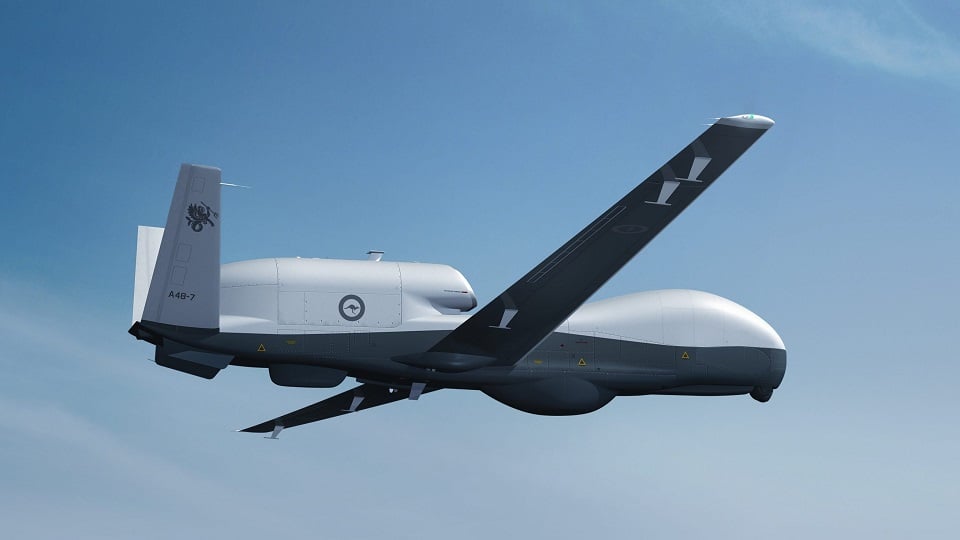
Naval Air Systems Command (NAVAIR) has awarded Northrop Grumman Systems Corp. a $66,041,453 firm-fixed-price delivery order to retrofit fielded MQ-4C Triton unmanned aircraft with 33 engineering change proposals (ECPs): 17 for the U.S. Navy and 16 for the Royal Australian Air Force (RAAF). The Pentagon announced the award on October 5, 2026. Placed under basic ordering agreement N0001925G0003, the order covers recurring engineering retrofit work, material, and spares, with completion expected in June 2030.
The order arrives as the Navy manages a truncated fleet. In 2023, the service cut the Triton program of record from 68 to 27 aircraft and its planned 24/7 orbits from five to three. It had taken delivery of 20 aircraft by 2025, and it lost one in a Class A mishap over the Persian Gulf on April 9, 2026; no cause was disclosed when the loss was confirmed. Australia, which acquires Triton through a Cooperative Program with the Navy, has received three of its four aircraft.
MQ-4C Triton Retrofit Covers 33 Engineering Changes Across Two Fleets
Recurring engineering covers the per-aircraft work of installing changes whose design has already been developed, as opposed to the non-recurring engineering that creates them. In practice, the contract pays for kits, installation, and spares on aircraft already in service. The Pentagon described the effort as supporting fleet standardization and mission readiness. It did not identify the individual ECPs, how many airframes each affects, or whether the Navy and RAAF packages overlap.
Funding splits along national lines. Fiscal 2026 aircraft procurement (Navy) funds account for $53,606,096, about 81% of the total, and RAAF cooperative-program funds for $12,435,357, about 19%. Both amounts obligate at the time of award. The order was not competitively procured, consistent with configuration changes to a platform whose technical data rests with its original manufacturer.
Hayward, California, carries 63% of the work, and San Diego, where Northrop runs the Triton program, carries 31%. Red Oak and Waco, Texas; Tukwila, Washington; Elyria, Ohio; Irvine, California; and other continental U.S. locations take 1% each. Palmdale, California, where Triton is assembled, is not named in the workshare, which suggests component and kit work rather than airframe-level rework.
The contract structure also departs from earlier Triton retrofits. In August 2023, NAVAIR placed an $83.1 million cost-plus-fixed-fee order to bring two Navy aircraft, B9 and B10, and one main operating base to the Integrated Functional Capability 4 (IFC-4) multi-intelligence standard. Moving recurring retrofit work to a fixed price shifts cost risk to Northrop and indicates the government considers the changes mature enough to price.
Radar, SIGINT, and Endurance: The IFC-4 Configuration Both Fleets Operate
Both fleets operate the IFC-4 Multi-INT configuration, which reached initial operational capability with the Navy in 2023 and is the standard Australia ordered under AIR 7000 Phase 1B.
Publicly available specifications describe an airframe derived from the U.S. Air Force RQ-4B Global Hawk: 47.6 feet (14.5 meters) long, with a 130.9-foot (39.9-meter) wingspan and a maximum design gross takeoff weight of 32,250 pounds (14,628 kilograms). A single Rolls-Royce AE 3007H turbofan delivers endurance beyond 24 hours above 50,000 feet, a range of 7,400 nautical miles, and a speed of 320 knots, according to Navy data.
Unlike the Global Hawk, Triton adds a reinforced airframe and wing, de-icing, and lightning protection, letting operators descend through cloud to identify surface contacts before climbing back to altitude.
The primary sensor is the belly-mounted AN/ZPY-3 Multi-Function Active Sensor (MFAS), an X-band active electronically scanned array (AESA) radar with 360-degree coverage that the Navy credits with surveying more than 2.7 million square miles per mission. It works alongside the MTS-B (AN/DAS-3) electro-optical/infrared turret, the AN/ZLQ-1 electronic support measures (ESM) suite, and an Automatic Identification System (AIS) receiver.
IFC-4 adds signals intelligence through a low-band suite from Boeing subsidiary Argon ST and a high-band suite from Sierra Nevada Corp., with processing at the Top Secret/Sensitive Compartmented Information level. That package lets Triton take on collection missions flown by the crewed EP-3E Aries II.
It is also why configuration control matters: each ground station runs a five-person crew that includes a SIGINT coordinator, and both services plan to share data from identical aircraft. Diverging hardware baselines would complicate common software loads, spares pools, and airworthiness certification.
Analysis: The dollar value is modest, but the order shows how the Navy is managing a small, high-demand fleet. With the program of record capped at 27 aircraft and at least one airframe lost in 2026, availability depends on keeping every fielded Triton current and interchangeable rather than on new buys. The 19% Australian share also shows the Cooperative Program functioning as a cost-sharing tool for a four-aircraft partner.
Timing matters beyond the Pacific: on July 7, 2026, Denmark, Finland, Germany, and Norway signed a letter of intent to acquire up to five MQ-4Cs for a NATO-operated capability. A single, documented configuration baseline across the Navy and RAAF is what a third operator would inherit.
Work runs through June 2030. Next markers include delivery of the RAAF’s fourth aircraft, expected in early 2028, Navy progress toward its 27-aircraft objective, and whether the NATO letter of intent matures into a contract. The Pentagon has not disclosed which capabilities the 33 ECPs address or the retrofit sequence by airframe.