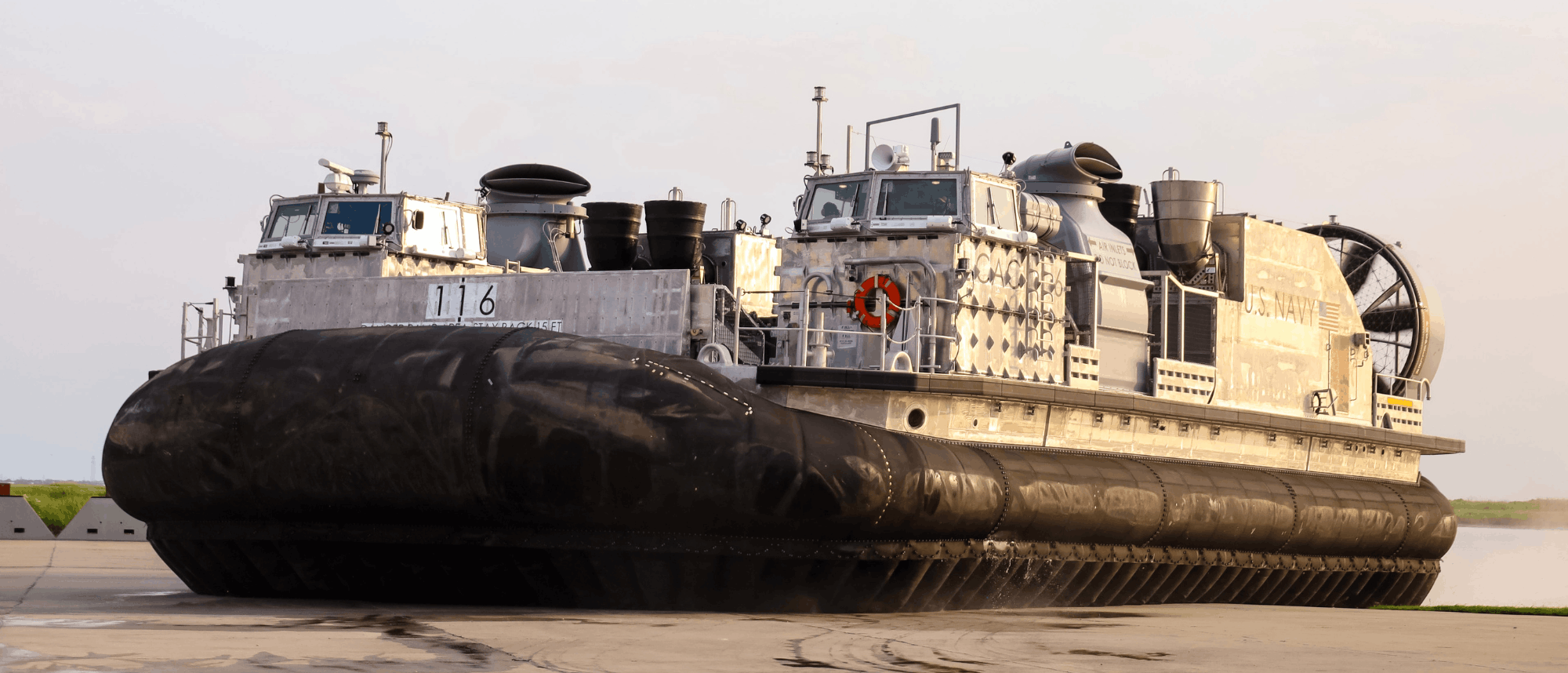
Textron Systems has won a $230 million contract modification from the U.S. Navy to build two more Ship-to-Shore Connector (SSC) air cushion landing craft, the company announced on October 6, 2026. The craft belong to the Landing Craft, Air Cushion (LCAC) 100 class and will be engineered, built and tested at Textron’s shipyard in New Orleans, Louisiana.
The order extends a production line that has delivered 18 craft to the Navy, with 13 more in testing or construction, according to Textron. The SSC is replacing the legacy LCAC fleet that entered service in the 1980s and has relied on a service life extension program launched in 2000. The program of record covers 72 operational craft plus one test and training craft, Craft 100. The two-craft buy matches the slower rate the Navy adopted for fiscal 2025 through fiscal 2028, a cut the Government Accountability Office (GAO) linked in part to limited procurement funding, although the fiscal 2025 order ultimately covered three craft.
Inside the $230 Million Ship-to-Shore Connector Contract Modification
The Pentagon’s contract announcement values the fixed-price incentive modification at $231.5 million, funded entirely with fiscal 2026 Shipbuilding and Conversion, Navy funds. Naval Sea Systems Command (NAVSEA) in Washington is the contracting activity, and work is expected to run through May 24, 2032. Most of it will take place in New Orleans, with smaller shares at nine other U.S. locations and one site in Gloucester, United Kingdom.
Textron said the scope covers engineering, manufacturing, and quality and test operations at the New Orleans yard. Larry D. Randle Jr., senior vice president of Marine Systems at Textron Systems, called the craft “a critical enabler for our nation’s amphibious operations.” The company credits the SSC with access to 80 percent of the world’s coastline, a figure that reflects the air cushion’s ability to cross tidal flats, shallow gradients and beach obstacles that stop displacement landing craft.
Divided evenly, the award implies roughly $115.7 million per craft, slightly below the approximately $118 million per craft implied by the $353.96 million fiscal 2025 modification for three SSCs. Those averages understate full unit cost: the Navy has bought material through separate actions, including a $312.4 million cost-reimbursable modification in July 2024 covering material and recurring and non-recurring work for up to nine future craft.
LCAC 100 Payload, Propulsion and Crew Compared With Legacy LCAC
Textron’s published specifications give the SSC a 74-ton payload, a 92-foot overall length, a 48-foot beam and a 26-foot height, with a 67-by-24-foot cargo deck totaling 1,608 square feet. Publicly available specifications rate the legacy LCAC at 60 tons, so the SSC adds roughly 23 percent of lift inside a footprint built to legacy dimensions and clearances. That compatibility lets the craft operate from existing well deck amphibious ships and Expeditionary Transfer Docks without reworking their well decks.
Power comes from four Rolls-Royce MT7 marine gas turbines derived from the AE 1107C turboshaft that drives the V-22 Osprey, offering parts commonality with the tiltrotor fleet; published ratings put each engine at about 4.6 megawatts. The craft reaches 35 knots in sea state 3 and is sized for ship-to-shore transits of about 25 nautical miles, letting amphibious ships stand farther offshore during a landing. Publicly available specifications indicate the legacy craft runs on four Avco Lycoming TF40B gas turbines.
The redesign also targets workload and maintenance. A fly-by-wire control system and a reduction from eight gearboxes to two cut mechanical complexity, and Textron lists a crew of four (pilot, co-pilot, loadmaster and deck engineer) against five on the legacy craft. A personnel transport module lets the deck carry up to 145 troops or 108 casualties, and the design targets a 30-year service life. Program documentation names Marine Expeditionary Brigades and Army Brigade Combat Teams as supported assault elements; with the Marine Corps having divested its tanks, the 74-ton margin chiefly preserves single-lift transport of Army M1A2 Abrams tanks.
Delivery Delays, Gearbox Fixes and the Full-Rate Production Decision
The SSC reached the fleet late. Textron delivered Craft 100 in February 2020, roughly two years behind the original schedule, and the first fleet asset, LCAC 101, in August 2020. GAO assessments traced earlier slips to gearbox wear and slippage, propulsion control issues and cracking propeller blades, and a February 2015 fire at a supplier’s propeller plant forced production into a temporary facility.
Initial operational capability hinges on completing initial operational test and evaluation and fielding six fleet craft with Assault Craft Unit 4 in Virginia. GAO’s 2024 assessment projected that milestone for September 2024 and placed the full-rate production decision by January 2028, so current orders still precede formal full-rate approval.
Even with the new pair, fewer than half of the 73 planned craft have been delivered or placed into production, and at two craft per year the remaining balance would push procurement into the 2040s. GAO also reported that the program office had weighed a second shipbuilder but judged it infeasible below 10 craft per year, citing a perceived annual economic order quantity of five.
Analysis: The award sustains the line without accelerating recapitalization. Two craft a year keeps Textron below the five-craft economic order quantity the program office itself identified, removes any business case for a second source and extends reliance on legacy LCACs that entered service in the 1980s. For Navy and Marine Corps planners, connector throughput, not amphibious hull count alone, sets how fast heavy combat power crosses the beach, and a slow SSC buy caps that rate even if amphibious ship availability improves.
The next markers are fiscal 2027 shipbuilding appropriations, which will set the following year’s SSC quantity, and the full-rate production decision GAO expects by January 2028. Textron has not disclosed hull numbers or delivery dates for the two new craft beyond the contract’s May 24, 2032 completion date. Whether the Navy restores higher annual quantities after fiscal 2028 will determine how quickly the legacy fleet can retire.