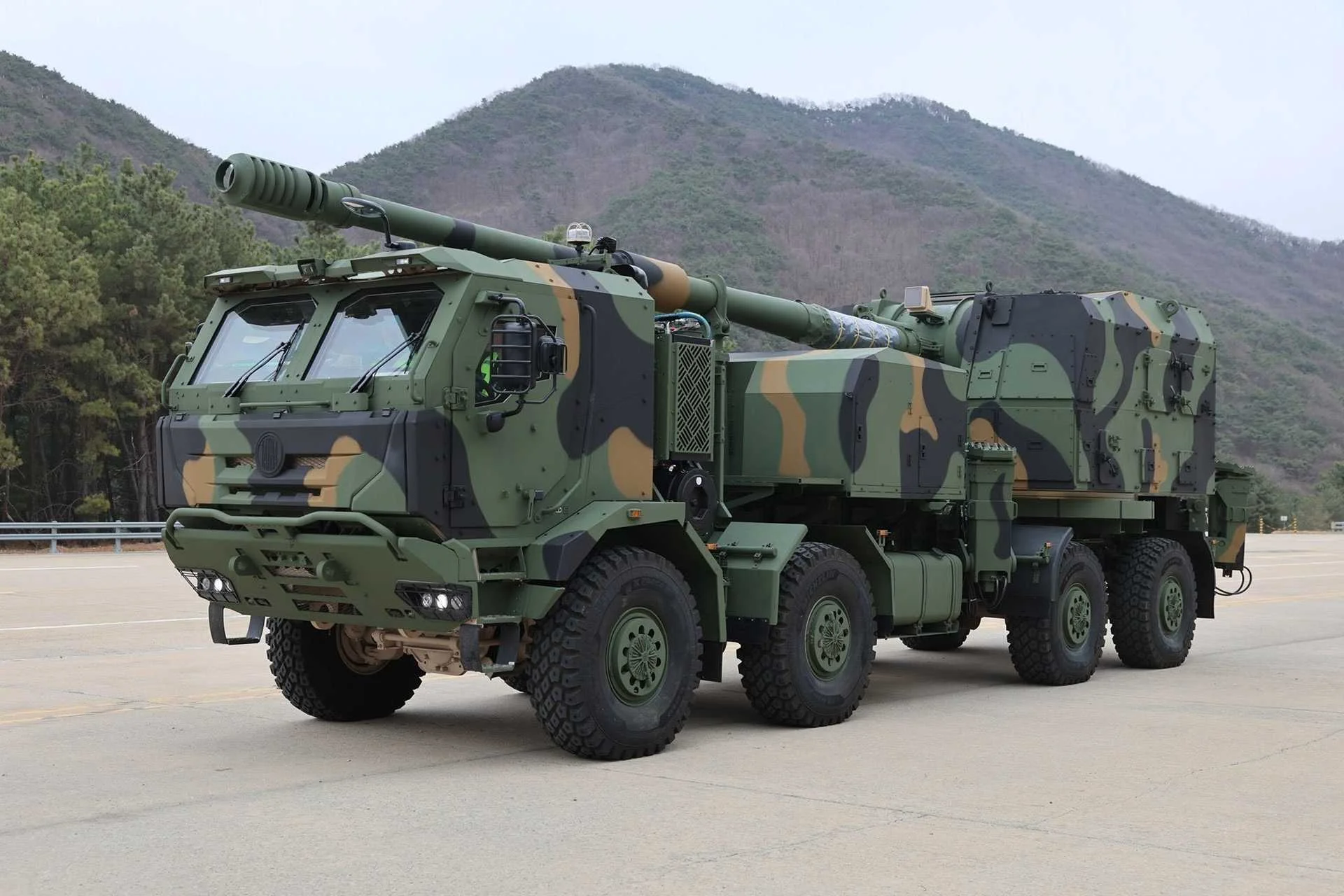
Hanwha Defense USA (HDUSA) has received a US Army order for three additional prototype K9 Mobile Howitzers (K9MH), raising the number of wheeled 155mm systems on order under the Mobile Tactical Cannon (MTC) program to nine, Shephard reported on October 7, 2026. According to the report, the order is the first exercise of a 12-system option attached to the six-prototype agreement awarded on August 18, 2026, and HDUSA will display a K9MH at the Association of the US Army (AUSA) annual meeting in Washington, DC, from October 12 to 14. Neither the Army nor Hanwha had publicly announced the order at the time of writing.
The reported top-up comes less than two months after award and fits the pace the Army has set for MTC since it ended the Extended Range Cannon Artillery (ERCA) prototyping effort in 2024 over barrel wear and turned to mature designs. The Other Transaction Authority agreement, awarded competitively under 10 U.S.C. Section 4022, is firm-fixed-price: $100,302,961 for the initial tranche and a total cumulative face value of $262,903,274 for up to 18 systems over an estimated four years. That leaves $162.6 million attached to the option; the value of the three-system tranche has not been disclosed. If fielded, MTC will replace M777 towed howitzers in select formations.
K9 Mobile Howitzer Prototype Deliveries and the MTC Option Path
At award, Hanwha executives said the first prototype would reach the Army in early fall 2026, with the other five of the initial batch delivered within a year, placing the last around August 2027. Those vehicles are built in South Korea and integrated at a site HDUSA leased in Opelika, Alabama, in April 2026. Neither the Army nor Hanwha has published a delivery schedule for the three additional systems, and open sources do not confirm whether the first prototype has formally been handed over.
Soldiers will run the prototypes through operational experiments assessing performance, reliability and supportability, according to the Army, and the resulting data will inform any fielding decision. The agreement does not commit the service to production. Hanwha executives have suggested a full-rate run could approach 500 systems, and earlier Army planning pointed to production around fiscal 2028; the Army has not confirmed a procurement objective. The K9MH was selected over competing wheeled designs that reportedly included Elbit America’s Sigma 155mm, a KNDS CAESAR variant, Rheinmetall’s RCH 155 and BAE Systems’ Archer.
Automated K9A2 Turret on an 8×8 Chassis: Inside the K9MH Design
Hanwha Aerospace began formal K9MH development in December 2024 under a 30-month program ending in June 2027 and rolled out the first complete vehicle in March 2026. The company repackaged the K9A2’s automated artillery functions as a minimally modified, truck-agnostic module. The prototype rides on a third-generation Tatra Force 8×8 chassis with an armored forward cab and four rear stabilizers that transfer recoil into the ground; Hanwha has also shown the module on a Mack Defense chassis, an option that matters if the Army prioritizes a US-built carrier.
The armament is the Hyundai WIA CN98 155mm/52-caliber gun, compliant with the NATO Joint Ballistics Memorandum of Understanding. Projectiles and modular charges travel through separate automated handling paths, so a crew of three fights the gun from the cab, against five on the tracked K9. Across a six-gun battery, that cuts onboard gun crew from 30 to 18 soldiers.
Publicly available specifications indicate a maximum rate of fire of 8 to 9 rounds per minute; in a 2026 demonstration, the prototype fired nine rounds in 59 seconds. It can fire about 20 seconds after halting and emplaces or displaces in under 30 seconds. Range is about 40 km with conventional ammunition and exceeds 60 km with extended-range or rocket-assisted projectiles. The vehicle weighs an estimated 40 tonnes, is 3.4 m wide, and reaches 100 km/h with a 700 km road range. Its 40-projectile, 192-charge magazine represents roughly five minutes of fire at maximum rate, which makes the planned wheeled derivative of the K10 Ammunition Resupply Vehicle central to sustained operations.
M777 to Mobile Tactical Cannon: What Wheels Change for Army Fires
Publicly available specifications for the M777A2 indicate a 4,218 kg towed howitzer with a 39-caliber barrel, a nominal crew of eight, and ranges of about 24 km with standard rounds and 40 km with the M982 Excalibur guided shell. It depends on a prime mover and takes minutes rather than seconds to come into and out of action. Against counter-battery radar and persistent drone surveillance of the kind observed in Ukraine, those minutes define survivability, and the K9MH’s sub-30-second shoot-and-scoot cycle addresses that gap directly.
The trade-offs are concrete. At nearly ten times the M777’s weight, the K9MH cannot be sling-loaded by a CH-47 helicopter, and its width and mass affect bridge classification, rail movement and airlift planning. Hanwha says the K9MH is compatible with the Army’s full suite of munitions, but each US projectile, fuze and propellant combination still requires integration and qualification.
Analysis: If confirmed, exercising part of the option this early would signal that the Army wants a larger experimental fleet sooner than six vehicles allow. Nine systems could equip a full six-gun battery while three platforms continue technical and ammunition testing in parallel, compressing the path to a fielding decision. The top-up does not make the K9MH a program of record, however. Its industrial case rests on Hanwha shifting production from South Korea to US sites, and a Korean-designed system on a Czech chassis will face domestic-content scrutiny that the Mack Defense option only partly answers.
The next milestone is the AUSA display from October 12 to 14, the most likely venue for official confirmation. Open questions include the value and delivery dates of the three new systems, whether the Army exercises the remaining nine options, and which chassis it favors for production. Hanwha’s development program and the initial six-prototype deliveries both conclude around mid-2027, after which soldier experimentation will decide whether MTC moves toward a production run that could approach 500 guns.