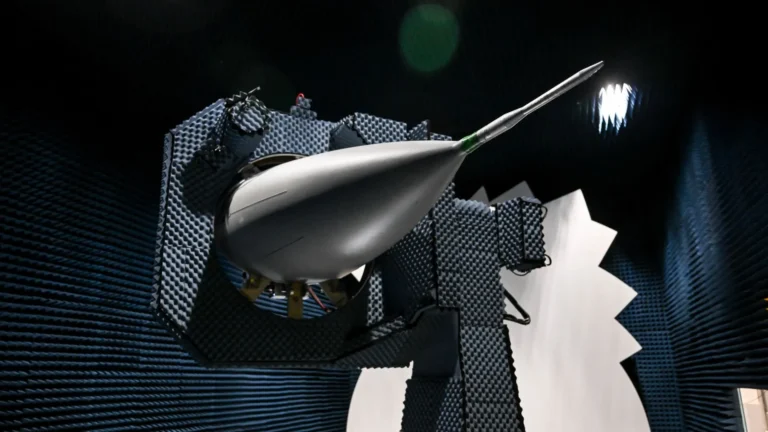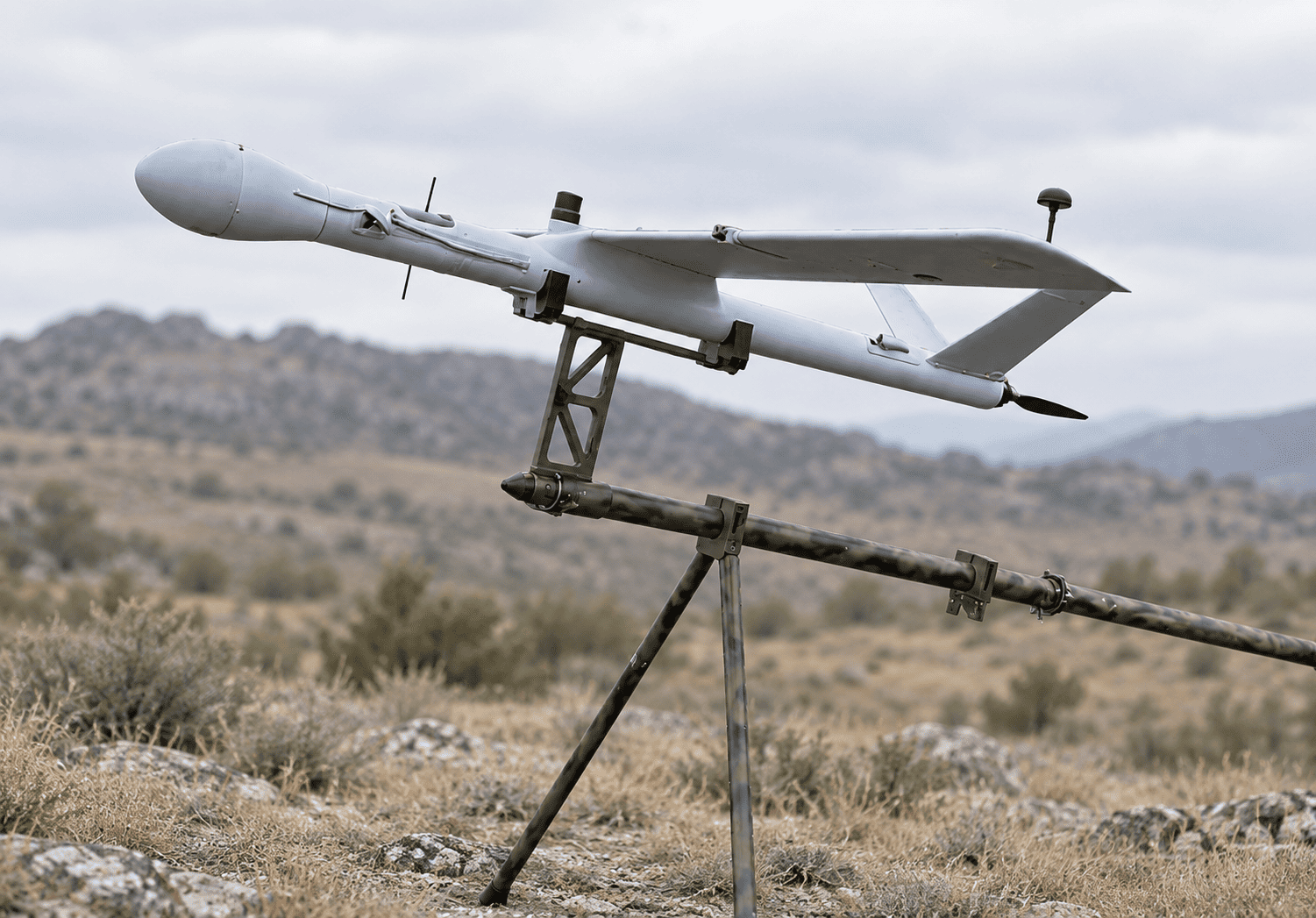
Ukraine’s state-run Brave1 Market has listed the SHOT-L1 drone, a fixed-wing strike munition that autonomously detects Russian electronic warfare (EW) emitters and dives onto the strongest signal it finds. Made public on October 6, 2026, the listing prices each unit at UAH 416,000, roughly $9,300, and names three Russian jamming systems as typical targets: the R-340RP Pole-21, the R-330Zh Zhitel and the Mgla. The manufacturer has not been disclosed.
The listing reflects Kyiv’s push to devolve procurement to fighting units. Brave1 Market, launched in 2025, lets brigades buy unmanned aerial vehicles (UAVs), ground robots and EW equipment with their own budgets or with ePoints earned for verified combat results. Troops ordered more than 590,000 drones through the platform between January and September 2026, according to Ukraine’s Ministry of Defense, which also identified fixed-wing kamikaze UAVs as the fastest-growing category. In September, Ukrainian forces struck a record number of Russian air defense assets and radars under the same ePoints scheme.
How the SHOT-L1 Drone Finds and Strikes Russian EW Emitters
The SHOT-L1 flies a two-phase mission. An operator directs the aircraft toward the area where a target is believed to be operating. Once inside the designated square, the onboard system scans for radio-frequency emissions, establishes the bearing of any source it detects and steers the airframe onto it without operator input. When several emitters are active at once, it selects the most powerful. If no signal appears within a preset window, the drone switches to a backup profile and attacks a static ground target designated before launch.
The manufacturer quotes a cruise speed of 100 km/h, endurance of up to 60 minutes, an operational range of up to 80 km and a payload of 4 kg. The sensor suite pairs a thermal imaging camera and an analog video link with a terminal guidance system for the final approach. Those figures set a tight search budget: at 100 km/h, a transit to the full 80 km consumes roughly 48 of the 60 available minutes, leaving about 12 minutes to find an emitter before the fallback logic takes over.
The listing does not disclose airframe dimensions, launch method, propulsion, warhead type or, critically, how the drone navigates to its search area when Pole-21 jammers deny global navigation satellite system (GNSS) signals. The analog video link is itself exposed to the jamming the SHOT-L1 is built to hunt, which makes the autonomous terminal phase central to the concept rather than an add-on.
The closest foreign analogue is Israel Aerospace Industries’ Mini Harpy. Publicly available specifications indicate it weighs about 40 kg, carries an 8 kg warhead, reaches 100 km and loiters for up to two hours with combined anti-radiation and electro-optical seekers. The SHOT-L1 offers roughly half that endurance and payload at a price a single brigade can pay from its own allocation.
Zhitel, Pole-21 and Mgla: Russian Jammers on the SHOT-L1 Target List
The three named targets cover distinct layers of Russia’s EW architecture. The R-330Zh Zhitel, built by Protek in Voronezh, is a truck-mounted station on a KamAZ-43114 or Ural-43203 chassis. Publicly available specifications indicate it detects, direction-finds and jams emitters from 100 MHz to 2,000 MHz, a band spanning Inmarsat and Iridium satellite communications, GSM-900/1800 cellular networks, GPS and many UAV control links, with jamming radii commonly cited at 20 to 25 km. Ukrainian estimates put a single Zhitel at around $10 million.
The R-340RP Pole-21, developed by Russia’s Electronic Warfare Scientific and Technical Center and adopted in 2016, works differently. It is a spatially distributed system that denies GPS, GLONASS, Galileo and BeiDou signals between 1,176.45 MHz and 1,575.42 MHz. Its jammer modules can mount on cellular towers, drawing power from the mast, and each is credited with an effective radius of at least 25 km. The Mgla is the least documented of the three; no detailed open-source specifications could be confirmed.
All three share a weakness. A jammer must radiate to function, and the antenna doing the radiating is both the source the seeker tracks and the system’s most fragile component. In a strike on a Zhitel in the Zaporizhzhia region, about 30 km behind the front line, Ukrainian drone operators disabled the entire station by hitting its antenna; Ukrainian assessments hold that such repairs can take months. A 4 kg payload is modest, but it does not need to destroy the truck to open a corridor for follow-on drone operations.
Analysis: The SHOT-L1 inverts the cost logic that has favored Russian EW since 2022. Measured against the Ukrainian $10 million estimate for a Zhitel, the exchange ratio exceeds 1,000 to one, and the strongest-emitter rule automatically prioritizes the high-power stations that do the most damage to Ukrainian drone operations. The obvious countermeasure is emission control, but a crew that shuts down its jammer to evade the seeker also stops jamming, which is the suppression effect the attacker wants. Anti-radiation missiles have imposed that dilemma on air defense radars for decades; the SHOT-L1 extends it to tactical EW at a brigade-level price.
The listing carries no information on codification, the formal approval that admits a product into service with Ukraine’s armed forces, and no combat results have been published. Nor has the manufacturer addressed seeker frequency coverage, decoy rejection or production capacity. Order volumes on Brave1 Market over the coming months will be the first indicator of whether front-line units consider the SHOT-L1 worth their ePoints.