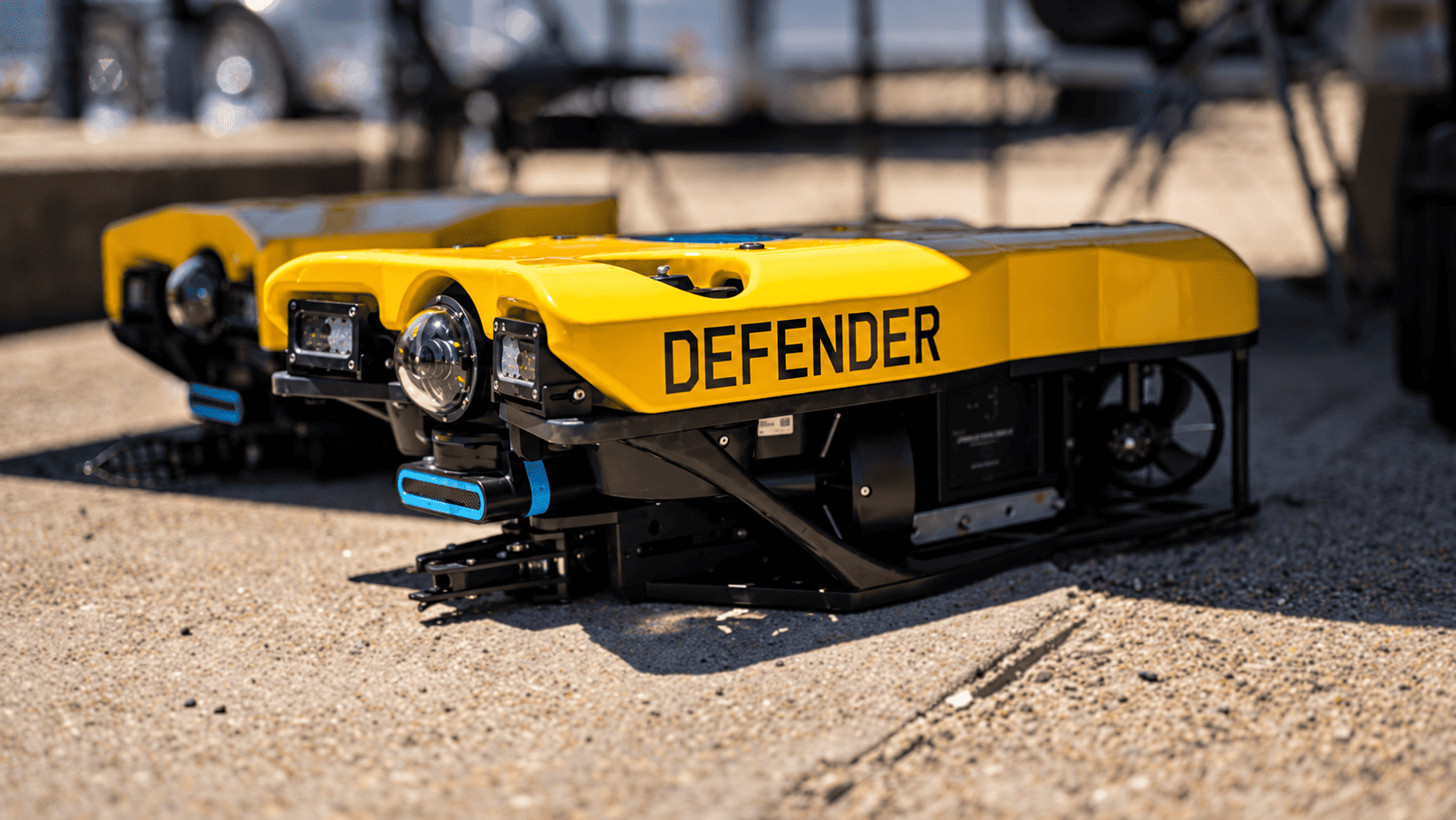
AeroVironment Inc. (AV) said on October 8, 2026, that wholly owned subsidiary VideoRay is part of an AEVEX-led team selected for a prototype Other Transaction Agreement (OTA) following the U.S. Navy and Defense Innovation Unit (DIU) Mine Countermeasure (MCM) Modernization Prize Challenge. The team paired a VideoRay Mission Specialist Defender remotely operated vehicle (ROV) with an AEVEX unmanned surface vessel (USV) using autonomous launch and recovery, controlled over the horizon from a remote ground station. The value of the agreement has not been disclosed.
DIU and the Navy’s Direct Reporting Portfolio Manager for Robotic and Autonomous Systems (DRPM RAS) launched the $10 million challenge on May 29, 2026, amid Iranian mining of the Strait of Hormuz. Of 80 applicants, 11 companies were invited to on-water testing, and BeeX, BlackSea Technologies and Vatn Systems were named prize winners this month. BlackSea now sits within AEVEX Maritime Systems after AEVEX agreed in August to buy the Baltimore-based builder for up to $650 million.
Inside the AEVEX-VideoRay Mine Countermeasure Prototype Demonstration
The challenge targeted commercial systems at Technology Readiness Level 7 or higher, fieldable within six months and able to integrate on a USV of the Navy’s choosing. DIU built it around three mission tracks: near-surface and volume mine engagement down to 50 meters, bottom mine detection, and bottom mine engagement against targets on the seabed at depths up to 300 meters. The bottom engagement track required navigation without satellite positioning and station keeping within plus or minus 1 meter during the terminal neutralization profile. Solutions also had to work over degraded, encrypted links, with no more than three operator decisions per track and human approval before any neutralization.
During competitive in-water trials, the AEVEX entry ran the full sequence autonomously: vessel transit, station keeping, ROV launch and recovery, target investigation, simulated neutralization and post-engagement assessment. VideoRay also worked with ECS Special Projects Ltd., a UK firm that has integrated its twin-shot Viper Mine Disposal System on the Defender since 2020, with charges initiated by surface shock tube or acoustic signal. AV did not specify the role ECS played in the trials, and neither AV nor the Navy has said which track the team competed in. Vatn Systems says its SIGURD system won the near-surface and volume track.
Mission Specialist Defender: Seven Thrusters and a 1,000-Meter Rating
Publicly available specifications indicate the Mission Specialist Defender is VideoRay’s heaviest-duty configuration: a 17.2-kilogram (38-pound) vehicle measuring 71.1 by 39.4 by 23.8 centimeters and driven by seven brushless thrusters, four vectored horizontal and three vertical. That layout delivers six-degree-of-freedom control with active pitch, allowing the vehicle to point sensors or tooling straight down at a bottom target, and the manufacturer rates it for currents up to 4 knots. Depth rating is 300 meters as standard, with a 1,000-meter option, covering the challenge’s 300-meter bottom-mine ceiling without modification.
The vehicle draws 1 to 2.4 kilowatts from a 110/220-volt AC supply, while an optional 400-volt DC power module feeds up to 1,500 watts at 48 volts to payloads through five 100-megabit Ethernet ports and five RS-485 ports. Optional subsea batteries remove the need for topside power. Typical mission fits include Blueprint Subsea Oculus multibeam imaging sonars, manipulators, and third-party navigation and autonomy software from Greensea Systems or SeeByte. That open architecture lets a small ROV serve as the terminal element of a kill chain hosted on another company’s USV.
The Navy already fields the type. It selected the Defender as the base vehicle for the MK20 Defender ROV under the Maritime Expeditionary Standoff Response (MESR) program, which equips explosive ordnance disposal (EOD) teams, and in May 2024 awarded VideoRay a $92.6 million, five-year indefinite-delivery/indefinite-quantity contract for production, sustainment and development. An established logistics, training and spares pipeline eases the move from prize demonstration into fleet kits on a six-month timeline.
Avenger Retirements and Hormuz Mining Drive Standoff MCM Demand
The Navy’s dedicated mine countermeasures fleet is shrinking. Four Avenger-class mine countermeasures ships were decommissioned in Bahrain in 2025, leaving four in service, all forward-based at Sasebo, Japan. The Pentagon’s Director, Operational Test and Evaluation has found elements of the MCM mission package aboard Independence-class littoral combat ships not operationally suitable for sustained minesweeping. After Iran’s Islamic Revolutionary Guard Corps began laying mines along Hormuz shipping routes in early April 2026, U.S. Central Command said clearance of the transit routes, declared complete in late August, was led by Navy divers and SEALs.
Winning systems will be integrated into the fleet’s autonomous mine countermeasure kits. The host vessel brings industrial depth: according to AEVEX, BlackSea has delivered more than 350 USVs and its Baltimore facility can build roughly 40 a month, and the company plans to integrate its CompassX autonomy software, designed for GPS-denied navigation, with selected BlackSea platforms. “Mission Specialist Defender gives the Fleet a modular underwater platform that can integrate with different surface vessels and payloads,” said Chris Gibson, AV’s vice president of underwater uncrewed vehicles.
Analysis: The selection shows the Navy rebuilding mine countermeasures as a modular kit, not a dedicated hull: a USV carries a man-portable ROV already in the EOD inventory, and a human authorizes the final step from outside the threat area. That trades the area-clearance capacity of a minesweeper for speed and reduced risk at the point of engagement, the gap exposed when divers closed on live mines in Hormuz. Volume is the weak point. A small ROV with a limited charge load prosecutes few contacts per sortie, so throughput will hinge on how many USV-ROV pairs the Navy buys and how fast detection assets cue them.
The OTA’s value, quantities, delivery schedule and test plan remain undisclosed, including whether live charges will replace the simulated neutralization flown in trials. The next milestones are definitization of the prototype agreement, the first integration of the Defender into the Navy’s autonomous MCM kits, and whether CompassX is layered onto the BlackSea host before fielding. With winners named four months after launch, the six-month fielding goal now sets the pace.