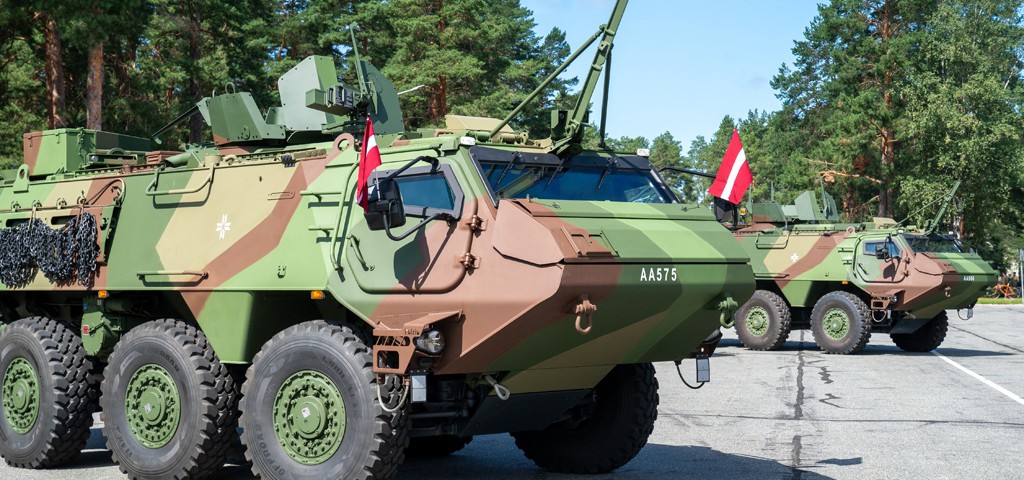
Patria laid the foundation stone on October 7, 2026, for the new Patria Latvia military vehicle production facility at the Valmiera Industrial and Export Park in Latvia’s Vidzeme region. The plant will build Patria 6×6 armored personnel carriers and assemble and maintain the General Dynamics European Land Systems (GDELS) Hunter infantry fighting vehicles ordered by the Latvian National Armed Forces (NAF). Construction is scheduled for completion in the third quarter of 2027.
Until now, Valmiera has produced only Patria 6×6 armored personnel carriers, under a 2021 contract in which Latvia’s Ministry of Defence ordered more than 200 vehicles for delivery by 2029. Defence Partnership Latvia, a Patria majority-owned joint venture with Latvian partner Unitruck, opened that plant on May 24, 2024, and handed the first Latvian-built vehicle to the NAF on August 5, 2024. The new building, next door, adds a second vehicle family as Riga fields its first tracked infantry fighting vehicles to replace a legacy fleet of ex-British Combat Vehicle Reconnaissance (Tracked), or CVR(T), platforms.
How Patria Latvia Will Assemble and Sustain 84 Hunter IFVs
The Hunter program is the main driver behind the expansion. Latvia signed with GDELS-Santa Bárbara Sistemas in January 2025 for 42 infantry fighting vehicles valued at €373 million, then ordered 42 more for €387 million on June 30, 2025, bringing the fleet to 84 vehicles and the total investment to nearly €800 million. The Hunter is a Latvian configuration of the ASCOD 2 tracked platform and will primarily equip the Land Forces Mechanized Infantry Brigade.
GDELS builds the hulls at the Trubia plant in Asturias, Spain, while Patria Latvia handles final assembly, component integration, test preparation, and long-term maintenance. That work share covers roughly 30 percent of the domestic industrial participation Latvia required under the program. The first Hunter was presented at Patria Latvia’s Valmiera site in June 2026, marking the start of local final assembly, and Latvian officials expect full fleet deliveries in 2027.
Patria Chief Executive Panu Routila said the cooperation with GDELS shows how partnerships and local industry “can help deliver modern military capabilities to the Latvian National Armed Forces faster and more efficiently.” With the new building not due until the third quarter of 2027, the first Hunters are being assembled in existing infrastructure, while Patria says the new facility is planned to produce Hunters and provide full lifecycle support for the fleet.
Hunter IFV Specifications: ASCOD 2 Hull and UT30 Mk2 Turret
Publicly available specifications indicate the Hunter weighs up to 45 tonnes depending on configuration, carries a crew of three and up to eight dismounts, and accepts roughly 10 tonnes of additional payload. An MTU 8V199 diesel rated at up to 1,100 hp drives through a Renk HSWL 256B transmission on Soucy composite rubber tracks, giving a top road speed of 70 km/h and a range of about 500 km. Hull protection meets STANAG 4569 Level 4.
Firepower comes from the Elbit Systems UT30 Mk2 uncrewed turret, ordered by GDELS under a contract valued at approximately $100 million. The turret mounts a dual-axis stabilized 30 mm Mk44 Bushmaster II chain gun, a coaxial 7.62 mm machine gun, and an interface for Spike LR2 anti-tank guided missiles, a family already in Latvian infantry service in dismounted form. The turret does not penetrate the hull, preserving internal volume for the troop compartment.
The CVR(T) family the Hunter replaces is a 1960s-era light reconnaissance design never built to carry a full infantry squad under armor. The Hunter gives the Mechanized Infantry Brigade a vehicle that can fire on the move, engage armor at standoff range with Spike-series missiles, and deliver dismounts under Level 4 protection, a combination the legacy fleet never offered.
Patria 6×6 Production and the CAVS Supply Chain in Latvia
The Patria 6×6 line remains the backbone of the Valmiera operation. Latvia buys the vehicle through the Common Armoured Vehicle System (CAVS) program, a multinational procurement framework launched with Finland that Sweden and Germany have since joined, with Germany becoming a full member in January 2025. Riga added an order for 56 Patria 6×6 command-and-control vehicles in November 2024, and the Valmiera line has also built vehicles Latvia purchased for Ukraine.
Publicly available specifications indicate the Patria 6×6 has a combat weight of 24 tonnes and a payload of up to 8.5 tonnes. A Scania DC09 five-cylinder inline diesel delivers 294 kW and 1,870 Nm through a seven-speed automatic transmission. The vehicle carries a driver and commander plus up to 10 dismounts, or a three-person crew including a gunner with eight to nine dismounts. Baseline protection is STANAG 4569 Level 2, with an optional Level 4 kit.
Latvian firm EMJ Metāls manufactures armored hulls for the Valmiera line, and Patria presents the plant as one node in the wider CAVS security-of-supply network. Housing two vehicle families in adjacent buildings gives Latvia a single industrial site able to produce, repair, and upgrade both its wheeled and tracked fleets.
Analysis: The Valmiera expansion moves Latvia from vehicle customer toward regional sustainment base. A country of under two million people running Patria 6×6 and Hunter fleets in parallel cannot depend on depot work in Finland or Spain during a crisis, when Baltic Sea and Polish transit routes would compete with allied reinforcement traffic. Collocating production and full lifecycle support keeps battle damage repair, overhaul, and spare-parts flow on Latvian territory.
Defence Minister Raivis Melnis tied the project to “security of supply and resilience,” and both he and Patria framed the site as serving allied forces too, with CAVS partners operating the same 6×6 platform the obvious customers.
Construction now runs against a third-quarter 2027 completion date that overlaps with final Hunter deliveries and the back half of the Patria 6×6 schedule, which extends to 2029. Key unknowns remain: Patria has not published the investment value, capacity, floor area, or headcount for the new building, nor named the other defense industry projects it intends to host. Watch for follow-on CAVS orders, any Hunter buys beyond the 84-vehicle baseline, and whether allied operators begin routing 6×6 maintenance through Valmiera.