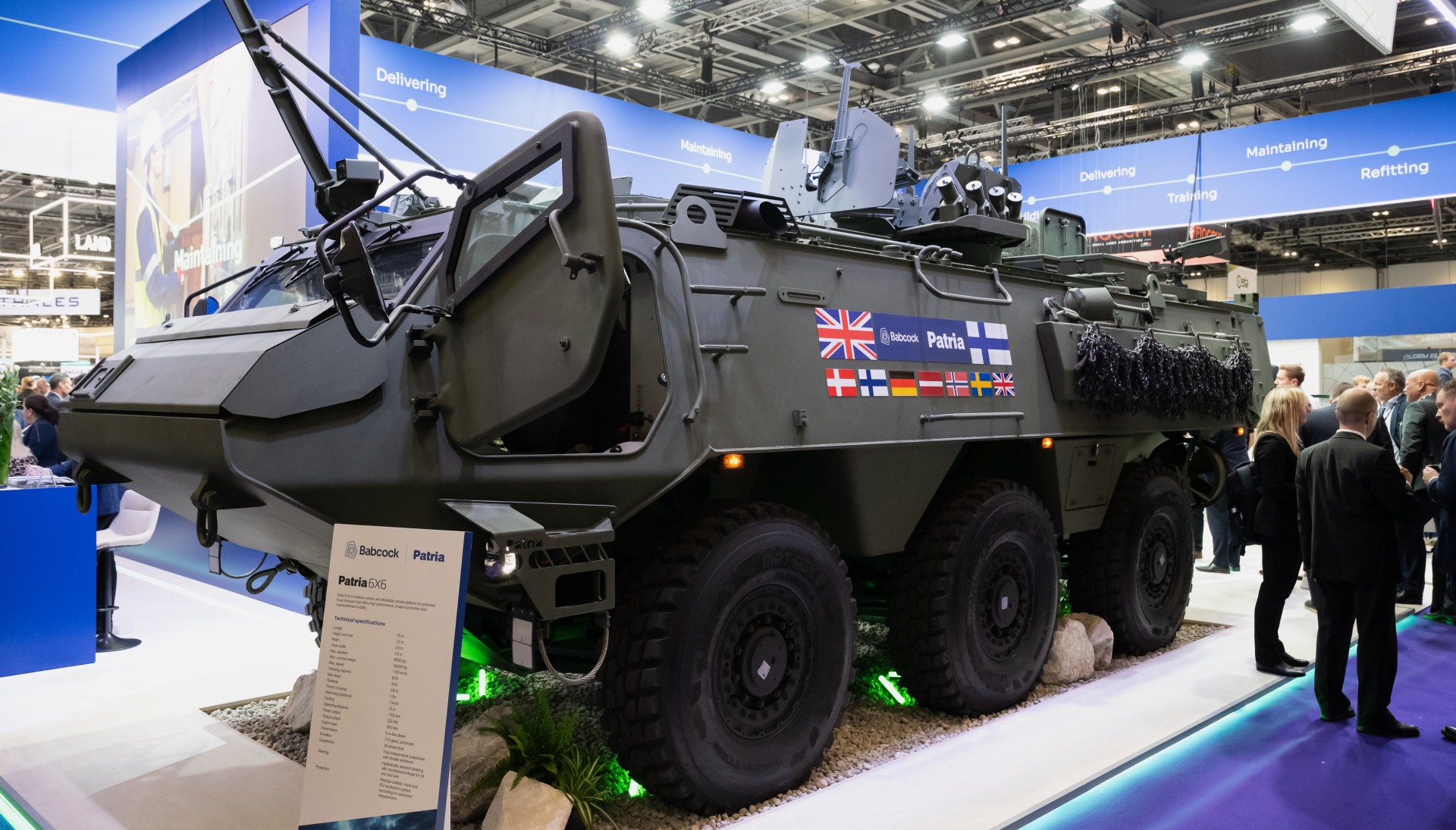
KNDS Deutschland and Finland’s Patria have reaffirmed their cooperation on the multinational Common Armoured Vehicle System (CAVS) program, the companies announced on September 30, 2026, after a working visit to Freisen, Saarland. The KNDS Deutschland Maintenance plant there will fit mission kits to the Bundeswehr’s Patria 6×6 armored personnel carriers (APCs) and perform their final assembly under an August 11, 2026 framework agreement.
The Freisen line sits at the center of Germany’s plan to replace its Fuchs armored transport fleet under the Transportpanzer Neue Generation (TPz NG) effort. On December 18, 2025, the Federal Office of Bundeswehr Equipment, Information Technology and In-Service Support (BAAINBw) signed two framework contracts with Patria for up to 876 Patria 6×6 vehicles. Patria put the combined value above €2 billion, roughly half of it in firm orders. Germany buys through CAVS, the Patria-led program launched in 2020 that now groups Finland, Latvia, Sweden, Denmark, Norway, Germany, and the United Kingdom.
CAVS 6×6 Final Assembly and Integration at KNDS Freisen
Under the August 11 agreement, KNDS Deutschland Maintenance works as a subcontractor to Patria for the assembly and final integration of 6×6 APCs destined for German units. The first series vehicles are built in Finland, then receive mission-specific kits and final assembly in Freisen. KNDS places the first Freisen work at the end of 2026; Patria says 2027. Both frame it as the first step of a technology transfer.
The visit brought together Patria board chairman Jyri Häkämies and Jussi Järvinen, head of Patria’s Protected Mobility business area, with KNDS Deutschland CEO Florian Hohenwarter and KNDS Deutschland Maintenance CEO Christoph Cords, who presented the KNDS work packages, the series production setup, and options to scale capacity. Neither company disclosed the subcontract value, a production rate, or how many of the 876 vehicles will pass through Freisen.
Freisen brings a deep maintenance base. KNDS Deutschland Maintenance employs more than 820 people there and services platforms from the MUNGO to the PUMA infantry fighting vehicle and the LEGUAN bridge layer, as well as the Fuchs the 6×6 will replace.
Hohenwarter said the group is “taking new paths as a system integrator” by contributing its know-how to CAVS through KNDS Deutschland Maintenance as a subcontractor to Patria, with the stated aim of strengthening European defense production capacity.
Patria 6×6 Protection, Mobility, and Mission Variants for the Bundeswehr
The Patria 6×6 is a three-axle wheeled APC that the Bundeswehr describes as highly mobile off-road, with a gross vehicle weight of 24 tonnes and amphibious capability. Patria specifies baseline STANAG 4569 Level 2 ballistic and mine protection, with enough payload margin for optional Level 4 protection on selected variants. The hull carries a crew of two, driver and commander, plus up to 10 dismounts, with internal stowage sized for a 72-hour mission. Continuous all-wheel drive, fully independent suspension derived from the Patria AMV XP, and steering on the front two axles define its mobility profile. Patria cites a design service life beyond 30 years.
Germany’s firm order covers five configurations, per public breakdowns of the December contracts: 10 APCs in the Swedish configuration, 170 engineer squad carriers, 48 armored reconnaissance squad carriers, 69 heavy mortar carriers armed with the 120 mm Patria NEMO turreted mortar, and 52 fire control vehicles. That totals 349 vehicles. Options cover 54 additional engineer carriers, 14 reconnaissance carriers, 61 mortar carriers, and 398 fire control vehicles. Part of the fleet will also mount the Kongsberg Protector RS4 remote weapon station.
Level 2 baseline protection positions the 6×6 as a protected mobility asset rather than a frontline fighting vehicle, suited to engineer and reconnaissance squads operating behind heavier mechanized formations. The NEMO carrier places a turreted 120 mm mortar on a wheeled chassis, allowing rapid fire-and-displace missions, a capability the Fuchs family does not provide.
How Technology Transfer Reshapes Germany’s Wheeled Armor Supply Chain
Security of supply shaped the industrial structure. BAAINBw presented the December contracts as delivering local manufacturing, maintenance, and supply security through German industry. Patria began building a German team in February 2024 with a KNDS maintenance subsidiary and Flensburger Fahrzeugbau Gesellschaft (FFG), planning engineering, production, and life cycle support across Freisen, Flensburg, and Kirchen.
Pre-series vehicles are already in German hands. Patria delivered five pre-series Patria 6×6 vehicles to the Bundeswehr’s wheeled vehicle evaluation and repair center at Zeithain, Saxony, in February 2026. They support verification of technical requirements, followed by user testing toward formal approval for use.
Saarland Minister-President Anke Rehlinger pledged support for expanding the site and building a regional supplier network, drawing in particular on Saarland’s automotive industry. Järvinen said the combination of Patria’s 6×6 expertise and technology transfer with KNDS’s local capabilities “strengthens security of supply, creates value in Germany and supports Europe’s defence manufacturing capacity.”
Analysis: The Freisen arrangement reverses the pattern of most German armored vehicle programs, where a domestic prime such as KNDS or Rheinmetall leads. Here a Finnish prime, owned 50.1% by the Finnish state and 49.9% by Norway’s Kongsberg Defence & Aerospace, leads design and development, and KNDS works as its subcontractor. For Berlin, the trade buys schedule: a platform already in serial production in Finland and Latvia, with German content phased in. For CAVS, a German integration line adds depth beyond the Nordic and Baltic production base. The limit is scope: final assembly is not hull manufacturing, and the value to Germany depends on how quickly Freisen moves up that ladder.
The next milestones are the first Freisen integrations, at the end of 2026 or in 2027 depending on the company statement, and completion of Bundeswehr testing on the pre-series fleet. Still undisclosed are Freisen’s planned output, the timeline for German hull production, and when Berlin will decide on the 527 optional vehicles. Those decisions will determine whether the Fuchs replacement becomes a German production line or remains a Finnish product finished in Saarland.