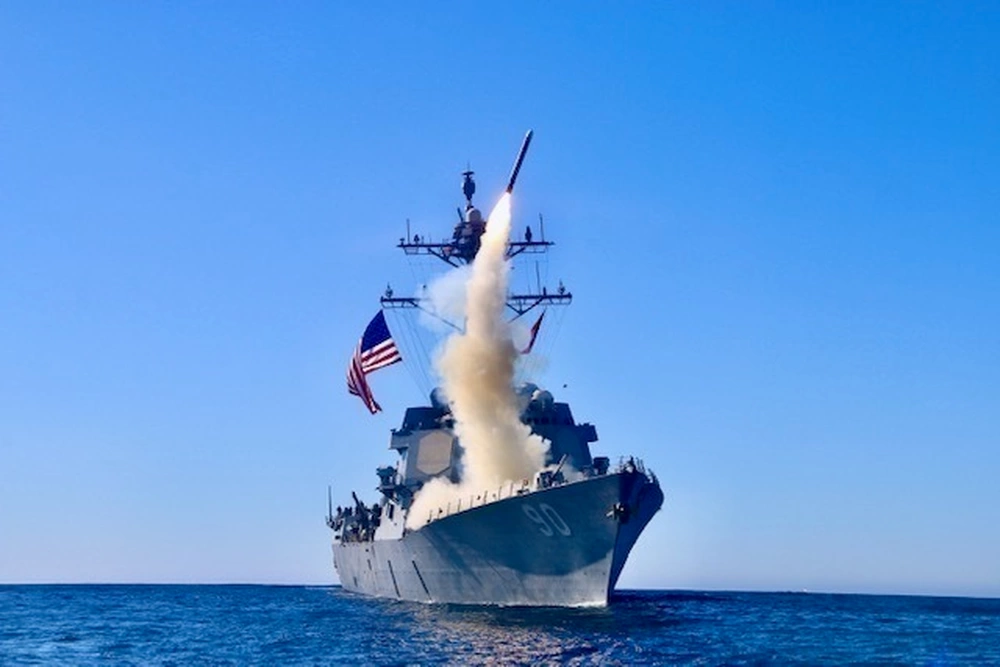
Naval Air Systems Command (NAVAIR) intends to award Raytheon a sole-source contract for low-rate initial production (LRIP) of the Joint Multiple Effects Warhead System (JMEWS), the hard-target warhead that defines the Tomahawk Block Vb cruise missile, according to a presolicitation notice published October 7, 2026. The action moves JMEWS out of engineering and manufacturing development (EMD) and into production. The notice discloses no contract value, quantity or delivery schedule.
The step comes as the US Navy rebuilds a Tomahawk inventory drawn down by Operation Epic Fury, the US campaign against Iran that began February 28, 2026. The Center for Strategic and International Studies estimated that 319 Tomahawks were launched in the first week alone, and published estimates put expenditure above 850 missiles within four weeks. In August 2026, Raytheon received a seven-year, $22.9 billion contract intended to lift annual Tomahawk output above 1,000 missiles. JMEWS addresses a different question: what each missile can destroy once it arrives.
Tomahawk JMEWS Warhead Moves From EMD to Low-Rate Production
The Tactical Tomahawk program office at Naval Air Station Patuxent River, Maryland, issued the notice under Federal Acquisition Regulation 6.302-1, which allows the government to negotiate with only one responsible source. The Navy states that Raytheon’s Tucson, Arizona, business has been the sole developer, designer and manufacturer of Tomahawk since 1994, and that RTX alone holds the current configuration and manufacturing data required for the work. The notice describes Raytheon as the only known source able to meet the required timeframe without duplicating costs.
The announcement is not a request for competitive proposals. Firms may submit capability statements until 4:00 p.m. EDT on October 22, 2026, and the Navy says it will consider them. Tomahawk technical data remains export controlled and unavailable to foreign sources.
LRIP follows an EMD phase launched in February 2020, when NAVAIR awarded Raytheon a $90.4 million contract to design, integrate, test and assess JMEWS for Tomahawk, with work in Arizona, Ohio, Minnesota and West Virginia. The program’s roots go back further: a $12.8 million Joint Capability Technology Demonstration contract in July 2009 funded the first integration work on the Block IV missile.
How the Two-Stage JMEWS Design Is Built to Defeat Hardened Targets
The Tomahawk Land Attack Missile has carried a 1,000-pound-class unitary warhead, publicly identified as the WDU-36/B, optimized for blast-fragmentation effects. JMEWS retains that blast-fragmentation capability and adds penetration in a single two-stage package. A forward charge breaches reinforced structure, then a follow-through element passes through the opening and functions inside the target. In a static test on August 16, 2010, the warhead cut a hole large enough for the follow-through element to fully penetrate a concrete target and pass through two witness plates. Penetration depth against specific concrete strengths has never been released.
The Navy designed JMEWS for bunkers, underground laboratories, missile facilities and large-area targets. Fuzing is programmable, and Raytheon has described reprogramming it in flight when an operator retasks a loitering missile against a newly identified target. That pairing carries operational weight: a commander can hold a missile in a loiter pattern, review imagery sent over the satellite datalink, then select a penetrating or area effect matched to the target.
JMEWS integrates onto the existing Block V all-up round. Publicly available specifications indicate a length of 5.56 m (18 ft 3 in) with booster and a 0.52 m (20.4 in) body diameter. A Williams International turbofan drives the missile at subsonic speeds above 550 mph, and Raytheon cites a range of about 1,600 km (1,000 miles). Block V adds an Advanced Communications Architecture and an anti-jam GPS receiver, and recertification extends each missile’s service life by 15 years. The Pentagon’s Director, Operational Test and Evaluation (DOT&E) judged the Block V upgrades operationally effective in 2021, including in a GPS-denied environment.
Block Vb Test Campaign and the 2027 Fielding Target
Block Vb is one of two mission variants in the Navy’s Block V modernization. The Navy received its first Block V missile in March 2021. The other variant, the Block Va Maritime Strike Tomahawk, adds a seeker to engage moving ships at sea.
DOT&E reported that the Navy conducted two JMEWS arena tests in fiscal 2023 and planned to complete the live-fire test campaign in the fourth quarter of fiscal 2026, which closed September 30. Its fiscal 2024 report noted further JMEWS testing but stated that warhead lethality had yet to be evaluated, and DOT&E has not published a lethality assessment since. In 2022, then-program manager Capt. John Red placed initial operational capability (IOC) for the JMEWS variant in 2027.
Analysis: The 2026 production ramp addresses how many Tomahawks the Navy can buy; JMEWS addresses what a single round can achieve. Hardened and buried targets have largely remained the domain of penetrating aircraft. In June 2025, B-2 bombers carrying GBU-57 Massive Ordnance Penetrators struck Iran’s deeply buried nuclear sites, while submarine-launched Tomahawks hit surface facilities. A Block Vb round places a penetrating option in destroyer and submarine launch cells, at standoff range and without exposing aircrew. Epic Fury showed how quickly cruise missile magazines empty under sustained strikes, so a warhead that defeats a hard aim point with fewer weapons has direct value for inventory management. That efficiency remains unproven until lethality data emerges. RTX has said the 1,000-per-year framework covers the Land Attack and Maritime Strike variants; how JMEWS rounds fit inside that ramp has not been disclosed.
Capability statements are due October 22, and the notice goes inactive on November 6, 2026. The Navy has not said when it expects to award the LRIP contract, how many warheads the first lot will cover, or whether JMEWS will be installed on new-build missiles, on Block IV rounds cycling through recertification, or both. The contract award, DOT&E’s lethality finding and the 2027 IOC target are the next markers to watch.