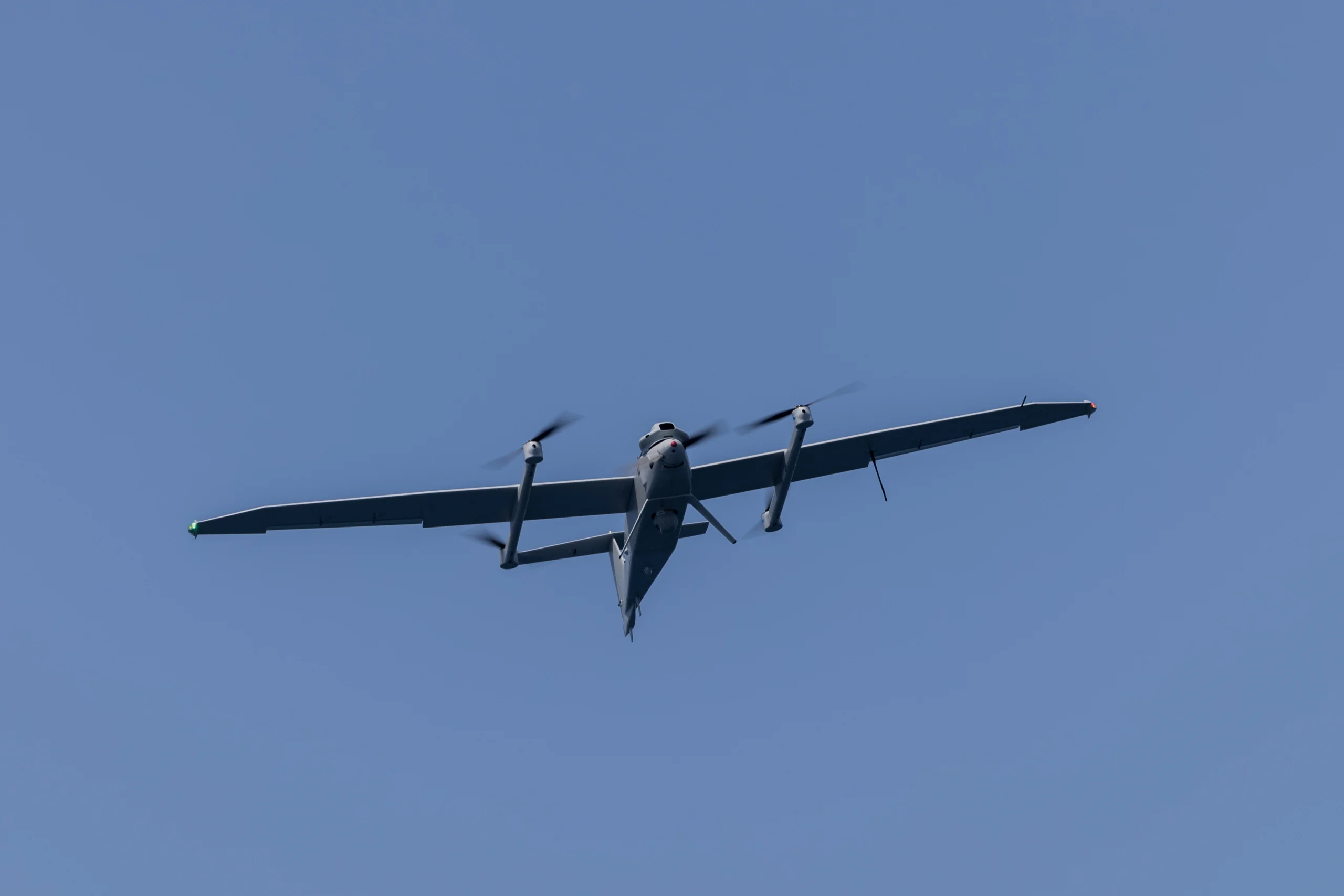
AeroVironment (AV) and Madrid-based Alpha Unmanned Systems announced a memorandum of understanding (MOU) on October 14, 2026, to explore in-country fielding, sustainment, training, maintenance, and in-theater support for AV’s JUMP 20 vertical takeoff and landing (VTOL) fixed-wing unmanned aircraft system (UAS), starting in Spain. Unveiled at the Association of the United States Army (AUSA) Annual Meeting and Exposition in Washington, the framework could later extend to other markets in Europe and Latin America.
The agreement builds on a growing European user base. Denmark’s Defence Acquisition and Logistics Organisation (DALO) selected the JUMP 20 in February 2025 under a contract with a $181 million ceiling, and Italy’s Ministry of Defence awarded AV a $46.6 million, five-year contract on April 21, 2025, to replace its Shadow fleet. In the US Army, the Germany-based 2nd Cavalry Regiment received a JUMP 20 in October 2022 under the Future Tactical UAS (FTUAS) Increment 0 effort to replace its RQ-7B Shadows. Spain has not announced a JUMP 20 purchase, and neither company disclosed a Spanish end user, program, or contract value tied to the MOU. Shane Hastings, AV’s senior vice president and general manager of uncrewed systems, framed the deal around readiness, saying a platform “only delivers value when operators can keep it flying.”
JUMP 20 Drone Specifications and the Sustainment Burden
The JUMP 20 traces back to Arcturus UAV, which AV acquired in 2021, and derives from the Arcturus T-20 airframe. It is a US Group 3 aircraft with a maximum gross takeoff weight of 97.5 kg (215 lb), a 5.7-meter wingspan, and a 2.9-meter length, which places it within NATO’s Class I category below 150 kg. A 190 cc fuel-injected gasoline engine powers cruise flight, while battery-driven electric rotors on twin wing booms handle vertical takeoff and landing. AV lists endurance above 13 hours, a datalink range of 185 km (115 mi), a 13.6 kg (30 lb) payload, and an operating altitude of 17,000 ft density altitude.
Runway independence is the operational selling point. Crews can set the system up in under 30 minutes, and it needs neither a runway nor a launch system. AV’s datasheet lists integrated electro-optical and infrared turrets including the Hood Tech 09EO960, L3Harris WESCAM MX-8, and Trillium HD80 and HD95.
The maritime JUMP 20-X, launched at IDEX in February 2025, adds a heavy-fuel, multi-fuel engine, a modular open systems architecture with STANAG-compliant communications, and autonomous launch and recovery from moving vessels. Engines, VTOL battery packs, and stabilized gimbals all generate recurring maintenance work, and AV framed the agreement as bringing training, maintenance, and sustainment closer to its European customers. That is the gap the MOU targets.
How Alpha’s GCASE, GTRACK and AIS Subsystems Could Fit JUMP 20
Alpha, founded in 2014 and based in San Sebastián de los Reyes on the northern edge of Madrid, builds fuel-powered unmanned helicopters. Its Alpha 800 weighs under 14 kg at maximum takeoff, while the heavy-fuel Alpha 900 stays under 25 kg and carries up to 4 kg of payload for up to four hours, according to company data. Operators include Spain’s Military Emergencies Unit (UME) and the Hellenic Navy. In November 2025, Alpha signed a separate MOU with Spanish state shipbuilder Navantia covering shipborne UAS.
Under the AV agreement, the partners will evaluate integrating three Alpha products into the JUMP 20: the GCASE ground control station, the GTRACK antenna tracking system, and an Automatic Identification System (AIS) module that receives and displays vessel identity and position data. The AIS module points directly at maritime domain awareness and the JUMP 20-X, giving operators a cooperative track picture to correlate against radar and electro-optical returns.
The GCASE question carries more weight. Neither company has said whether GCASE would replace, complement, or simply interface with the JUMP 20’s existing ground control station. That choice affects cybersecurity accreditation, operator training pipelines, and export licensing. Eric Freeman, Alpha’s chief executive, described the deal as pairing Alpha’s subsystem technologies and in-country support capabilities with the AV airframe.
Analysis: The MOU is a sustainment play rather than a sale, and that is its significance. European ministries increasingly weigh in-country maintenance, training capacity, and domestic industrial content when scoring bids, a trend sharpened by the EU’s Security Action for Europe (SAFE) loan instrument, which caps non-European component content at 35 percent of an end product’s component cost. A US-built airframe cannot clear that bar on its own; a Spanish ground segment, tracking hardware, and local support base are the levers left to a non-European prime. The limiting factor is demand. Madrid’s replacement for the Spanish Army’s IAI Searcher Mk II-J fleet, flown since 2008, is the far heavier Airbus-led SIRTAP, so any JUMP 20 opening would sit in the lighter Class I tier, where no competition has been announced.
The MOU carries no disclosed value, timeline, or binding purchase commitment. The next indicators are whether Spain’s Directorate General of Armament and Material (DGAM) opens a Class I tactical VTOL requirement, whether GCASE integration reaches flight testing, and whether the support model extends to Denmark, Italy, or a first Latin American customer. Until a funded Spanish contract appears, the arrangement remains an exploration of local support rather than a confirmed fielding.