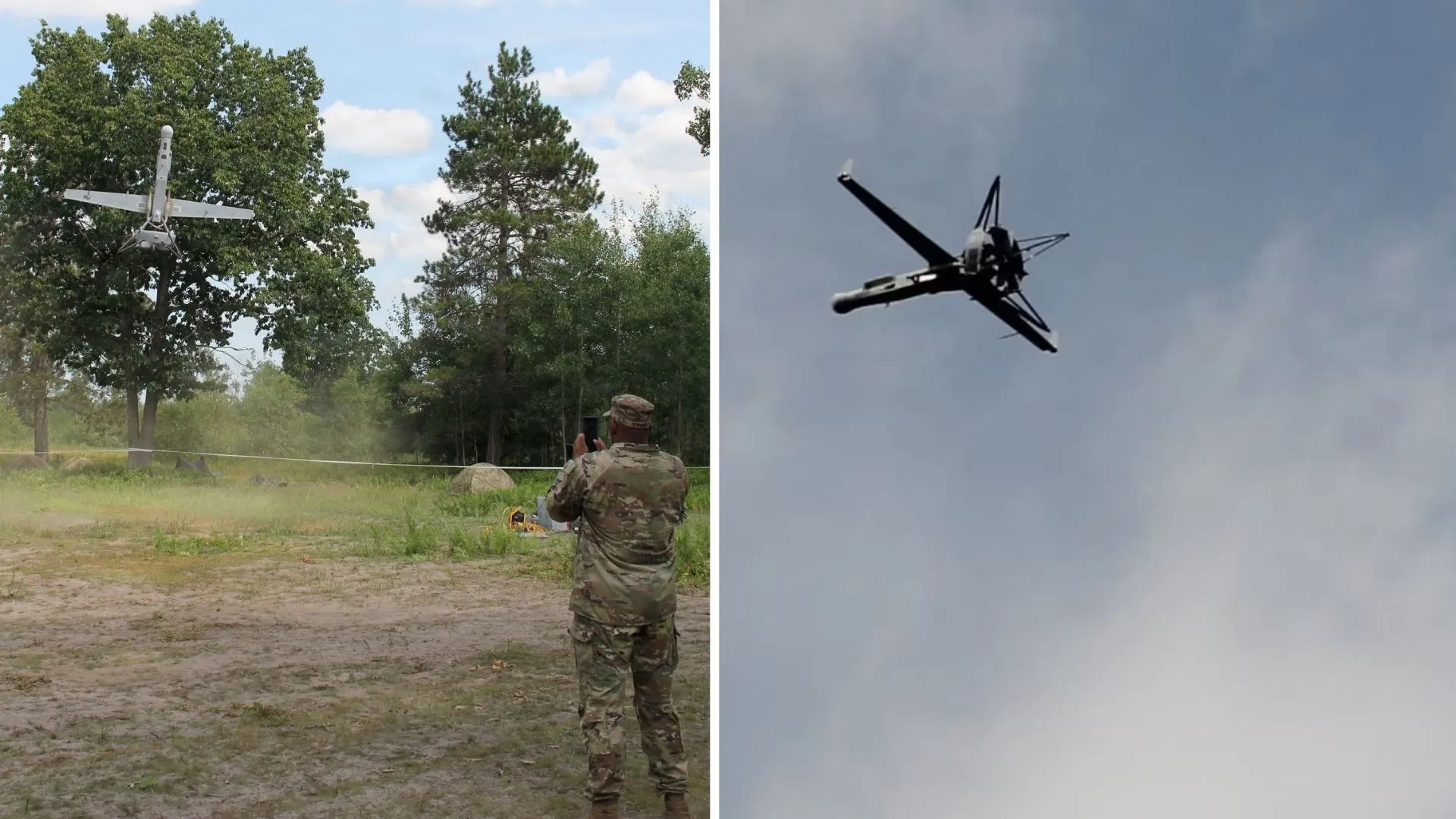
Soldiers from the 75th U.S. Army Reserve Innovation Command (75th USARIC) assessed more than 20 types of military technology and engaged 21 companies directly during Northern Strike 26-2 at Camp Grayling, Michigan, from August 3 to 8, 2026. The work covered Group 1 to Group 3 uncrewed aircraft systems (UAS), counter-UAS (C-UAS) equipment, sensors and logistics robotics, and will inform future Army and Army Reserve requirements.
The evaluation was led by Tech Assessment Team 1 of Detachment 6, Support Group, the first of two such teams the command sent to the exercise. The 75th USARIC serves as the Army Reserve’s Chief Innovation Office and directly supports the U.S. Army Transformation and Training Command (T2COM), created in October 2025 by merging Army Futures Command and Training and Doctrine Command. Northern Strike 26-2, held August 1 to 15, 2026, drew more than 9,000 personnel from 36 states and territories and five international participants, including the United Kingdom, Latvia, Lithuania and Romania.
Inside the CAGE: How the Army Reserve Tests Drones and Jammers
The test lanes sat inside the National All-Domain Warfighting Center (NADWC), designated a National Range for Deep UAS Training in February 2026, which pairs nearly 200,000 acres at Camp Grayling with more than 17,000 square miles of special-use airspace. Most days began at the UAS and C-UAS Controlled Airspace Geospatial Environment, known as the CAGE, an open grass range where vendors run drone and counter-drone experiments under military supervision. The team observed tethered and untethered drones, radio frequency (RF) jammers and autonomous waterborne systems, and tested two Soldier-level systems: a body-worn passive detector that alerts the wearer to incoming UAS, and a handheld RF jammer. Team members also operated live jamming equipment alongside the Michigan National Guard.
The 21 companies covered five areas: Group 1 to Group 3 UAS platforms; C-UAS tools including jamming guns and active and passive detection; autonomy software; intelligence, surveillance and reconnaissance (ISR) sensors such as synthetic aperture radar; and robotics for contested logistics, sustainment and casualty evacuation (CASEVAC). Vendors ranged from established firms with joint force customers to early-stage startups. The Army Reserve has not named them.
Several systems mapped directly to Reserve-specific problems, including distributed UAS detection for units without organic protection, logistics resupply and CASEVAC. Sgt. 1st Class Ben Downing, the detachment’s innovation noncommissioned officer, said the site’s low-signal environment lets communication packages operate at full functionality, which matters for the spectrum monitoring that counter-UAS depends on.
Switchblade 600 Live Fire and Flying Basket CASEVAC Trials
Other ranges hosted demonstrations under operational conditions rather than trade-show settings. In one live-fire scenario, a Switchblade 600 one-way attack loitering munition was launched while a vertical takeoff and landing (VTOL) UAS provided ISR in support of 5th Security Force Assistance Brigade trainers. The Army Reserve did not identify the VTOL aircraft or the Switchblade 600 configuration.
Publicly available manufacturer specifications list the AeroVironment Switchblade 600 at 15 kg (33 lb) for the munition and 29.5 kg (65 lb) as a tube-launched all-up round, with more than 40 minutes of endurance, a 113 km/h loiter speed and a 185 km/h sprint speed. It carries an anti-armor warhead, a dual electro-optical/infrared (EO/IR) gimbal and a tablet fire control unit with tap-to-target guidance. Rated standoff is 40 km or more, beyond 90 km with datalink handoff. Cueing it with a separate ISR aircraft lets the munition spend its endurance on the engagement rather than the search.
At another site, a UAS dubbed the Flying Basket demonstrated a sling-load capability with potential CASEVAC applications, including delivery of blood and other payloads to isolated, austere locations. No payload or range figures were released.
Analysis: The assessment makes the Army Reserve a structured feedback channel between industry and the requirements process at a time when, as one vendor account manager at the event put it, the drone and counter-drone environment shifts almost weekly. The focus on Soldier-worn detection and handheld jammers is the most relevant thread for the Reserve, whose sustainment and support formations operate in rear areas now within reach of small drones yet rank low in the queue for dedicated air defense. Observation reports do not field equipment; impact depends on how T2COM and the Office of the Chief of Army Reserve (OCAR) act on them.
The 75th USARIC will deliver an after action review and a technical white paper with findings, recommendations and supporting data to Army and Army Reserve stakeholders. Neither has been released publicly, and no procurement decision tied to the assessment has been announced. The command plans to commit assets to Northern Strike 27-2, and Camp Grayling’s August 2026 selection as one of four stateside Army test ranges open to private industry points to a larger vendor presence at the next iteration.