Elbit Systems has been awarded contracts worth approximately $200 million by an unnamed Asia-Pacific country to supply airborne intelligence, surveillance, target acquisition and reconnaissance (ISTAR) and training solutions, the Israeli company announced on October 26, 2026. The package covers SPECTRO 12 multispectral payloads for integration on helicopters, follow-on support and upgrades for airborne live training systems, and Head-Up Display (HUD) systems, with performance spread over up to five years.
The award is the second package featuring SPECTRO-family payloads that Elbit has disclosed in roughly two months, following contracts worth about $270 million with an unidentified international customer, announced in September 2026, for SPECTRO and AMPS NG systems over up to six years. It also extends a regional track record: in September 2016, Elbit announced a contract worth more than $90 million for the 15-inch class SPECTRO XR with an undisclosed Asia-Pacific country. Elbit has not identified the current customer, the helicopter type selected for integration, or how the $200 million is split across the three work streams.
SPECTRO 12 Payload Packs Multispectral Targeting Into a 12-Inch Turret
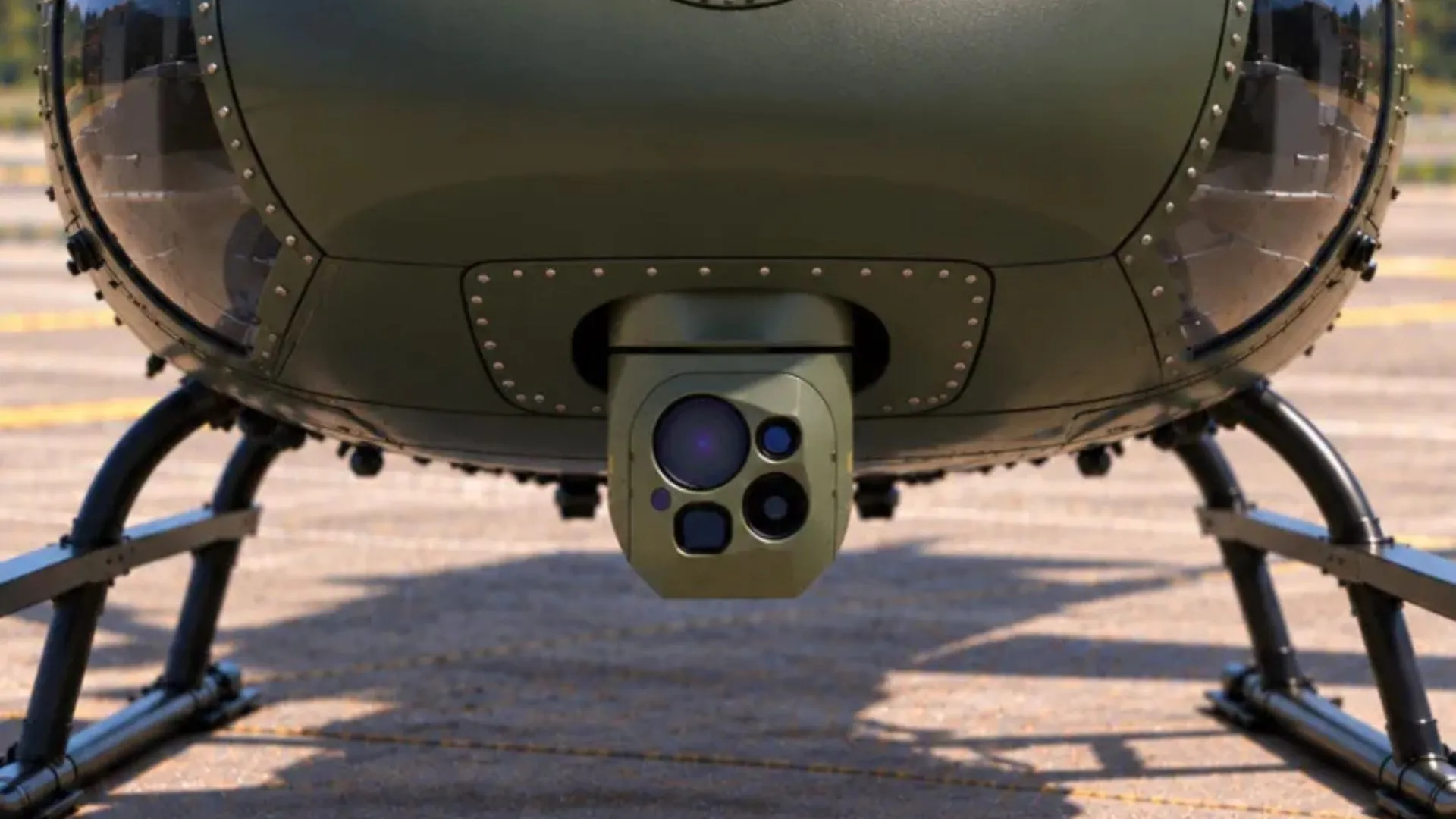
SPECTRO 12 is the newest member of the SPECTRO family, a 12-inch class turret packaged as a fully digital single line-replaceable unit (LRU). Elbit describes it as a compact multispectral payload designed for platforms with strict size, weight and power (SWaP) constraints; the announcement does not give its weight. For scale, Elbit’s product sheet lists the 15-inch class SPECTRO XR at 51 kg, 415 mm in diameter and 500 W of average power. A smaller turret is what opens this class of sensor to light helicopters that cannot carry the larger ball without trading away fuel, weapons or cabin load.
The sensor suite combines three imaging channels: a Full HD mid-wave infrared (MWIR) thermal imager, a 4K visible and near-infrared (VIS-NIR) CMOS day channel, and an HD indium gallium arsenide (InGaAs) short-wave infrared (SWIR) channel. The SWIR band improves visibility through haze and fog, which matters for maritime and littoral missions.
Targeting relies on a laser target designator compliant with STANAG 3733, an eye-safe laser rangefinder and an integrated laser pointer. Onboard INS and GPS provide navigation, and the line of sight is gyro-stabilized. Elbit cites AI-powered image processing, automatic target recognition (ATR) and multi-target tracking, which it says enable long-range target detection, identification, tracking and engagement in complex environments and adverse weather. The designator allows a helicopter crew to self-designate for laser-guided munitions or hand targets off to other shooters; Elbit has not said which weapons the customer plans to pair with it.
Live Training Upgrades and HUD Systems Round Out the Contracts
The second work stream covers follow-on support and upgrade services for airborne live training systems already installed on aircraft. According to Elbit, the systems operate in live, virtual and constructive (LVC) and virtual combat training scenarios, supporting air-to-air and air-to-ground training with real-time combat simulation, weapon scoring and mission debriefing. The company did not name the product, but its airborne live training portfolio includes Embedded Virtual Avionics (EVA), which generates virtual sensors, threats and weapons onboard the aircraft, and the EHUD autonomous air combat maneuvering instrumentation (ACMI) system. The follow-on scope points to an existing Elbit training base with this customer.
The third element is the supply of HUD systems featuring high-resolution displays, enhanced video capability and low power consumption for day and night operations across several airborne platforms. Elbit did not disclose the HUD model or the aircraft types concerned. President and CEO Bezhalel Machlis said the company was proud to deliver “innovative capabilities that enhance mission effectiveness, situational awareness and operational readiness.”
Analysis: The contract illustrates how Elbit is pushing targeting-grade electro-optics down to smaller airframes. Light and medium helicopters across the Asia-Pacific are increasingly tasked with maritime domain awareness, littoral patrol and armed reconnaissance, missions that have traditionally required larger turrets or dedicated ISR aircraft. A 12-inch class payload with a NATO-standard designator and three-band imaging lets a single helicopter detect, identify and mark a target without a separate sensor platform. Bundling sensors, training sustainment and cockpit displays also deepens Elbit’s position with one customer across several programs, a pattern that typically generates follow-on work.
Key unknowns remain the customer, the helicopter platform, delivery quantities and the schedule within the five-year performance window. Integration and flight qualification on the selected airframe will be the first milestone to watch. Further export orders for the 12-inch class variant would show whether it is becoming a volume product in Elbit’s ISR portfolio.