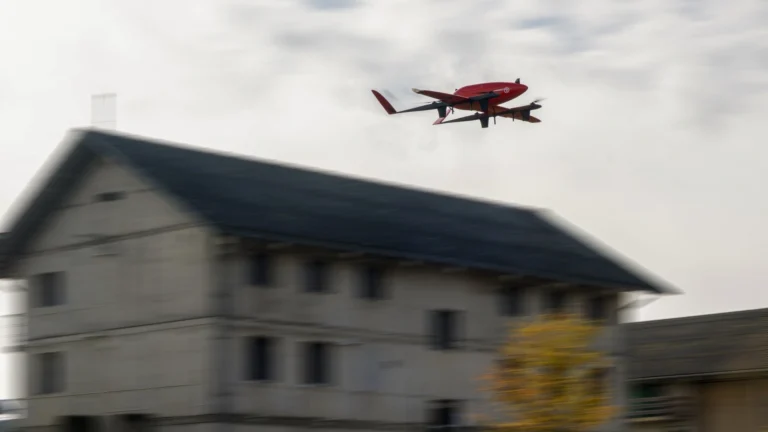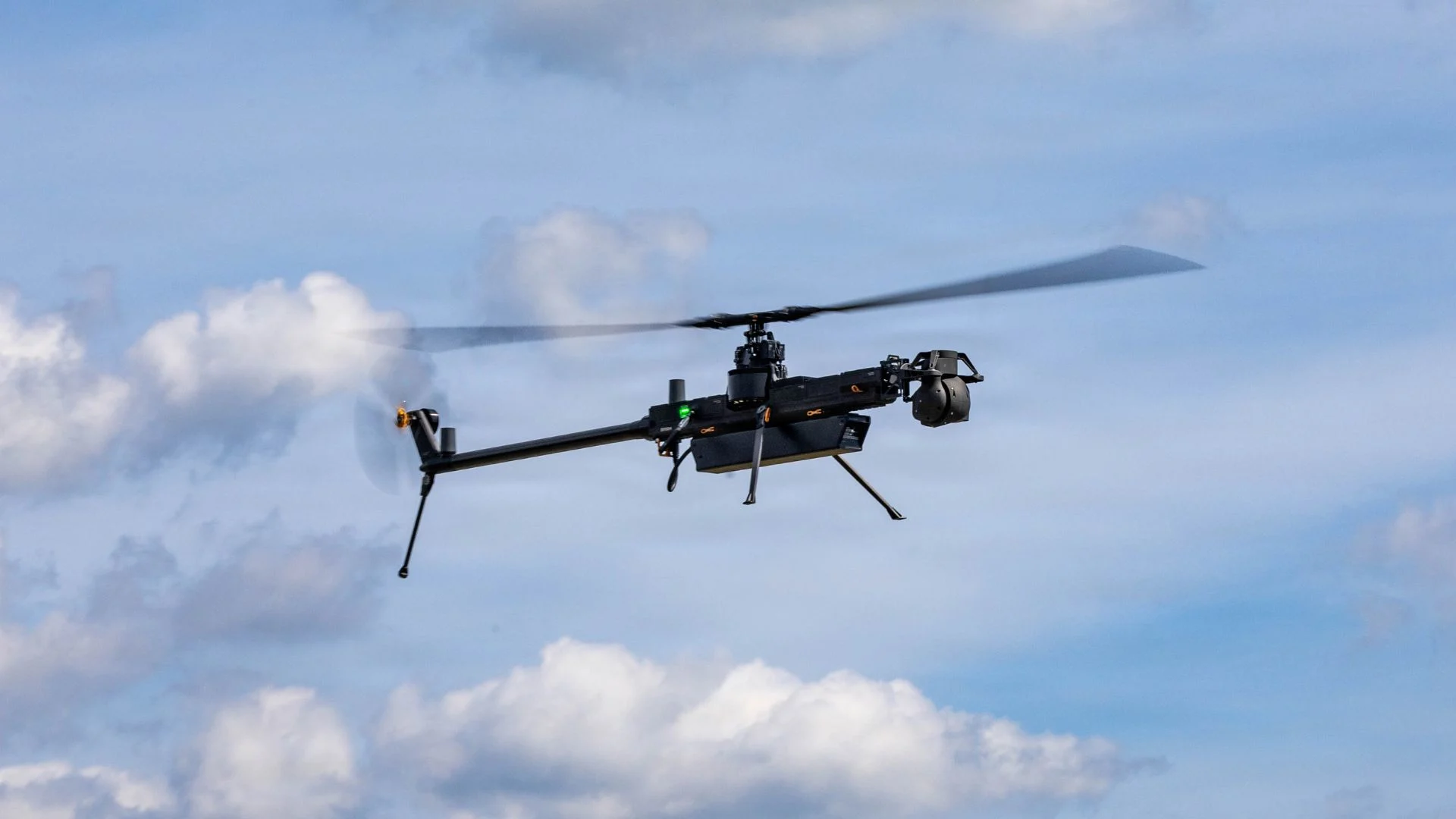
The U.S. Army has awarded Safe Pro Group Inc. a $2.5 million prime contract to run the company’s AI mine detection software aboard Anduril Industries’ Ghost-X small uncrewed aircraft system, with the stated goal of protecting M1 Abrams main battle tanks from mines and first-person-view (FPV) drone ambushes. The Aventura, Florida-based firm disclosed the award on November 10, 2026, in a filing with the Securities and Exchange Commission (SEC).
The award is Safe Pro’s first prime contract, placing the company in a direct relationship with the Army after a run of subcontracts. The Army issued it through a Commercial Solutions Opening (CSO), an accelerated pathway for buying commercial technology, under a topic titled Ground Threat Detection through Aerial Reconnaissance. The company did not disclose the period of performance, the number of aircraft involved, or which units will receive the capability.
Ground Truth Air Brings AI Mine Detection to Ghost-X
The software, branded Ground Truth Air, runs on the drone’s onboard computer and processes live video at the tactical edge rather than sending raw footage back for analysis. According to the company, it identifies and geolocates more than 150 types of explosive threats, including landmines, anti-personnel mines, cluster munitions, and FPV drones positioned for ambush. Detections are streamed into the Android Team Awareness Kit (ATAK), the mapping application carried by Army ground units, and into Lattice, Anduril’s command-and-control software.
Safe Pro says its models were trained on more than 3.2 million drone images, yielding over 60,200 confirmed detections across more than 40,520 acres, roughly 16,400 hectares, in Ukraine. The dataset is growing quickly: in June 2026, the company cited 2.8 million images and 50,368 confirmed detections across 35,000 acres. The filing provides no probability of detection, false-alarm rate, or performance data under vegetation, obscurants, or night conditions, the metrics that will decide whether this AI mine detection tool can inform route decisions for armored columns.
The company now markets the capability as “super intelligence,” or SI, after describing the same detection pipeline as artificial intelligence in earlier announcements. By its own account, the underlying technology is computer vision and machine learning. Daniel Leighton, general manager of tactical effects at Anduril, said the integration gives soldiers “faster, more reliable situational awareness at the tactical edge” in support of the Army’s tank survivability and reconnaissance missions.
Ghost-X and the Army Medium Range Reconnaissance Program
Ghost-X is the extended-range variant of Anduril’s rotary-wing, vertical takeoff and landing Ghost family. Anduril lists 90 minutes of cruise endurance, an operating range of up to 25 kilometers, and a payload capacity of 25 pounds, while publicly available specifications indicate a maximum takeoff weight of about 25 kilograms (55 pounds). An optional long-range communications kit extends range to 25 kilometers, roughly double the baseline Ghost’s 12 kilometers, while the dual-battery configuration adds endurance and payload capacity, according to open-source data. Lattice allows a single operator to control multiple aircraft, which matters for small units that cannot spare dedicated drone crews.
The Army selected Ghost-X in September 2024, alongside Performance Drone Works’ C100, for the Company Level Small Unmanned Aircraft System Directed Requirement, which fields commercial aircraft to brigade combat teams to shape requirements for the Medium Range Reconnaissance (MRR) program. On April 7, 2026, the Pentagon announced a $16.8 million firm-fixed-price award to Anduril for Ghost-X hardware and components, including Trillium HD45LP imaging payloads. Soldiers from the 2nd Armored Brigade Combat Team, 1st Cavalry Division, flew Ghost-X during National Training Center rotation 26-02 in October and November 2025, giving the aircraft a foothold in Abrams-equipped formations.
Analysis: The contract is small, but its structure is telling. Rather than buying a dedicated mine-detection drone, the Army is adding a software payload to an aircraft already in its MRR inventory, consistent with the modular payload approach it set for Ghost-X from the start. The war in Ukraine has shown that minefields and FPV ambushes can halt armored maneuver, turning route reconnaissance into a survivability requirement for heavy formations rather than an engineer-only task. Running detection on the aircraft also reduces dependence on a contested datalink. The gap is validation: without published detection and false-alarm data, commanders cannot yet weigh the tool against conventional route clearance.
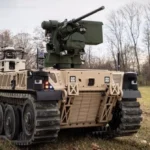
Safe Pro also holds a $1.3 million subcontract from Forterra, announced June 23, 2026, to integrate its detection pipeline on autonomous uncrewed ground vehicles, pointing toward a paired air-ground route reconnaissance concept. Milestones to watch include the contract’s period of performance, test results against Army detection thresholds, and whether a production agreement tied to MRR fielding follows the CSO award.