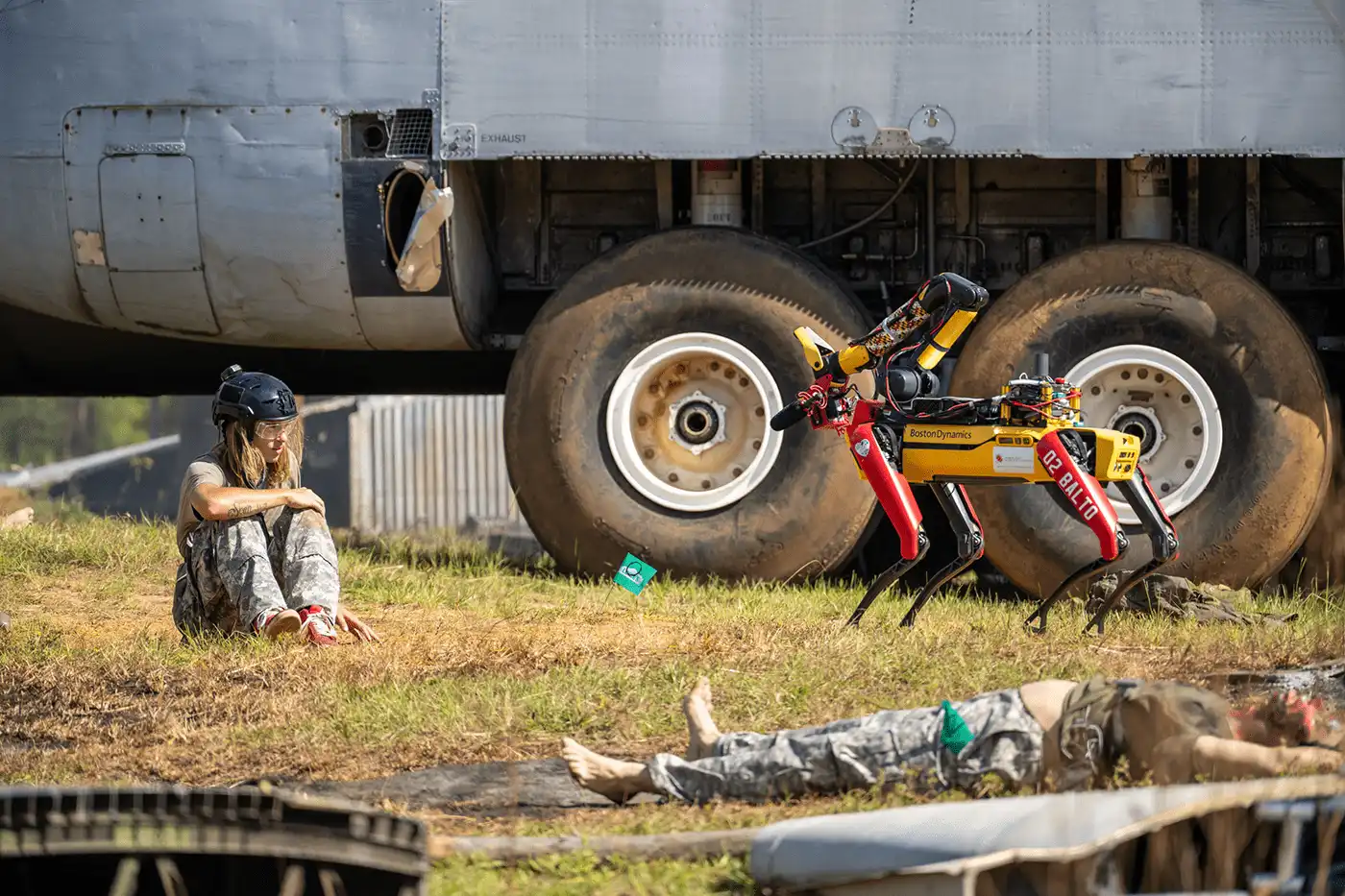
The DARPA Triage Challenge ended on November 13, 2026, at Disaster City in College Station, Texas, with RoboScout winning $1.5 million and Disruptors $1 million. RoboScout took the Systems competition and Disruptors the Data competition, the Defense Advanced Research Projects Agency (DARPA) announced. The finals pitted autonomous platforms and human-machine teams against simulated catastrophes, including a tornado strike on an open-air market, dense smoke, heavy darkness, and complex obstacle lanes.
DARPA launched the challenge in 2022 to address a persistent gap in mass casualty incident (MCI) response: primary triage still relies on hands-on evaluation that does not scale when casualties outnumber medics. Teams used stand-off sensors on uncrewed aerial and ground vehicles to locate casualties, assess injuries, and predict who needs life-saving interventions. The first event took place in September 2024 at Guardian Centers in Perry, Georgia, and difficulty rose each year, moving from daytime courses to night scenarios without casualty markers. The finals venue, operated by the Texas A&M Engineering Extension Service, is a training site for disaster responders.
DARPA Triage Challenge Systems Competition Results and Prizes
The Systems competition was split into two tracks. The autonomous platforms track scored teams on the most lives saved on a human-machine teaming lane. RoboScout, a multi-institutional team led by the University of Maryland, took the $1.5 million grand prize. DART, the top Systems performer at the 2025 event, finished runner-up and earned $500,000. RoboScout’s win caps a steady climb: the team placed third in 2024 and second in 2025.
The technical capabilities track measured overall performance on component testing gates. UAS-DTU, a team from Delhi Technological University in India, finished first and earned $300,000, with Guardian Angel second at $150,000. Both teams competed self-funded. DARPA also awarded four gate prizes of $12,500 each. DART won three of them, Find and Locate, Rapid Triage, and Trauma Assessment, while RoboScout won Accurate Vitals. Including gate awards, RoboScout collected $1,512,500 and DART $537,500.
Data Competition Targets Life-Saving Intervention Prediction
The Data competition evaluated algorithms rather than hardware. Teams were scored on overall performance across three tasks: first look, continuous triage, and resource allocation. The objective is to predict which casualties will require life-saving interventions and how limited medical assets should be distributed. This predictive layer is what would sit behind any fielded sensor platform, turning raw vital signs into treatment priorities. Disruptors won the $1 million grand prize and OCA-SENTINEL took the $300,000 runner-up award. Across both competitions, DARPA’s prize table for the finals totals $3.8 million.
DARPA Director Stephen Winchell noted that teams excelled at different parts of the triage chain. “Some of the teams perform really well on the identification of victims. Some of the teams perform really well on the triage and lifesaving or the evacuation pieces,” he said. “Thank you for delivering. Thank you for surprising us.”
Analysis: The results describe a fragmented capability landscape. DART swept three of the four gate prizes, covering detection, rapid triage, and trauma assessment, while RoboScout won accurate vitals and the overall lane, which suggests the next hurdle is integration rather than invention. For the Department of Defense (DoD), the relevance is direct. Large-scale combat operations against a peer adversary would generate casualty volumes and evacuation delays that current combat casualty care models, built around rapid evacuation under friendly air superiority, would struggle to absorb. Autonomous stand-off triage that flags priority casualties before a medic arrives is designed for exactly that problem: too many casualties and too few medics.
DARPA is already pushing the work toward intervention. An open Small Business Innovation Research (SBIR) topic, TRIAGE-X, seeks autonomous medical triage systems that can recognize chemical toxidromes and physically deliver the corresponding antidote or life-saving intervention. The topic closes November 25, 2026. DARPA has not said whether any finalist system will transition to a service program of record, which remains the key unknown.