Lockheed Martin’s 300-kilowatt Valkyrie laser, formally the Indirect Fire Protection Capability-High Energy Laser (IFPC-HEL), has destroyed a surrogate cruise missile target, a company executive announced on November 17, 2026. Jack Cheung, program director for Lockheed Martin’s Laser and Sensor Systems, described it in a LinkedIn post as the team’s “FIRST EVER engagement against a surrogate cruise missile target” with full kill chain integration. A Lockheed Martin spokesperson confirmed to Laser Wars that the system is IFPC-HEL. Lockheed Martin has not disclosed when or where the test took place, the engagement range, or the type of target used.
The result lands eight months after the U.S. Army walked away from the same system. In a Congressional Research Service (CRS) report published March 9, 2026, Army officials said the service no longer planned to transition IFPC-HEL to a program of record. The single remaining prototype is instead slated to be divested as a fielding candidate, and the Department of War’s fiscal year 2027 budget request says lessons from IFPC-HEL will feed the Joint Laser Weapon System (JLWS), a joint Army and U.S. Navy program launched to give the Golden Dome for America architecture a laser defense against cruise missiles.
How the Valkyrie Laser Closed the Kill Chain Without Track Augmentation
Cheung singled out three parameters. “It was the first kill WITHOUT track augmentation, WITH short engagement time at meaningful distance,” he wrote. Track augmentation refers to beacons, retroreflectors, or other cooperative aids fitted to test targets to simplify acquisition and fine tracking. Removing them means the system’s own sensors and beam director had to acquire the target, build a precise track, select an aimpoint, and hold the beam on a target presenting no cooperative signature, the condition an operational system would face against a real threat.
Full kill chain integration implies cueing, track handoff, fine tracking, and beam engagement ran as one sequence. Lockheed Martin has not said which sensors cued the engagement. The company has defeated this kind of target before: in 2022, its Layered Laser Defense system destroyed a target representing a subsonic cruise missile in flight during a U.S. Navy demonstration at White Sands Missile Range.
Short engagement time reflects the threat. Land-attack cruise missiles fly at high subsonic speed and low altitude, often below the radar horizon, compressing the time between detection and impact. At 300 kilowatts, Valkyrie carries six times the output of the 50 kW lasers on the Army’s Directed Energy Maneuver-Short Range Air Defense (DE M-SHORAD) Strykers, shortening the dwell time needed to burn through a target. Cheung did not quantify “meaningful distance.”
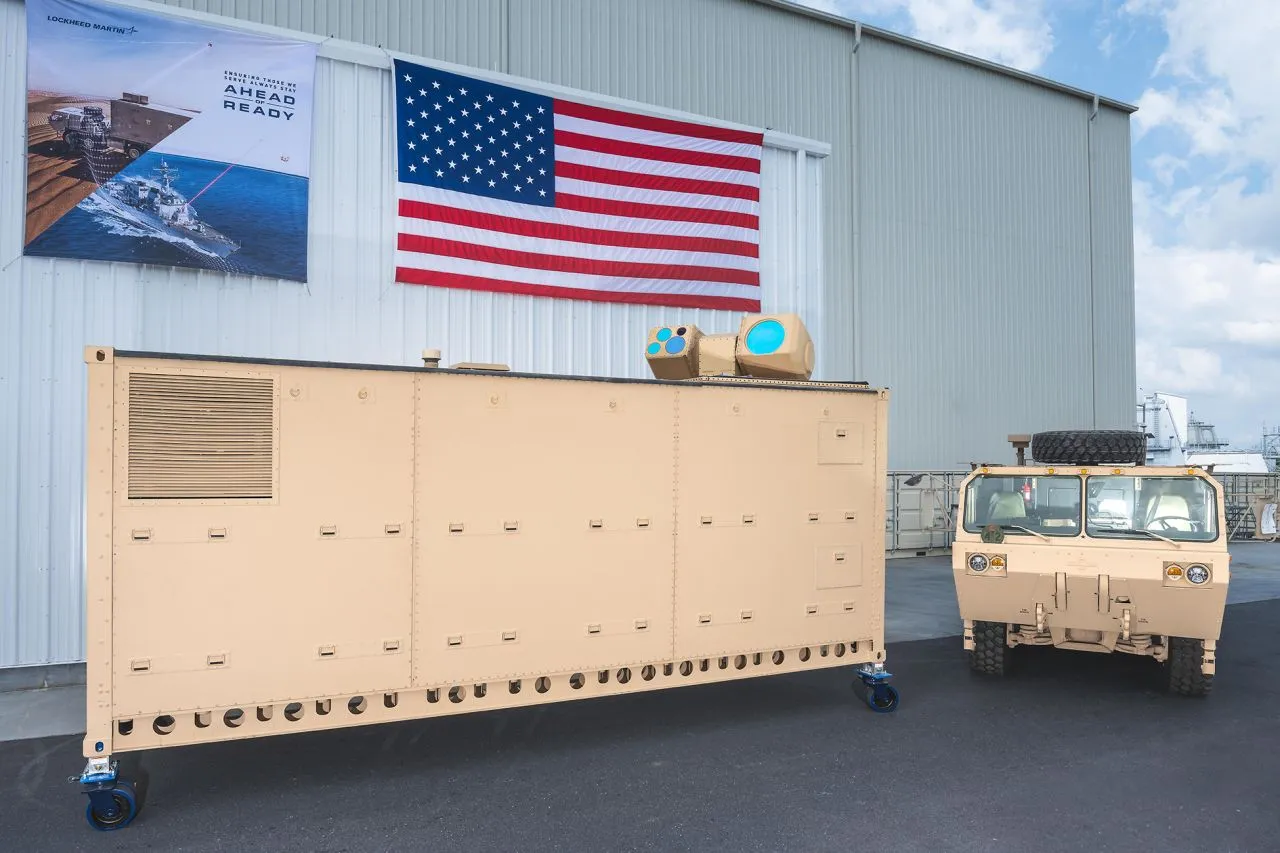
The photo accompanying the announcement shows a tan, shipping container-sized enclosure topped with a beam director, parked beside a tactical truck in front of a hangar, a configuration consistent with the program’s original mission of defending fixed and semi-fixed sites.
From HELSI to JLWS: The 300 kW Laser’s Program Path
Valkyrie’s laser source traces back to the Pentagon’s High Energy Laser Scaling Initiative (HELSI). The Office of the Under Secretary of Defense for Research and Engineering selected Lockheed Martin in 2019 to scale its spectral beam combined architecture to the 300 kW class; the company delivered the laser in September 2022. The design merges fiber laser channels at slightly different wavelengths into one beam, so output scales by adding channels.
IFPC-HEL followed the Army’s 10 kW High Energy Laser Mobile Test Truck (HELMTT) and 100 kW High Energy Laser Tactical Vehicle Demonstrator (HEL-TVD) and was built to protect bases against cruise missiles, drones, rockets, artillery, and mortars. In July 2023, the Army awarded Lockheed Martin an Other Transaction Authority (OTA) agreement worth up to $220.8 million for four prototypes. That order was cut to a single unit, slated for developmental testing at Dugway Proving Ground, Utah.
In June 2026, IFPC-HEL was among the lasers shown to Secretary of War Pete Hegseth at White Sands Missile Range, New Mexico. On July 9, 2026, the Department of War awarded JLWS OTA agreements to Lockheed Martin Aculight and nLIGHT Defense, with an initial combined value of $86 million and a program ceiling of $847 million. The fiscal year 2027 budget request lists $675.93 million in JLWS research funding over five years. First prototypes are planned at about 150 kW, with later iterations scaled to 300 to 500 kW, while a 500 kW integrated system using a HELSI-developed laser source is developed in parallel.
Analysis: The engagement addresses the question at the center of the Army’s retreat from IFPC-HEL: whether a 300 kW-class laser can defeat a cruise missile-representative target under conditions closer to combat than to a controlled range. Dropping track augmentation removes the most common test-range shortcut, which matters for Golden Dome, where defending dispersed infrastructure with interceptors alone strains magazines and budgets. It also strengthens Lockheed Martin’s hand inside JLWS alongside nLIGHT. Caution is warranted: the claim is the manufacturer’s, unconfirmed by the Army or the Department of War, and lacks the range and target data needed to judge operational relevance. One kill does not resolve the size, power, and thermal burdens behind the Army’s decision.
Next markers include government confirmation of the test, word on the IFPC-HEL prototype handover, which the CRS report said would come no earlier than September 2026, and the first 150 kW JLWS milestones. The Navy’s 300 kW High Energy Laser Counter-ASCM Program (HELCAP) and 400 kW SONGBOW effort will show whether JLWS converges on one architecture. Whether Valkyrie hardware migrates into JLWS remains unknown.