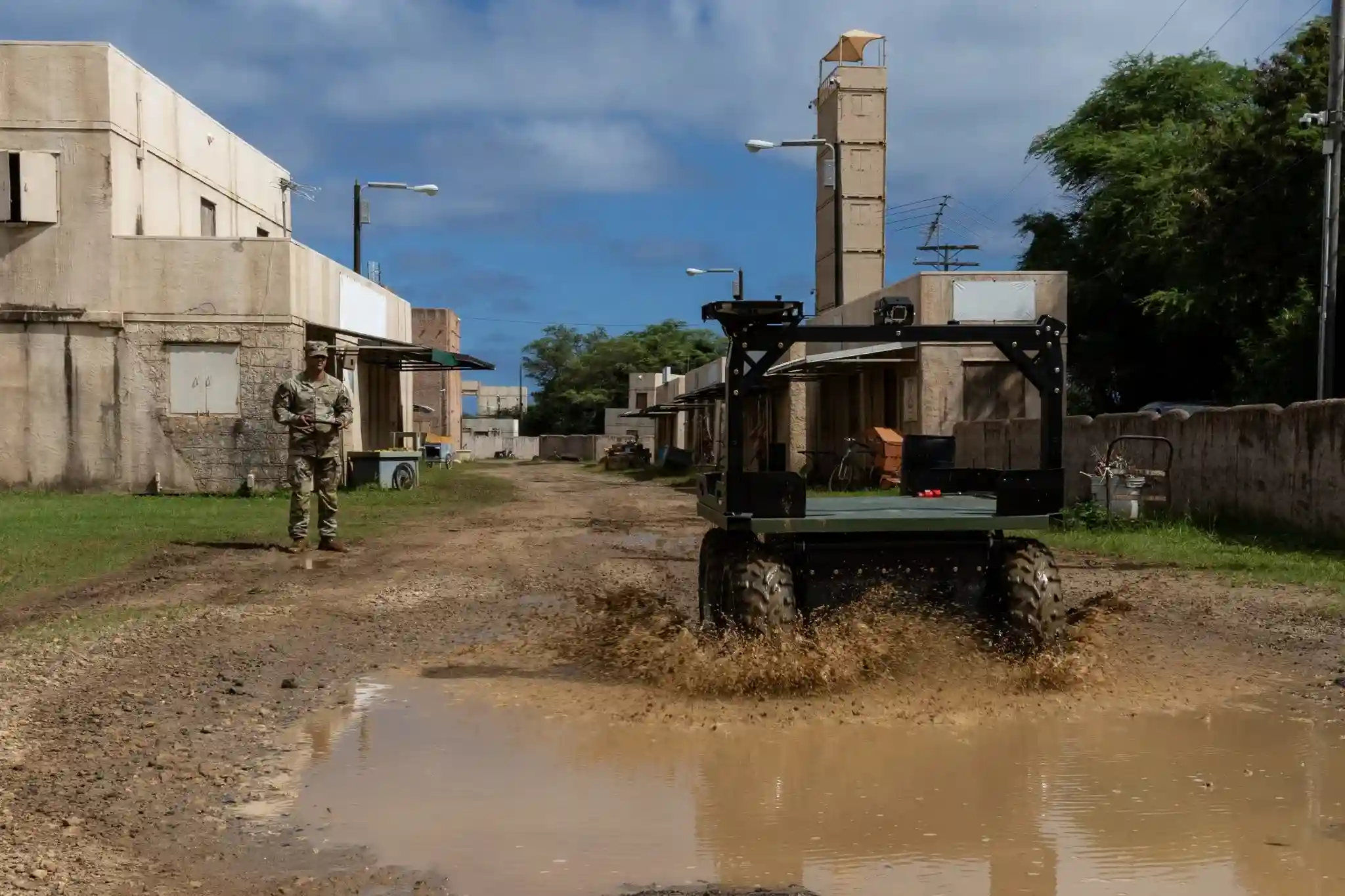
The U.S. Army has awarded $750,000 in cash prizes and six Prototype Other Transaction Agreements (OTAs) to companies developing autonomous ground resupply vehicles for the Indo-Pacific, closing out the G-TEAD USARPAC ACE 27-01: Autonomous Sustainment competition in Honolulu, Hawaii. Five firms, Cyborg, BlueSky Innovations, Dataspeed Inc., Stridar Inc., and Swarmbotics AI, each received $150,000, while a sixth finalist, Raptor Defense Company, secured an OTA without a cash prize, the Army announced in a November 23, 2026 release.
The event was the first Accelerated Capability Event (ACE) run with U.S. Army Pacific (USARPAC) by the Global Tactical Edge Acquisition Directorate (G-TEAD), the Army directorate created in 2025 to turn theater requirements into contracts faster. Run through the Army FUZE xTech prize program, it targeted a core Pacific problem: moving supplies and casualties across dispersed, contested terrain where crewed logistics are exposed. The original call, opened in August 2026, sought systems at Technology Readiness Level (TRL) 6 or higher and also covered autonomous air delivery and surface vessels; the finals focused on ground platforms.
How Soldiers Evaluated Autonomous Sustainment Vehicles in Hawaii
Evaluation began November 6, 2026, at Marine Corps Training Area Bellows on Oahu, where vendors trained soldiers from the 25th Infantry Division and the 8th Theater Sustainment Command. Each soldier team was assigned a single platform to operate and assess for the full week, generating candid end-user feedback rather than vendor-run demonstrations.
Testing ran November 7 to 9 and, according to Stars and Stripes reporting from Bellows, took vehicles over jungle, swamp and mud routes. Day one tasked systems with hauling water cans and Meals Ready-to-Eat (MREs) to objectives, then simulated litter casualty evacuation and high-speed movement across restrictive terrain. Day two measured endurance and range under maximum payload. Day three tested reliability and durability through repeated short runs. Ease of use and vulnerability to electronic warfare were also assessed. A round-robin, in which soldiers operated rival platforms, preceded company pitches to judges.
The Army has not released per-system scores. Specifications reported by Stars and Stripes cover three of the six finalists:
- Stridar Siderunner Pro: battery-powered, up to 500 lb of payload off-road, about 15 hours per charge, modular kits for supplies, communications, radar, ammunition or litters, priced at about $45,000 with software and control computer. The company says the system has been used in Ukraine.
- BlueSky Innovations jEKYLL: electric tracked carrier, nearly 2,000 lb of payload, towing capacity up to 22,000 lb, 10 mph top speed, 31 inches wide.
- Dataspeed Tweedle: gasoline-powered wheeled vehicle, 500 lb of payload plus 1,300 lb towed, 60 mph top speed, roughly 125 miles of range per tank, about $30,000 for the fully autonomous model.
Entries from Cyborg, Swarmbotics AI and Raptor Defense Company have not been publicly detailed. Swarmbotics AI was separately selected in February 2026 to build swarming, attritable small unmanned ground vehicles for the 1st Cavalry Division. The spread from a narrow heavy-lift tracked mule to a 60 mph wheeled runner shows the Army is still sampling the payload, speed and footprint trade space. Reported prices of $30,000 to $45,000 for two of them sit in attritable territory.
Soldier Vote and OTA Pathway Set the Transition Timeline
G-TEAD weights soldier input heavily. Col. Christopher Hill, director of G-TEAD, said the competition is evaluated on “technical maturity, producibility, and cost,” with soldier feedback added on top. “Everything we do forward, regardless of theater, Soldiers get 51% of the vote,” Hill said.
The awards are not the end of the evaluation. All six finalists received Prototype OTAs and invitations to a follow-on operational assessment approximately 45 days after award. The Army has not disclosed individual OTA values; the August call capped the follow-on OTA pool at $2 million. Before then, companies are expected to refine hardware, software, autonomy, payload, durability and ease of use based on soldier feedback.
The Army Test and Evaluation Command (ATEC), the participating unit, G-TEAD and the intended transition partner will judge how far each vendor closed the gaps. G-TEAD’s stated model transitions successful systems into a Portfolio Acquisition Executive (PAE) portfolio, with a fielded capability targeted within 90 days of evaluation. Col. Jeremy Schunke, director of concepts at USARPAC, said embedding acquisition professionals within Army Service Component Commands “truly is innovation,” replacing a process that required reaching back to the Pentagon.
Analysis: ACE 27-01 is less about any single robot than about proving a theater command can source, test and contract prototype logistics autonomy in roughly one quarter. For USARPAC, distributed operations across island chains depend on last-mile resupply that does not pull infantry away from the fight, and low-cost unmanned carriers offer one answer. The harder questions sit beyond the lanes: whether these platforms survive salt, humidity and sustained electronic attack, and whether units can maintain and power them at the edge without creating a new logistics tail.
The next milestone is the follow-on operational assessment, expected roughly 45 days after the November awards. Still unknown are the OTA values per company, the transition partner, the receiving PAE portfolio, and whether the air and maritime topics from the original call will produce separate awards. Hill has said further ACEs with USARPAC are planned on a quarterly basis.