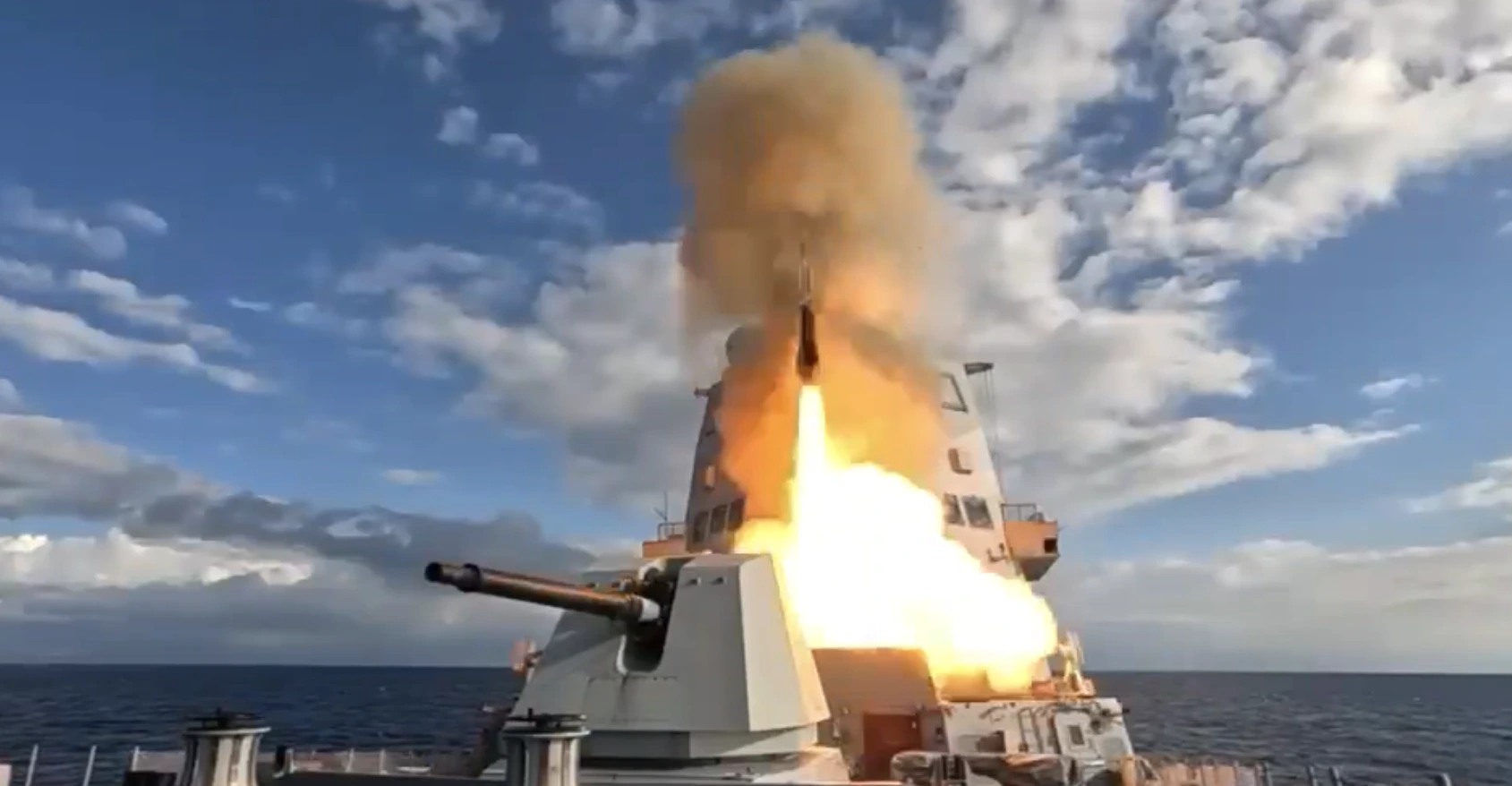
The Italian Navy’s multi-mission combat ship Giovanni delle Bande Nere (P434) has intercepted a high-speed ballistic target with two MBDA Aster 30 surface-to-air missiles, the service announced on November 20, 2026. According to the Navy, the ship detected and tracked the target, calculated a firing solution with its onboard Combat Management System and destroyed it, a result the service said places the Marina Militare among a select group of navies able to counter ballistic threats directly from the sea.
The Navy did not disclose the date, location or target type, and published accounts diverge. Some open-source reporting places the firing on November 10 against a STAR 160 ballistic target, with comparative analysis of radar imagery pointing to the NATO Missile Firing Installation (NAMFI) at Souda Bay, Crete, three days before the ship returned to its home port of Taranto on November 13. Italian defense magazine Rivista Italiana Difesa instead reports that the intercept took place in the Pacific during Pacific Dragon 2026, the multinational ballistic missile defense exercise led by the US 3rd Fleet around Hawaii from August 6 to 15. The ship had sailed from Taranto on May 3 for a deployment of more than six months that included RIMPAC 2026 and Pacific Dragon. The firing also completes a step the ship did not take at Formidable Shield 2025, when it tracked a short-range ballistic target until splashdown without attempting an intercept.
How Giovanni delle Bande Nere Engaged the Ballistic Target
The engagement chain described by the Navy follows the classic terminal defense sequence: detection and precision tracking, fire control computation, then a salvo of two interceptors fired in quick succession. The two-round salvo reflects standard shoot-shoot doctrine against ballistic targets, raising the cumulative kill probability at the cost of magazine depth.
The ship’s sensor backbone is the Leonardo Dual Band Radar. Publicly available specifications describe eight fixed active electronically scanned array (AESA) faces from the Kronos family, combining C-band panels for volume search with X-band panels for precision tracking and fire control, managed by the Leonardo SADOC 4 combat system. For ballistic defense, the split matters: C band provides early cueing at long range, while X band delivers the track accuracy needed to guide an interceptor onto a fast-descending target.
Open-source reporting identifies the interceptors as Aster 30 Block 1NT (New Technology) rounds, possibly pre-production examples, with series deliveries expected in 2027. The Navy has not confirmed the variant. Block 1NT keeps the two-stage Aster 30 airframe and its combined aerodynamic and thrust-vector control, but replaces the Ku-band active seeker with a Ka-band unit offering a narrower beam and finer angular resolution. The missile is designed to counter ballistic missiles in the 1,500 km range class, against the 600 km class for Aster 30 Block 1, with an interception range in the 150 km class. Its qualification campaign included firings at the French DGA test range at Biscarrosse on October 8, 2024, and in July 2025.
PPA Full Combat Configuration and the SAAM-ESD Missile System
Giovanni delle Bande Nere is the fourth of seven Pattugliatori Polivalenti d’Altura (PPA), or Thaon di Revel-class multi-purpose offshore combatants, built by Fincantieri at Muggiano under a program valued at about €3.9 billion. It is the first hull delivered in the Full Combat configuration. Laid down on August 28, 2019, launched on February 12, 2022, and delivered on October 2, 2024, the ship measures 143 m overall with a 16.5 m beam and displaces about 6,270 tonnes at full load, per publicly available specifications.
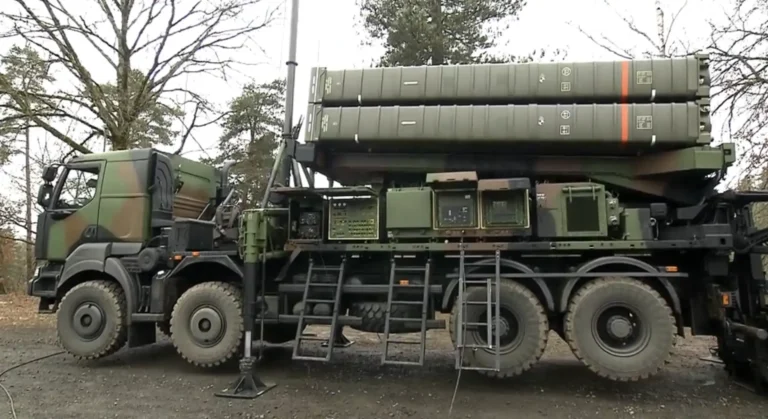
Its combined diesel and gas (CODAG) plant pairs one General Electric LM2500+G4 gas turbine rated at 32 MW with two MTU 20V 8000 diesels of 10 MW each, plus electric motors for low-speed operations, for a top speed of about 32 knots and a range of 5,000 nautical miles at 15 knots. Air defense rests on the MBDA SAAM-ESD system, fed by two eight-cell Sylver A50 vertical launchers, or 16 cells shared between Aster 15 and Aster 30 rounds. The rest of the fit includes a 127 mm/64 Vulcano gun, a 76 mm/62 gun, provisions for Teseo Mk2/E anti-ship missiles, two triple 324 mm torpedo launchers and a hangar for two NH90 helicopters.
The magazine defines the ship’s role. At two interceptors per ballistic target, a full load of Aster 30 rounds allows at most eight engagements before reloading in port, fewer if cells are reserved for Aster 15 self-defense. That makes the PPA Full a capable point and limited area defender, not a standalone theater ballistic missile defense asset.
Analysis: The firing gives Italy a demonstrated sea-based lower-tier ballistic missile defense layer in the Mediterranean, where ports, energy infrastructure and NATO naval forces sit within reach of short- and medium-range ballistic missiles fielded across the Middle East. Aster 30 Block 1NT intercepts within the atmosphere, so it complements rather than replaces the exo-atmospheric SM-3 coverage provided by US Aegis destroyers. Its operational value will depend as much on Aster production rates as on the missile itself, and MBDA has said it will cut Aster production time in 2026 by more than half compared with 2022.
The next markers are series deliveries of Aster 30 Block 1NT, expected in 2027, and the missile’s planned integration on other Franco-Italian naval programs, including the Horizon-class mid-life update. Key unknowns remain: the Navy has not confirmed when or where the firing took place, has released no data on the target’s velocity, apogee or intercept altitude, and has not said whether the event represented a medium-range ballistic profile or a shorter-range threat.